
BookPicks: Man and the Sea
Posted on April 26, 2016 2 Comments
I’ve selected three BookPicks, separated in time from the fifteenth to the twentieth centuries. Although spanning half a millenium, together they deal with a number of important aspects of man’s relationship with the sea – courage facing danger in the exploration of the unknown; the struggle for supremacy of the oceans throughout much of our recent past; and the life and death decisions at sea that only a captain can take. One of the books, now reprinted, was first published in 1898, and is a classic in the history of exploration. The other two are more recent but each of the three is eminently readable and I commend them to all students of the sea and those like me with an inquiring mind about the past.
— ♥ —
John and Sebastian Cabot by Charles Raymond Beazley
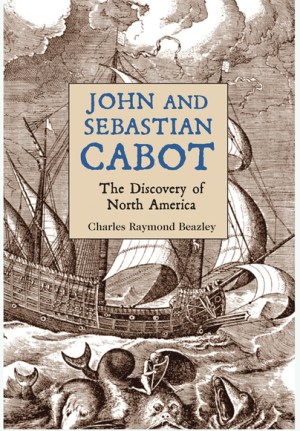 John Cabot led an expedition to the New World in 1497 on behalf of Henry VII. He is considered the first European to explore North America since the Viking voyages five hundred years earlier. Although Cabot’s exact landfall on his first voyage is not known – it could have been Nova Scotia, Newfoundland, or even Maine – his claim for England to this territory countered the Spanish and Portuguese explorations to the south, and changed world history. Cabot made three round trips between Bristol, England, and North America, and later, his son, Sebastian, made two similar voyages. John and Sebastian Cabot was first published in the late nineteenth century. Its enduring value in addition to its lucid, well-balanced, and researched narrative is the author’s detailed perspectives of prior voyages to the North American continent, including those from China and the Pacific Islands as well as those from the realms of mythology.
In Pursuit of the Essex by Ben Hughes
 The frigate USS Essex set sail on 26 October, 1812. After rounding Cape Horn, she proceeded to systematically destroy the British South Seas whaling fleet. When news reached the Royal Navy’s South American station at Rio de Janeiro, HMS Phoebe was sent off in pursuit. So began one of the most extraordinary chases in naval history. In Pursuit of the Essex follows the adventures of both hunter and hunted as well as a host of colourful characters that crossed their paths: traitorous Nantucket whalers, Chilean revolutionaries, British spies, a Peruvian viceroy and bellicose Polynesian islanders. A gripping tale!
The Watery Grave by Richard Osborne
 In 2002 the wreck of the British cruiser HMS Manchester was located by divers off the coast of Tunisia. After taking part in the Norway campaign of 1940, the ship was sent to the Mediterranean, where she was involved in the Malta convoys. On her first convoy she was struck by a torpedo and badly damaged. In danger of sinking, her captain, Harold Drew, managed to save his ship. But her next operation was to prove her last. In Operation Pedestal, the vital Malta relief convoy, Manchester was again hit by a torpedo. This time, rather than risk the lives of his crew Drew took the decision to scuttle his ship. For this he was court-martialled in what would become the longest such case in the history of the Royal Navy. This book sheds new light on the controversial incident.
Still looking for bookish inspiration?
You might also like to take a peek at my other BookPicks this year this year
And I have a very limited number of Signed First Editions, which I’m happy to inscribe with a personal message
Enjoy!
KyddFest-10:-Treachery
Posted on April 19, 2016 5 Comments
Over the coming months I’ll be celebrating the earlier titles in the Kydd Series, it’s Treachery for this blog. I’d love to hear your thoughts on the book, either as a first-time reader or if you’re a re-reader and have read it more than once! It’s very gratifying for an author to be told that his work has inspired people to go back an read it again. And some of you have told me you have done this more than twice! Either reply to this blog or email me. Every respondent goes into the hat for a chance to win a mystery prize!
- ‘Thomas Kydd has dragged himself up in the Navy from press-ganged seaman to captain of his own ship. Now he faces disgrace. After losing favour with his superiors, and suffering terrible personal tragedy, Kydd and his ship are sent to guard the Channel Islands from Napoleon’s forces. When he is brutally betrayed off the Normandy Coast and removed from command, only his old friend Renzi is willing to stick by him.

Kathy on the battlements of Mt Orgeuil where d’Auvergne had the headquarters of his clandestine activities
Kydd is determined to clear his name, but soon finds himself fighting yet another battle he seems to have no chance of winning. Can he defeat his enemies on both sides, and win back the glory taken from him?
Julian Stockwin has done it again he has cast an enchantment over the booklover to heave them into the exciting world of Thomas Kydd, a working class lad who has advanced from being a pressed man of the lower deck to the quarterdeck over a succession of seafaring yarns.
A superbly written book, progressing the story of Thomas Kydd and his best friend Nicholas Renzi.
Through more twists and turns than a first-rate murder mystery this book is in basic terms outstanding and once started it is easier said than done to put down, Julian Stockwin weaves a remarkable account set early on in 18th Century England as well as sticking to his guns with the standard of story telling he has made me appreciate.
Julian Stockwin is a instinctive teller of tales and, with his Thomas Kydd and the captivating intrigues a man with a stunning imagination and just as unfalteringly his research is truthful and matchless, I can’t recommend Treachery highly enough.’ – The Book Shelf
Two titles, same book
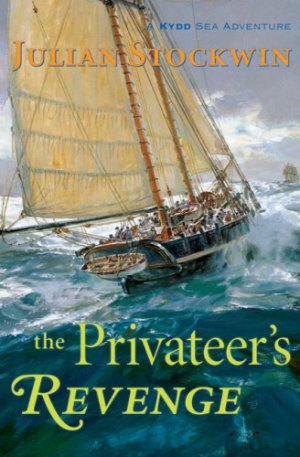
The US edition of the book, The Privateer’s Revenge
Sometimes in publishing the same book may appear in different territories under different titles. The reasons for this are varied – a publisher may feel an alternate title works best for his audience or that the original title is too close to another book familiar to readers. Treachery was published in the UK and Commonwealth countries under that name but in the US as The Privateer’s Revenge.
Pirate vs. privateer
One question I’m sometimes asked is what is the difference between a pirate and a privateer. It’s all down to a piece of paper called a Letter of Marque. This was a government license authorizing a named captain and ship (really as a privateer business) to attack and capture enemy vessels by way of reprisal and bring them before admiralty courts for condemnation and sale. A kind of privatised man-o’war. Cruising for prizes with a letter of marque was considered an honorable calling combining patriotism and profit, in contrast to unlicensed piracy, which was universally reviled as a crime against all humanity.
Minor character spotlight: D’auvergne

Philippe d’Auvergne
One of the really fascinating real-life characters I researched in the course of writing the book is the spy-master Philippe d’Auvergne, a British naval officer and the adopted son of Godefroy de La Tour d’Auvergne the sovereign Duke of Bouillon. He chose a career in the Royal Navy (beginning as midshipman in 1770) that spanned a period of history where Great Britain was at the centre of wars and empire building and took him from Boston and the War of Independence to espionage with French Royalists; prisoner of war to shipwrecked; all this while hoping to become a Walloon ruler or, at least, heir to a princely fortune. Mont Orgueil castle in Jersey was the base for his clandestine activities.
D’Auvergne was born in Jersey. His mother Elizabeth, the daughter of Philip Le Geyt, died giving birth to him. His father, Charles, was an ex-British Army officer, aide-de-camp to various governors, and an advisor to British Cabinet committees. D’Auvergne was educated in Jersey, then England and France. He was fluent in French and English and had a mathematical mind.
In the event, after peerless war service and when Waterloo disposed of Napoleon, the allies met at the great Congress of Vienna where he was to be sadly betrayed. His princely inheritance to which he was able to finally return was taken and partialled out among the victors and he was left with nothing.
Previous blog on BOOK : Treachery: prey and prizes!
Treachery / The Privateer’s Revenge has been published in the UK/US in English, in translated editions and in ebook, large print and audiobook.
Buy on Amazon or The Book Depository (free postage worldwide!) Also available at most bookstores.
Detailed list
Copyright notices
D’Auvergne image: By Inconnu (début XIXème siècle) [Public domain], via Wikimedia Commons
Every effort is made to honour copyright but if we have inadvertently published an image with missing or incorrect attribution, on being informed of this, we undertake to delete the image or add a correct credit notice
KyddFest-9:- The Admiral’s Daughter
Posted on April 12, 2016 8 Comments
Over the coming months I’ll be celebrating the earlier titles in the Kydd Series, it’s The Admiral’s Daughter for this blog. I’d love to hear your thoughts on the book, either as a first-time reader or if you’re a re-reader and have read it more than once! It’s very gratifying for an author to be told that his work has inspired people to go back an read it again. And some of you have told me you have done this more than twice! Either reply to this blog or email me. Every respondent goes into the hat for a chance to win an unabridged audiobook set of The Admiral’s Daughter.
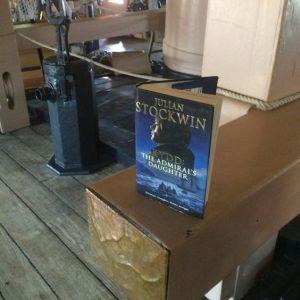
The Admiral’s Daughter at the main-mast bitts of HMS Victory
- ‘It is 1803, and Commander Thomas Kydd’s mission is to patrol home waters in order to suppress the smuggling trade. His friend Renzi joins him as captain’s clerk, also guiding Kydd’s steps in social situations when ashore. His coaching works well enough that Kydd attracts the interest of an admiral’s daughter, Persephone. The relationship develops to the degree that society assumes they will shortly become engaged. Then Kydd’s ship Teazer is damaged, and the ship must remain in an isolated Cornish cove for repairs. Kydd and Renzi lodge with the local squire, who unfortunately has a lovely, shy daughter, Rosalynd, and Kydd is again smitten. Word of his unfaithfulness reaches the admiral, who vows to bring about social and professional ruin for the man who has tarnished his family’s honor.
Fans of fast-paced adventure will get their fill with this book: there are at least four major plot threads. I enjoyed learning about naval lore, some of which this landlubber didn’t “get” when reading sea stories by other authors. There is a nice scene in which a sailor from the Teazer, working undercover to catch the smugglers, learns how difficult a fisherman’s life can be. One example of Stockwin’s humor is particularly appealing: “Commander Kydd, lord of sixteen guns and suzerain of near a hundred men, agreed meekly and followed his sister.”’ – Historic Novel Society
Listen to the book!
I’m very honoured and delighted to have the wonderful Christian Rodska narrating the audiobooks of the Kydd Series. These are available as audio downloads worldwide and also physical CDs (UK and Europe).
Fowey

Fowey from seaward
- ‘Fowey? Then I believe we’ll pay a visit, Mr Dowse.’ Fowey – Dowse had pronounced it ‘Foy’ – was one of the customs ports and well situated at the halfway point between Plymouth and the ocean‑facing port of Falmouth. They would no doubt welcome a call from the Navy and it was his [Kydd’s] duty to make himself known and check for orders.’ – The Admiral’s Daughter, chapter four
Fowey is a small town dating from medieval times at the mouth of the River Fowey in south Cornwall, England.
Its natural harbour allowed trade to develop with Europe and local ship owners often hired their vessels to the king to support various wars, although the town also developed a reputation for piracy, as did many in Kydd’s day.
If you’re visiting there’s a grand overview of the town and the magnificent harbour to be had with a stroll out along the Esplanade passing the grand parade of historic houses to the medieval St Catherine’s Castle which looks out over the harbour entrance and Readymoney Cove.
Kon Ni Chi Wa, Kydd!

Yoko Ohmori, Japanese translator of the book
One of the delights of being published around the world is seeing the various foreign language editions of my books. The Japanese edition is a delightful pocket-sized tome, read from the back to the front, of course! I was very happy to meet my Japanese translator Yoko Ohmori when she came to England a few years back. We retraced many of Kydd’s steps, visiting Plymouth, Polperro and other locations in the books. Yoko is a very experienced translator and extraordinarily, has sailed in tall ships herself across the Pacific.
Previous blog on The Admiral’s Daughter : THE ADMIRAL’S DAUGHTER: dangerous waters!
The cover of The Admiral’s Daughter is also available as a superb Limited Edition print
The Admiral’s Daughter has been published in the UK/US in English, in translated editions and in ebook, large print and audiobook.
Buy on Amazon or The Book Depository (free postage worldwide!) Also available at most bookstores.
Detailed list
Copyright notices
The Admiral’s Daughter aboard Victory by Paul Waite
Every effort is made to honour copyright but if we have inadvertently published an image with missing or incorrect attribution, on being informed of this, we undertake to delete the image or add a correct credit notice
KyddFest-8: Command
Posted on April 5, 2016 23 Comments
Over the coming months I’ll be celebrating the earlier titles in the Kydd Series, it’s Command for this blog. I’d love to hear your thoughts on the book, either as a first-time reader or if you’re a re-reader and have read it more than once! It’s very gratifying for an author to be told that his work has inspired people to go back an read it again. And some of you have told me you have done this more than twice! Either reply to this blog or email me. Every respondent goes into the hat for a chance to win a genuine eighteenth century maritime artefact.

COMMAND aboard HMS Victory: taken in Capt Hardy’s cabin
- ‘At the outset of Command, seventh in the Kydd Series, the hero seems poised to watch his promising career spiral down the drain. But just when the ire of Thomas Paine Kydd’s old adversary seems to have wrecked his chances, a great stroke of fortune restores them, and Kydd finds himself the delighted commander of a sloop of war named Teazer. He is quickly confronted with all the challenges of command, from scraping together a crew at Malta and trying to rectify the ship’s light armament, to instantaneous decisions in the face of the enemy. Sometimes he blunders, other times he is undone by sheer bad luck, but he learns quickly, and with the occasional stroke of good fortune, finds that his leadership and judgement are up to the challenge. Just when he wins the sort of distinction that should lead to further advances in his career, he is undone by the direst turn of events that can befall a professional fighting man: the outbreak of peace. Soon Kydd is sculling hopelessly in a backwater, desperate for some way to return to the sea. When his chance comes, it involves a dispiriting compromise. But he is on his way once more, to the far side of the world, where he will play a role in exploring a new continent. In the meantime his friend Renzi, recovered from a near-fatal fever, is caught up in another clash between his idealistic dreams and the harsh realities of an unfamiliar land.
Once again author Stockwin provides well researched views of odd corners of the world at the dawn of the nineteenth century, as he spins out action sequences informed by a keen understanding of the details that made the crucial difference between life and death in combat during the Age of Sail. Command is an apt title, the right word both for Kydd’s latest step forward and for his creator’s mastery of historical detail and the storyteller’s art.’ – HistoricalNovels.info
Van Diemen’s Land

CPO Hart admires a model of Teazer. He actually served in her namesake
In Command, Kydd sails south from New South Wales to Van Diemen’s Land to look into reports that the French are interested in establishing a colony there. The Dutch explorer Abel Tasman was the first European to land on these shores in 1642. He named the island Anthoonij van Diemenslandt, in honour of Anthony van Diemen, the Governor-General of the Dutch East Indies, who had sent Tasman on his voyage of discovery. Van Diemen’s Land was not known to be an island until Matthew Flinders and George Bass circumnavigated it in Norfolk in 1798-99. The name of the island and colony was officially changed to Tasmania on 1 January 1856.
Flinders and Trim

One lucky winner will receive this prize!
Trim was a ship’s cat, much beloved of the navigator and cartographer Matthew Flinders. Born in 1799, aboard a ship ’roundabout’ on a voyage from the Cape of Good Hope to Botany Bay, the kitten fell overboard, but managed to swim back to the vessel and climb aboard by scaling a rope. Taking note of his strong survival instinct and intelligence, Flinders and the crew made him their favourite.
Trim sailed with Flinders in HMS Investigator on his 1801-03 voyages of circumnavigation around the Australian mainland, and survived the destruction of Porpoise on Wreck Reef in 1803. When I wrote Command I took special delight in having my fictional hero Thomas Kydd meet Flinders – and Trim – in the penal colony of New South Wales.
A real piece of history!
A special prize this time, a boxed set of musket balls retrieved from HMS Invincible, a 74 gun ship-of-the-line wrecked in the English Channel in 1758 off Selsey Bill, en route to Canada to rout the French in Quebec.
Either reply to this blog or email me. Every respondent goes into the hat for a chance to win this genuine eighteenth century maritime artefact.
Previous blog on Command : The Watershed Book
Command has been published in the UK/US in English, various foreign languages and in ebook, large print and audiobook. The cover of Command is also available as a superb Limited Edition print
Buy on Amazon or The Book Depository (free postage worldwide!) Also available at most bookstores.
Detailed list
Copyright notices
Command aboard VICTORY by Paul Waite
Every effort is made to honour copyright but if we have inadvertently published an image with missing or incorrect attribution, on being informed of this, we undertake to delete the image or add a correct credit notice
BookPicks: The Great War
Posted on March 29, 2016 4 Comments
This year is the centenary of the Battle of Jutland, the Royal Navy’s last great set-piece sea battle. Rarely has an engagement with the enemy been so controversial, misunderstood, written about, discussed and disputed. I know from my own naval wardroom conversations that this continues to this day. A number of excellent books on Jutland both contemporary and from a modern perspective are now available. Here’s a selection of these, along with two titles on other aspects of the ‘war to end all wars’, all published by Pen & Sword books and their imprints.
— ♥ —
The Jutland Scandal by Vice Admiral John Harper and Admiral Reginald Bacon
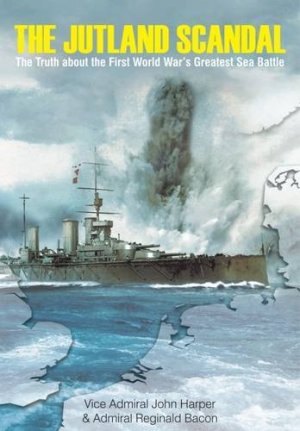 The Royal Navy had ruled the sea unchallenged for 100 years since Trafalgar. Yet when the Grand Fleet faced the German High Seas Fleet near Jutland the British battleships and cruisers were battered into a draw, losing more men and ships than the enemy. The Grand Fleet outnumbered and outgunned the German fleet so something clearly had gone wrong. The public waited for the official histories of the battle to be released to learn the truth, but months went by with the Admiralty promising, but failing, to publish an account of Jutland. Questions were raised in Parliament yet still no official report was produced, due to objections from Admiral Beatty. This led to Admiral Bacon producing his own account of the battle, called The Jutland Scandal in 1925. Two years later the man instructed to write the official report, Rear-Admiral Harper, published his account independently, under the title The Truth About Jutland. These two books are published as one volume for the first time, in this The Jutland Scandal.
Jutland: the Unfinished Battle by Nicholas Jellicoe
 This modern book not only re-tells the story of the battle from both a British and German perspective based on the latest research but it helps clarify the context of Germany’s inevitable naval clash. The author Nicholas Jellicoe is uniquely placed to tell the story of Jutland. His father served as First Lord of the Admiralty while his grandfather, Sir John Jellicoe commanded the Grand Fleet for the first two years in the war, from 1914 to 1916 including at Jutland, and was famously described by Churchill as being the only man who could have lost the war in an afternoon.
Voices from Jutland by Jim Crossley
 This new book examines the strengths and weaknesses of both navies and identifies some of the reasons for the disappointing performance of the Royal Navy in the battle. The German fleet performed magnificently and their ships proved extremely durable, but this was not enough to enable them to mount a serious challenge to superior British fire power and numbers. The book argues that the building of the High Seas Fleet was a strategic blunder on the part of the Germans, who could have forced Britain out of the war completely if they had instead concentrated on their submarine fleet and on mine-laying. And Admiral Jellicoe, commander of the British Grand Fleet, was in the unenviable position of having to give overriding priority to keeping his fleet intact, rather than inflicting a crushing defeat on the enemy. His steadfast pursuit of this objective was to lead to ultimate victory.
The Great War at Sea by Bob Carruthers
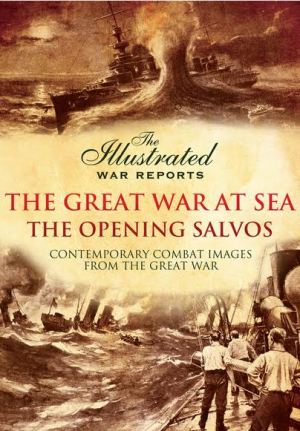 The photographic equipment in use during the Great War was cumbersome and bulky and the environment at sea and in the trenches was highly lethal. As a result it was extremely difficult to capture meaningful shots of the action. It was largely down to artists and illustrators to produce an accurate visual record of the fleeting moments the bulky cameras couldn’t reproduce. This collection of combat images is a vivid graphic record of life and death on the high-seas from 1914-18, as reported to contemporary audiences at a time when the events of the Great War were still unfolding.
British Submarines at War 1914-1918 by Edwyn Gray
 Originally published in 1970 and out of print for nearly thirty years, this book is a classic of submarine history, evoking the claustrophobic horror of war beneath the waves. Written with humanity and humour, it tells the story of Britain’s pioneer submarines during the 1914-1918 War and how their crews battled courageously in atrocious conditions against a skilled and ruthless enemy and an unforgiving sea. This second edition is a timely tribute to the gallant pioneers who created the legacy of dogged courage, determination, and standards of excellence of the Royal Navy’s submarine service.
Still looking for bookish inspiration?
You might also like to take a peek at my other BookPicks this year this year
And I have a very limited number of Signed First Editions, which I’m happy to inscribe with a personal message
Enjoy!
KyddFest-7: Tenacious
Posted on March 22, 2016 20 Comments
Over the coming months I’ll be celebrating the earlier titles in the Kydd Series, it’s Tenacious for this blog. I’d love to hear your thoughts on the book, either as a first-time reader or if you’re a re-reader and have read it more than once! It’s very gratifying for an author to be told that his work has inspired people to go back and read it again. And some of you have told me you have done this more than twice! Either reply to this blog or email me. Every respondent goes into the hat for a chance to win a special mystery thank-you prize.
‘Fans of Napoleonic naval action will certainly enjoy sailing with Lieutenant Thomas Kydd, RN in Stockwin’s sixth book in his Kydd Sea Adventure series. Set in the Mediterranean during the French expeditions against Egypt and Syria, Kydd’s service in H.M.S.Tenacious takes him to Toulon, Minorca, the Battle of the Nile, and the siege of Acre. Along the way, he encounters the always intriguing Lady Hamilton, the equally fascinating Admiral Nelson, and the largely forgotten but indefatigable defender of Acre, Sir Sidney Smith.
The historical events occupy center stage, but Stockwin fleshes out the story by continually reminding us that Kydd is designed to portray a living being and not simply a stereotypical hero. The treatment of one of Kydd’s fellow officers, a nobleman named Renzi, who rejects his life of privilege in favor of a man-of-war in wartime, is an unexpected highlight. I may be overstating the case when I say that secondary characters in novels such as this are rarely given the breadth and depth routinely accorded the hero or heroine. Renzi’s noble background is only hinted at in opening chapters, but the tension between this officer determined to make his way in the Royal Navy and his equally stubborn father, who wants him to resume his duties as the eldest son, provide the reader with a well-drawn glimpse into English upper-class life of the time.’ – Historical Novel Society
Nelson’s Band of Brothers

Nelson’s Band of Brothers
The original Band of Brothers were all captains at the battle of the Nile, and they were the elite of the Navy.
They had known Nelson for a number of years and there was a unique trust and understanding between them. This was not repeated in the same degree in any other fleet Nelson commanded.
But not all of the Nile captains were equally close to Nelson. We now know that there was an inner circle who he consulted regularly and they then conveyed the results of the consultations to the remainder by various means. But this inner circle was not static. Of the original Nile captains, only Hardy served in all Nelson’s later battles. Ball, for example, became governor of Malta and Miller was killed in an accidental explosion at the siege of Acre.
There’s a poignant story about Captain George Blagdon Westcott, the only one of the celebrated Band of Brothers to die at the Nile. He was born in Devon of humble origins, and left a widow and daughter. Nelson made a point of visiting them and presented Mrs Westcott with his own Nile medal saying, ‘You will not value it less because Nelson has worn it.’ He later wrote to Lady Hamilton about their low circumstances: ‘The brother is a tailor, but had they been chimney-sweepers it was my duty to show them proper respect.’
The cover
 The dramatic painting on the book’s cover which features the French flagship L’Orient exploding at the Battle of the Nile and the small boat with Kydd aboard picking up survivors was painted by Geoff Hunt RSMA.
When he created this artwork Geoff had not painted L’Orient before, although he had depicted the Battle of the Nile. He told me he was not aware of any existing plan for this huge ship (though he thought there might be one in a French archive) but French designs tend to be standardised so he felt justified in using the plan of Commerce de Marseilles which the British captured at the fall of Toulon in 1793.
Six Readers on TENACIOUS

The view from the top of Mt Toro from where Kydd signals
‘It is difficult for me to choose a favourite from the Kydd series, but Tenacious does stand out. Nelson’s victory at the Nile is so clearly written that I found myself understanding points of strategy that I had not grasped while reading history books. The Nile is just the beginning though; we get to see some real maturity in our characters in this book. Also present is the layer of the Kydd series that draws me to this day – the sentimental side. Stockwin portrays the rough and often violent world of Kydd’s naval life so vividly that when we see the emotional effects of lost friends we empathise. All too easy it is for the modern military author to marginalize casualties and allow them to become simply numbers. Stockwin, through this whole series, manages to balance the scales. Shortly after turning the last page, (and what a page it was) I had to go pull my copy of Kydd off the shelf and turn back to page one.’ – Jeff Kloss
‘Be prepared for a more confident Kydd, able to command respect from officers and men alike. Informing at so many levels, the narrative of Tenacious moves effortlessly between ships-of-the-line commanded by Admiral Nelson, eighteenth-century European politics, fine social gatherings and bloody carnage. A magnificent read.’ – Patricia Fray
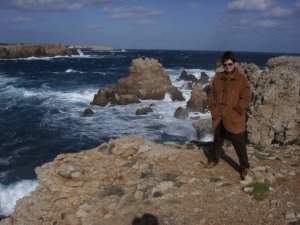
Kathy braves the winds on the rugged Minorca coast
‘Like a kid with a new toy I opened the pages of Tenacious. Immediately I am back on board, alongside Kydd and his fellow officers. Well-known characters of history are brought to life and in the ensuing battles the story unfolds – and you +become+ part of the adventure, such is the power of Julian’s writing. This is the series I would like to see on the silver screen!’ – David Pinsent
‘It’s a dangerous world in 1798 – but Kydd rises to the demands of the age. Tenacious is a superb read and one you will likely repeat again and again.’ – John Brown
‘The cover of Tenacious is beautifully illustrated, and the content is brilliantly evocative and accessible, even to followers who have little technical knowledge of naval matters. Julian Stockwin conveys to his readers a deep and certain knowledge of the sea – and at the same time delivers an excellent read.’ – Barbara Spencer
Previous blog on Tenacious : The Hunt for Napoleon’s Fleet
Tenacious has been published in the UK/US in English, in translated editions and in ebook, large print and audiobook.
The cover of Tenacious is also available as a superb Limited Edition print http://www.artmarine.co.uk/kydd.aspx
Buy on Amazon or The Book Depository (free postage worldwide!) Also available at most bookstores.
Detailed list
Copyright notices
Band of Brothers image: By Sir Robert Smirke, William Bromley, John Landseer, R. Bowyer (Collections of the National Maritime Museum) [Public domain], via Wikimedia Commons
Every effort is made to honour copyright but if we have inadvertently published an image with missing or incorrect attribution, on being informed of this, we undertake to delete the image or add a correct credit notice
KyddFest-6: Mutiny
Posted on March 15, 2016 7 Comments
Over the coming months I’ll be celebrating the earlier titles in the Kydd Series, it’s Mutiny for this blog. I’d love to hear your thoughts on the book, either as a first-time reader or if you’re a re-reader and have read it more than once! It’s very gratifying for an author to be told that his work has inspired people to go back an read it again. And some of you have told me you have done this more than twice! Either reply to this blog or email me. Every respondent goes into the hat for a chance to win a special thank-you prize: a Kydd Cap and a leather bookmark
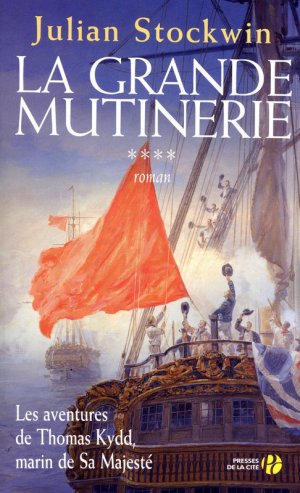
French edition of Mutiny
- ‘At the beginning of Mutiny, the fourth novel in Julian Stockwin’s brilliant Kydd Sea Adventures series, young Thomas Paine Kydd has reached the rank of master’s mate and has been posted to a different ship than his close friend Nicholas Renzi. For a while, during a perilous mission to retrieve a diplomat from Venice, they are reunited, but by the novel’s climax they are apart again and Kydd is swept up in the Great Mutiny, one of the most amazing events in British naval history. Kydd’s ship is caught in the mass mutiny at Nore, a secondary outbreak which began in sympathy with the original mutiny of the fleet at Spithead. The sailors have struck to win a much needed raise in wages, frozen during decades of inflation. Kydd’s warm heart and sense of fair play lead him to side with the sorely oppressed seamen. But the fierce logic of rebellion and reaction quickly outpace idealism, and our hero faces test after test of his loyalties. It is the nature of a series that we cannot seriously believe it will discard its hero, leaving him dangling from a yardarm; the challenge is to imagine how he can be disentangled from his latest predicament.
Although the drama at Nore is the centre of the novel and the emotional heart of the action, there are enough other strands to fill a novel by themselves. In addition to the Venetian mission, which offers a glimpse of that city in the final days of its long history as an independent republic, we are drawn into a ferocious fleet action, and find time to visit Gibraltar, where Kydd once more demonstrates that his understanding of young women has not advanced as rapidly as his seamanship. In Mutiny, author Stockwin turns a series of huge historical events into engaging tales that compel the speediest possible turning of pages.’– HistoricalNovels.info
The gondolas of Venice
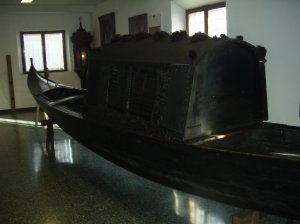
A gondola in Kydd’s day
When Kydd was in Venice the gondolas (some 14,000 compared to 500 or so today) were all painted black in deference to the sumptuary laws. Until the early 20th century gondolas were often fitted with a ‘felze’, a small cabin, to protect the passengers from the weather or from onlookers. Their windows could be closed with louvred shutters and black curtains, perfect for secret meetings and assignations as Renzi discovered…
The gondola is propelled by the gondolier, who stands facing the bow and rows with a forward stroke, followed by a compensating backward stroke. The oar rests in an elaborately carved wooden rest, the forcola, shaped to project from the side of the craft so as to allow the slight drag of each return stroke to pull the bow back to its forward course. Because of the vessel’s flat bottom it may also be ‘drifted’ sideways when required. The gondola is never poled like a punt as the waters of Venice are too deep.
Sheerness, one winter…
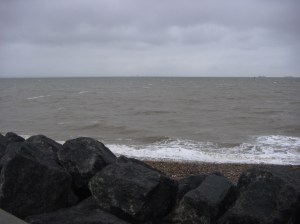
The Nore today
In the course of this book I revisited Sheerness, the bleak setting of this most awesome of mutinies. As I looked out over the cold, drab wilderness of the Nore one particularly raw winter’s day, seeing back into time to those great events, into my mind, too, came remembrance of myself as a very small boy looking out from that very spot to low, grey shapes slipping out to sea, disappearing over the horizon and taking my imagination with them. You can still walk out at low tide over the mud-flats and find clay pipes of Kydd’s time, but he had quite a different experience – this was where he first set foot on the deck of a man-o’-war, and as well crossed a threshold to meet his future.
Minor character spotlight: Richard Parker
In the Kydd books there are a number of real characters from the historical record. In Mutiny, we meet Richard Parker, leader of the mutineers during the 1797 Nore mutiny. A complex man, he has been the subject of speculation as to his motives – but one thing is certain: he deeply loved his wife. Parker was born in Exeter in the English county of Devon. He received a good education and at the age of twelve went to sea as a midshipman, becoming a master’s mate. He gave up a career at sea when he married Anne McHardy and the couple moved to Scotland, where Parker unsuccessfully speculated in business in Edinburgh. Too embarrassed to ask his wife’s family for help when financial difficulties arose he panicked and decided to take the King’s bounty and become a common sailor.
Previous blog on Mutiny : Divided loyalties
Mutiny has been published in the UK/US in English, French, German and Japanese and in ebook, large print and audiobook. The cover of Mutiny is also available as a superb Limited Edition print
Buy on Amazon or The Book Depository (free postage worldwide!) Also available at most bookstores
Detailed list
KyddFest-5: Quarterdeck
Posted on March 8, 2016 7 Comments
Over the coming months I’ll be celebrating the earlier titles in the Kydd Series, it’s Quarterdeck for this blog. I’d love to hear your thoughts on the book, either as a first-time reader or if you’re a re-reader and have read it more than once! It’s very gratifying for an author to be told that his work has inspired people to go back and read it again. And some of you have told me you have done this more than twice! Either reply to this blog or email me. Every respondent goes into the hat for a chance to win a thank-you prize: two Kydd Series paperbacks of your choice.

Quarterdeck reader, Tom Morga, a California based stunt man
- ‘At the battle of Camperdown, Thomas Kydd was promoted to acting lieutenant. Quarterdeck starts right at the examination to confirm his rank. As it turns out, he has a champion on the examining board. However, this is but the first of many obstacles. Kydd is from humble origins, but to become an officer he must now also become a gentleman. If not, he will spend the rest of his career as a tarpaulin officer. And Renzi, his friend, is of course a natural choice to train him in manners and the art of conversation.
So, in Quarterdeck Kydd and his particular friend Renzi set sail in Tenacious for the North American station. The young United States is in dispute with revolutionary France. Kydd soon finds himself seconded as a naval observer to the new-formed United States Navy.
Returning to the squadron in Halifax, Kydd participates in a hydrographic survey, and makes a chance acquaintance with a mysterious, beautiful young woman whom he invites as his companion to an official function in Halifax. As it turns out, this invitation has a number of consequences Kydd was totally unable to foresee!
I found Quarterdeck very interesting. In addition to the action in this book, Stockwin also puts his finger to some of the important differences in class and class culture between the foremast and quarterdeck, and illustrates these differences and their consequences very nicely.’ – Leserglede
Quarterdeck Ebook Offer for American readers!
For a limited time Quarterdeck is free to download for US readers on Amazon, Apple, B&N, Google, Kobo etc.
Tenacious
Tenacious was of a type of ship rapidly facing obsolescence – the 64 gun two-decker. Already showing her age in the American War, she was nevertheless classed as a ship-of-the-line and was therefore at least theoretically expected to take her place in the battle line at great fleet actions such as Trafalgar. Yet she had a serious weakness: where the standard 74 sported the ship-smashing 32 pounders of a three-decker Tenacious had only 24 pounders. The 64 was an unpopular command for an ambitious captain for they were kept away from the main strategic battle fleets.
She could still be useful: looking like her bigger brethren from a distance a cruise off an enemy port could keep quantities of frigates bottled up. Any important convoy escorted by a ‘ship-of-the-line’ could sail on untroubled, and when there was a colonial expedition mounted, a 64 was sure to be included as we saw in the Cape of Good Hope action in Conquest when three were sent. Nelson’s favourite ship Agamemnon was a 64 and in one famous action took on and defeated four frigates at the same time!
For her ship’s company a 64 was roomier than a frigate and for her officers was more comfortable also, her fitments harking from the earlier more leisurely and colourful years of the eighteenth century.
Prince Edward and Julie
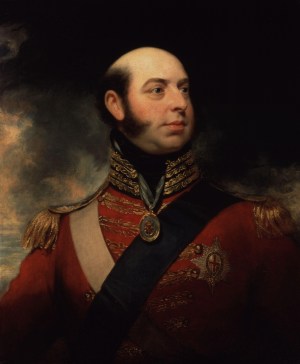
Prince Edward
The Prince Edward, Duke of Kent and Strathearn was the fourth son and fifth child of King George III and the father of Queen Victoria. Therese-Bernardine Mongenet was his long-term mistress. Known as Madame de Saint-Laurent, she used the forename Julie. She devoted herself to Edward for nearly twenty-eight years before she was set aside.
Edward was the first member of the royal family to reside in North America for a prolonged period. His North American career is remembered in the name of Prince Edward Island, adopted in 1799. He was instrumental in shaping Halifax’s military defences, protecting its important Royal Navy base, as well as influencing the city’s and colony’s socio-political and economic institutions.
Minor character spotlight: Fanny Kydd

‘Julie’
Previous blog on Quarterdeck Aft Through the Hawse-Hole
Quarterdeck has been published in the UK/US in English, in translated editions, and in ebook, large print and audiobook. The cover of Quarterdeck, an original painting by Geoff Hunt RSMA, is also available as a fine Limited Edition print
Buy on Amazon or The Book Depository (free postage worldwide!) Also available at most bookstores.
Detailed list
Copyright notices
Image of Prince Edward, William Beechey [Public domain], via Wikimedia Commons
Image of Julie [Public domain], via Wikimedia Commons
Every effort is made to honour copyright but if we have inadvertently published an image with missing or incorrect attribution, on being informed of this, we undertake to delete the image or add a correct credit notice
KyddFest-4: Betrayal
Posted on March 1, 2016 5 Comments
Over the coming months I’ll be celebrating the earlier titles in the Kydd Series, it’s Betrayal for this blog. I’d love to hear your thoughts on this book, either as a first-time reader or if you’re a re-reader and have read the book more than once! It’s very gratifying for an author to be told that his work has inspired people to go back an read it again. And some of you have told me you have done this more than twice! Either reply to this blog or email me. Every respondent goes into the hat for a chance to win a special thank-you prize of a Kydd cap and a leather bookmark.
- ‘Stockwin’s 13th novel of Napoleonic naval warfare featuring the redoubtable Captain Thomas Kydd of the Royal Navy features more high-seas adventure, ocean battles, bloody melees, and general villainy. After capturing the Cape Colony in South Africa in Conquest, Kydd and his crew are anxious for action. It’s 1806 and Kydd is the captain of the frigate HMS L’Aurore. When Commodore Popham decides to sail his small British squadron to South America to foment revolt against the Spanish, Kydd agrees to support the wild scheme without knowing that Popham plans to start a deadly war without the proper authority; the plan is ill-conceived, poorly supported, and doomed by treachery. Though the British capture Buenos Aires, the locals don’t rise against the Spanish, as had been expected, and while Popham achieves his objective, Kydd and the crew are beset by massive enemy forces and surprising betrayals. Neither Kydd’s imaginative determination, nor the courage of his men, seem likely to prevent disaster. Stockwin, who based this tale on a factual debacle easily overlooked by history, is a master of Napoleonic-era atmosphere and rich descriptions of the military, politics, and society.’– Publishers Weekly
Special Kindle Deal for March for UK readers!
A Kindle Monthly Deal, the ebook of Betrayal will be just 99p from today until the end of March, on Amazon UK and other online retailers.
St Helena

Late 18th century engraving of St Helena
‘St Helena lifted above the horizon, a rumpled grey shape set against deep blue seas with eager white horses as far as the eye could see. A vast azure heaven was populated with gambolling fluffy clouds, the warmth of the sun grateful to the skin. After their time of testing, the ships of the fleet had found one another and now proceeded in proper formation.‘ – chapter five BETRAYAL
En route to South America, Kydd stops briefly at St Helena, one of the most isolated islands in the world.
Only ten miles by six, St Helena is 1,200 miles from Africa, 1,800 miles from South America. By the late 17th century, island was known as a welcome landfall on the long journey home from the East Indies – a respite from the ocean, where fresh water and provisions could be purchased. There was the chance, too, that other sailors might be there, with news and gossip.

Captured colours of the 71st Highlanders now on display at Santo Domingo church, Buenos Aires
From about 1770, the island enjoyed a lengthy period of prosperity. Captain James Cook visited the island in 1775 on the final leg of his second circumnavigation of the world. Sir Arthur Wellesley, later to become the Duke of Wellington, stayed in 1805, and the famous naturalist William Burchell also arrived that year. During the 18th century, buildings and forts were improved and the historic Main Street of the town was constructed, only to be later destroyed and requiring rebuilding in the middle of the 19th century after white ants from wood used from a captured slave vessel ravaged the town.
In 1815 the British government selected St Helena as the place of detention of Napoleon Bonaparte. He was brought to the island in October 1815 and lodged at Longwood, where he died on 5 May 1821.
And Charles Darwin visited in 1836 on his round the world voyage in Beagle.
Minor character spotlight: Stirk

Signing BETRAYAL
Tobias Stirk hails from Hythe on the Channel coast, and a fishing family. He became impatient with the back breaking work of fisherfolk with their small boats on the rough shingle, and disappeared into the notorious Romney Marsh to join a smuggler’s crew. His luck ran out when he was caught by the press gang in the last year of the American war. However he took to the life and volunteered for the Navy on discharge. His talents as a gunner were noted in Alcide in action on the Barbary Coast and again in San Fiorenzo in the West Indies. After a spell in the sloop Terrier in Burma he returned to England to serve (ironically) in a Revenue cutter looking for Cornish smugglers. He was transferred into Duke William for service in the North American station but at the likelihood of war with the French she was sent to England and the Nore. He has the rate of gunner’s mate in Betrayal and appears in a number of the Kydd titles.
Previous blog on Betrayal The Tide Turns
Betrayal has been published in the UK/US in English, in translated editions and in ebook, large print and audiobook.
Buy on Amazon or The Book Depository (free postage worldwide!) Also available at most bookstores.
Detailed list
Copyright notices
St Helena image: By Thornton, engraver, fl. 1790 (themaritimegallery.co.uk) [Public domain], via Wikimedia Commons
Colours image: By Duche de Cleves [CC BY-SA 3.0 (http://creativecommons.org/licenses/by-sa/3.0)%5D, via Wikimedia Commons
Every effort is made to honour copyright but if we have inadvertently published an image with missing or incorrect attribution, on being informed of this, we undertake to delete the image or add a correct credit notice
BookPicks: An Easter Selection
Posted on February 28, 2016 8 Comments
With an early Easter coming up next month why not forget the chocolate eggs and Simnel cake and buy a book – either for yourself or to give to a friend. A book will bring hours of pleasure and be lasting reminder in itself of someone putting thought into a gift. Here’s my easter bookpicks – with hopefully something for everyone. They all have a salty connection of some kind!
— ♥ —
Able Seaman Simon by Lynne Barrett-Lee
 Simon is discovered in the Hong Kong docks in 1948 and smuggled on board H.M.S Amethyst by a British sailor who takes pity on the malnourished kitten. Amethyst is ordered to sail up the Yangtze and the ship comes under fire. A number of the crew are killed and Simon is among those who are seriously wounded. Despite his injuries the plucky feline keeps up morale aboard. Delightfully told in Simon’s voice!
The Seven Years War by Martin Robson
 The Seven Years War (1756-1763) was the first global conflict and became the key factor in creating the British Empire. Part of the excellent History of the Royal Navy Series this title looks at Britain’s maritime strategic, operational and tactical success (and failures), through a wide-ranging history of the Royal Navy’s role in the war.
On the Road with Wellington by A.L.F. Schaumann
 A remarkable memoir that captures the life and adventures of a junior officer as he endures the drama and agonies of the fierce struggle in Spain, Portugal, and southern France between 1808 and 1814. The book features an introduction by Bernard Cornwell.
A Confederate Biography by Dwight Sturtevant Hughes
 From October 1864 to November 1865, the officers of the CSS Shenandoah carried the Confederacy and the conflict of the Civil War around the globe through extreme weather, alien surroundings, and the people they encountered. In the words of one noted admiral, this book is: ‘a biography of a ship and a cruise, and a microcosm of the Confederate-American experience.’
Churchills Greatest Fear by Richard Doherty
 The Battle of the Atlantic was arguably the pivotal campaign of the Second World War. Using official records, personal accounts and a wealth of historical research, this work gives the reader a splendidly concise yet broad account of the course of the campaign, the men who fought it on both sides and the critical moments and analysis of the outcome.
Lusitania R. E. X. by Greg Taylor
 Winner of the inaugural M.M. Bennett Award for Historical Fiction in 2015, Lusitania R.E.X is an historical fiction account of the sinking of Lusitania with a new theory as to why the ship was a target. A tale replete with spies and secret societies, super weapons, millionaires and martyrs!
Sailors on the Rocks by Peter C. Smith
 A fascinating insight into the malevolent power of the sea and storms over man’s creation and dominion, chronicling some of the most dramatic shipwrecks ever to have occurred in our seas.
The Sailing Frigate by Robert Gardiner
 The author cleverly uses models from the Collections of the National Maritime Museum to tell the story of the evolution of the cruising ship under sail. Superbly illustrated, this new paperback edition will appeal to ship modellers and all those with an interest in ship design and development.
Jutland. The Naval Staff Appreciation edited by William Schleihauf
 Transcribed from a long-hidden and controversial critique of the Royal Navy’s performance at the largest sea battle of the First World War, this also contains an expert modern commentary and explanatory notes.
Still looking for bookish inspiration?
You might also like to take a peek at my other BookPicks this year this year
And I have a very limited number of Signed First Editions, which I’m happy to inscribe with a personal message
Enjoy!
 Julian Stockwin