
Collectors Sets 2017
Posted on November 15, 2016 8 Comments
There will be a Collectors Set Offer for Persephone the next title in the Kydd Series (out May 2017). As usual, the Collectors Sets comprise a signed, embossed and numbered UK First Edition of the book plus a signed cover postcard. The Sets are strictly limited to 500 in number. First come, first served!
Persephone Collectors Set
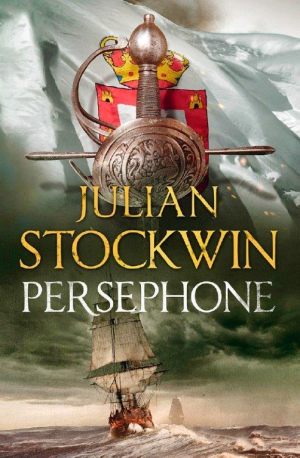
We are accepting pre-payment now and every paid order received before December 31 this year will go into a draw for a full refund of the price of the Collectors Set!
(Note: it is not necessary to have a PayPal account to use these links. You can pay with your credit card using the ‘Pay Without a Paypal Account’ button in your Shopping Cart. We cannot accept credit card details for processing this end.)
Reservations without payment may be made to this address. Please include your full postal address and write ‘Persephone Collectors Set’ in the subject line. We will contact you about payment at a later date.
Standing Orders
A number of readers have asked whether they could have a Standing Order for all future Collectors Sets. Just email with your postal details and ‘Sign Me Up for All Future Collectors Sets’ in the subject line.
(Note: There will be two Collectors Sets in 2017 and thereafter!)
You and Your Kydd!
Posted on November 8, 2016 6 Comments
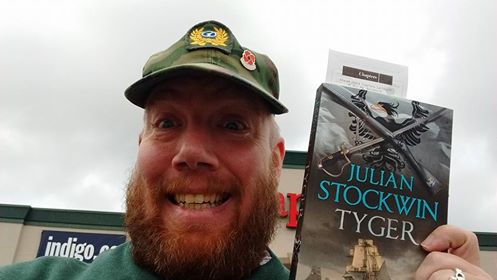
Over the years readers have sent me some great pix of themselves taken with one or more of the Kydd books – like this photo from Canadian Rod Redden with Tyger, which he posted a few days ago. I’m compiling an online album of these and if you’d like to be included email me a .jpg – or reply to this blog with your photo! There’ll be special prizes for six of the photographs featured, the winners drawn at random.
The Nelson Quiz
Posted on October 21, 2016 9 Comments
This day two hundred and eleven years ago Lord Horatio Nelson died at the Battle of Trafalgar. By request, I’m posting a Nelson quiz I devised a few years ago. Test your knowledge of Nelson lore with these twenty questions. (Answers at the end of the blog.)
And there’s a copy of Victory, up for grabs. Just email me with the name of the the plucky little vessel that brought the news of the battle back to England. Please put ‘Victory’ in the subject line and don’t forget to include your full postal address.
Deadline: October 31
Questions
1. Where is purportedly the largest collection of Nelson memorabilia in the New World?
2. How many siblings did Nelson have?
3. In what year was Nelson’s Column erected in Trafalgar Square?
4. Which French admiral attended Nelson’s funeral?
5. What was the origin of Nelson’s famous term ‘Band of Brothers’?
6. At which first recorded public event was the toast ‘The Immortal Memory’ first used?
7. What wound did Nelson receive on 12 July 1794?
8. What was unusual about Nelson’s coat of arms?
9. In which English county was Nelson born?
10. From which English county were the greatest number of sailors in Nelson’s Trafalgar fleet?
11. How tall was Nelson?
12. What was Nelson’s nickname as a child?
13. How many men and officers served in HMS Victory at Trafalgar?
14. Name Nelson’s first command in the Royal Navy.
15. Who was Josiah Nisbet?
16. How was Nelson’s body preserved after his mortal wounding at Trafalgar?
17. How did the inn called ‘The Wrestler’s Arms’ find a place in Nelson lore?
18. Which of Nelson’s captains was the only one killed at the Battle of the Nile?
19. Who is Anna Tribe?
20. During his lifetime Nelson was a prolific letter writer. Approximately how many do we know of that have survived?
[ Answers below ]

Answers
1. The Horatio Nelson Museum, Nevis. Nelson had a number of associations with the Caribbean, especially in his early naval career, and married a young Nevis widow, Frances Nisbet, there in 1787.
2. Nelson’s parents had eleven children, of whom three girls and five boys survived. Nelson was the third boy.
3. 1843. Almost forty years after Nelson’s death!
4. Villeneuve. After the Battle of Trafalgar he was taken on board Euryalus. In England he was placed in open confinement in Bishop’s Waltham in Hampshire, but was given leave to attend Nelson’s funeral. Later that year he was returned to France following a formal exchange of prisoners, but only a few days after his arrival he was found dead in his hotel room in Rennes, stabbed through the heart. The official story was that he committed suicide, but rumour has it that he was murdered on Napoleon’s orders.
5. The famous Agincourt speech in Shakespeare’s King Henry V. Nelson used this phrase to describe the close relationship that existed between himself and his captains at the Battle of the Nile. By extension it has come to encompass all those officers who were particularly close to Nelson.
6. Each year Nelson is remembered with a special toast, ‘The Immortal Memory’, at Royal Navy Trafalgar Night dinners. Although the word ‘immortal’ was often applied to Nelson even when he was alive, the first recorded public event at which it occurred was at a dinner held on Trafalgar Day in 1811, at the Green Man public house near Greenwich. The toast was slightly longer than today: ‘The immortal memory of Nelson and those who fell with him.’
7. While directing his ship’s guns set up in a shore battery during the siege of Calvi a French shot struck the battery rampart in front of him and he was struck in the face with a shower of gravel. Nelson subsequently lost the sight in his right eye; the eye itself remained intact and he never wore an eyepatch.
8. Nelson’s family already had a coat of arms but Nelson’s knighthood entitled him to supporters on either side of the shield. Nelson insisted on having Jack Tar as a supporter – this was a heraldic innovation and set a precedent, which has been followed by a number of naval knights and peers since.
9. Norfolk. He was born at Burnham Thorpe, close to the coastal town of Great Yarmouth on 29 September, 1758, the very year a new first-rate, HMS Victory, was ordered by the Admiralty. His father was rector of the parish and the Nelson family lived in the parsonage, now no longer standing.
10. Devon, where I now live. Nelson’s men at Trafalgar included over 1,100 men born in Devon.
11. The popular image of Nelson is that he was quite a small man. However, modern research has established that he was about five feet, six inches (around the average male height in the eighteenth century).
12. Horace.
13. Her full complement was 850, however at Trafalgar it was only 820.
14. The sloop Badger; he took command in January 1779.
15. Nelson’s step-son. In 1793 Nelson took Josiah to sea with him in HMS Agamemnon but their relationship deteriorated with Nelson’s infatuation with Emma Hamilton. Despite this, Nelson used his influence to have Josiah made a post captain at the early age of twenty. He was not fit for this responsibility, however, and left the sea shortly thereafter. He became a successful businessman and after the war ended moved to Paris. Nisbet died in 1830 and was buried in the churchyard at Littleham in Devon, where, just eleven months later, his mother was laid beside him.
16. Brandy and spirits of wine – not rum! Nelson’s body was placed in a large cask that was filled with brandy and lashed to Victory‘s mainmast, guarded by a sentry night and day. The popular nickname for rum, ‘Nelson’s blood’, originates from the sailors’ tall tale that Nelson’s body was preserved in rum, and then after the body had been removed, the alcohol was issued to all of Victory‘s Jack Tars!
17. When the landlady asked Nelson if she might change the inn’s name to ‘The Nelson’s Arms’ he delightedly told her that the name would be absurd, as he only had one.
18. Captain George Westcott, a Devon man, and like Kydd from humble origins as a common seaman to post captain and command. After Westcott’s death Nelson made a special visit to his widow and presented her with his own Nile medal.
19. Nelson’s closest living relative today. She is Nelson’s (and Emma Hamilton’s) great-great-great granddaughter. Mrs Tribe is also Life Vice President of the Nelson Society.
20. Well over 5000! Nelson’s letters were often characterised by an eager and somewhat unpolished style, almost as if speaking – like the diaries of Samuel Pepys, with which they have sometimes been compared.
How did you go? If you managed twelve or more correct answers award yourself an oragious tot of rum!
The Powder of Death: What Readers are saying
Posted on October 19, 2016 6 Comments
I’m chuffed with the reception my second historical standalone The Powder of Death is receiving, especially the all five-star reviews on Amazon, comments on social media, and the numerous personal emails to me from readers. Here’s a selection of these comments. And there’s a contest to win a copy of the book at the end of the blog!
‘Once again Julian has written a compelling, “Can’t put it down” yarn. Beginning at the end of the 1200s in England, the story travels to the Holy Land, Italy and France. It tells the story of the use of gunpowder and its development by the Chinese as a novelty, The central figure, a blacksmith turned merchant, Jared, witnesses its use in battle and immediately realizes its potential, thus the tale of the challenges Jared faces in trying to replicate and harness the power of the powder. A wonderful, informative novel that would make a great movie.’
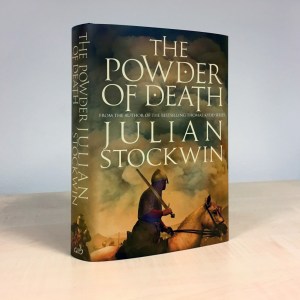 ‘This is a remarkable book for weaving historical facts on the origin and development of gun powder into novel or storytelling format. I learned so much. Perhaps Julian Stockwin will one day write about all the research he did for this book. I have to admit I thought he was making up names for some of the instruments but then I looked up the names and found it was all true.’
‘We know Julian Stockwin best for taking us on adventures on the High Seas with Captain Kydd not the medieval world of knights and castles, but don’t let that put you off – this is every bit as good.’
‘Big fan of Kydd series, so thought I’d get a copy of this book and give it a go…no regrets as it is a wonderful yarn. Fast paced and compelling read, great character detail and interplay, with Jared the blacksmith becoming the central figure in Julian Stockwin’s tale of gunpowder and guns. Historical backdrops add to the tale, just a wonderful book.’
‘Once again Julian Stockwin has shown us his prowess as an author not only of maritime matters but historical matters as well… This account of the development of the ‘gunne’ and ‘gunne powder’ you get so involved with Jared the blacksmith willing him on to succeed in the development of his gunne and cannones. A brilliant read as usual so please Julian keep them coming. A must read for people who like historical novels.’
The Powder of Death is available in hardback, ebook and audiobook in the UK and in Australia in hardback and ebook. In the US and Canada it’s out in ebook and audiobook and the hardback will be launched October 27 in the US and in Canada on November 14.
For a chance to go into the hat to win a copy of the book email julian@julianstockwin.com with the name of the first title in my Moments of History series published by Allison & Busby.
Deadline: October 28
Previous posts on The Powder of Death
Thrilling and entertaining
Ten cool facts
BookPick: British Expeditionary Warfare and the Defeat of Napoleon
Posted on October 11, 2016 5 Comments
 Britain’s naval victories in the French Revolutionary and Napoleonic Wars succeeded in protecting her from French invasion, but they could not of themselves defeat France. This required the support of allied armies and necessitated the shipping of formidable numbers of troops to, and successfully landing them on, French controlled territory – a major logistical operation much akin to D-Day in these times. Wellington’s expedition to Portugal and Spain led to Napoleon’s defeat in the Peninsular War, but there were many other British expeditions before this which were not successful, in part because they were too logistically ambitious and/or they lacked allied support.
‘British Expeditionary Warfare and the Defeat of Napoleon, 1793-1815‘ by Robert K Sutcliffe
Just how did Britain manage the transportation of decisive numbers of troops to French controlled territory during the French Revolutionary and Napoleonic Wars and successfully land them? Sutcliffe examines the nature of combined operations and the planning and preparation of expeditions. He highlights the navy’s crucial role in amphibious warfare and describes the often complex logistical operations which supported British expeditionary warfare in the period, bearing in mind that it was all achieved without telephones, typewriters and massive bureaucratic support.
 In outlining the role of the Transport Board, he explores how it periodically chartered a large proportion of the British merchant fleet in quite the same way as happened so recently in the Falklands operation, and picking up what the effects of this were on merchant shipping. He concludes that the Transport Board grew in competence; that the failure of expeditions was invariably due to circumstances well beyond its control; and that its pivotal role in the preparation of all the major military expeditions in which hundreds of thousands of British troops served overseas was significant and effective.
I have a particular interest in this book as not only will it be a valuable resource on my library shelves for writing my Thomas Kydd tales – but in more modern times Naval Control of Shipping (the logistics of deploying merchant vessels to meet wartime objectives) was my area of expertise when I was in the Royal Naval Reserve. The photo, taken during my active Service in the RNR, shows your reviewer on the bridge of such a merchant vessel in the South China Seas during a training exercise.
BookPick: Hornblower’s Historical Shipmates
Posted on September 26, 2016 3 Comments
Among the many larger-than-life naval officers who strode the quarterdeck in the period I write about (1793-1815) Edward Pellew ranks among the most memorable. Not far from where I live in Devon is the site of his heroic action in saving the lives of some 500 men, women and children from certain death aboard the troopship Dutton that had come to grief just off Plymouth Hoe. He was ashore at the time, heading to a social function in full evening dress. Seeing Dutton‘s plight he stopped his carriage, divested himself of his finery and swam out to the ship and at the point of a sword took matters in hand in the panic that had ensued. Pellew served the Royal Navy with great distinction for 50 years. He was undoubtedly one of the greatest fighting captains of the Napoleonic wars but has somewhat been overshadowed by Horatio Nelson. He died in 1833, a vice-admiral of the United Kingdom, peer of the realm and holder of many foreign honours. As well as great seamanship skills, indomitable courage and sheer grit, Pellew excelled in man management and mentoring. He has been criticised by some as an over-partial father to his own sons but he nevertheless earned the lasting devotion of his men.
Hornblowers Historical Shipmates by Heather Noel-Smith and Lorna M Campbell
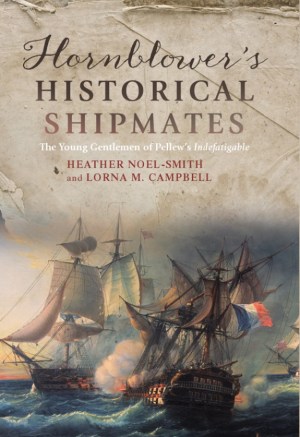 The book sets out the lives of seventeen ‘young gentlemen’ who were midshipmen under Pellew. Together, aboard the frigate HMS Indefatigable, they fought the celebrated action in 1797 against the French ship of the line Les Droits de l’Homme. C. S. Forester placed Horatio Hornblower aboard Pellew’s ship as a midshipman – this book tells the actual stories of Hornblower’s shipmates in real-life and provides a fascinating and absorbing snapshot of the later eighteenth-century sailing navy in microcosm.
From diverse backgrounds, aristocratic and humble, they bonded closely with Pellew, learned their naval leadership skills from him, and benefited from his patronage and his friendship in their subsequent, very varied careers. Besides tracing the men’s naval lives, the book shows how they adapted to peace after 1815, presenting details of their subsequent civilian careers. The colourful lives recounted include those of the Honourable George Cadogan, son of an earl, who survived three courts martial and a duel to retire with honour as an admiral in 1813; Thomas Groube, of a Falmouth merchant family, who commanded a fleet of boats which destroyed the Dutch shipping at Batavia, capital of the Dutch East Indies, in 1806; and James Bray, of Irish Catholic descent, who was killed commanding a sloop during the American war of 1812.
An Appendix, of a remarkable exchange of letters between Pellew and Lord Spencer, First Lord of the Admiralty, and Bibliography of primary and secondary sources, are offered for those wishing to delve deeper into the lives of Hornblower’s historical shipmates and their gallant commander.
Much enjoyed and recommended, and until October 3 you can take advantage of a 40% discount on this book and other titles.
INFERNO: Out next month!
Posted on September 16, 2016 28 Comments

UK Edition

US Edition
Just a few weeks to the official launch on October 6 of Inferno, my latest Kydd tale! For this book Kathy and I travelled to Denmark and Sweden on location research, braving the Baltic chill in winter. The book sees Captain Thomas Kydd involved in the Second Battle of Copenhagen in 1807.
UK Edition
US Edition
This is what Quarterdeck magazine had to say of the book:
‘Julian Stockwin’s stock-in-trade throughout the Thomas Kydd naval adventures has been creating stirring original, authentic, history-based stories, which often cover completely new subject matter in the genre. Stockwin splices a mariner’s sense of the sea, with a historian’s keen eye, to craft matchless true-to-life historical naval adventures. Immersing himself in minutiae, he leaves no stone unturned in bringing a Kydd novel to life. Whether it’s describing sail handling, a famed naval action, or a slice of Georgian England, the passage is based on factual resources. Inferno, the seventeenth instalment in the Thomas Kydd canon, brings another compelling epic to the fore.
It’s 1807 and Captain Sir Thomas Kydd is ashore, while his frigate, Tyger, is under repair in dry-dock, after her gallant action against three enemy frigates in the Baltic. Hailed as a hero, Kydd craves “space to find himself again; to get away somewhere blessedly remote and peaceful . . .” This lands him in a small, remote village along Scotland’s rocky western coast, with Tyger seaman Toby Stirk, who is recovering from wounds suffered in the recent frigate battle. When a mysterious gold doubloon surfaces, the mates are drawn into a perilous undersea treasure hunt, thrusting Kydd into an ethical dilemma.
At the same time, Napoleon Bonaparte’s victories across Europe and his Continental System – a broad embargo against British trade – threatens England’s economy. But the Emperor’s plan has one critical weakness: Denmark and her navy control the straits through which Baltic trade flows. In an effort to thwart the French, Nicholas Renzi – Lord Farndon – is dispatched by the government on a diplomatic mission to Copenhagen to prevail upon the Danish government to turn its fleet over to the British. Faced with the French army on its border and the Royal Navy at sea, the Danes demur, and risk being caught between two warring forces.
Returning from Scotland, Captain Kydd resumes command of Tyger and sails with a grand fleet and a military force bound for the Baltic on a mission to sway Denmark’s Crown Prince to surrender the Danish fleet. Failing this, the Danish ships could be unleashed by the French against the British. This leads to the Second Battle of Copenhagen, with the British bombarding the city over four days. Meanwhile, Lord Farndon and his wife, Cecilia – Thomas Kydd’s sister – are caught in the blazing inferno.
Stockwin’s passion for the sea, naval service, and the time of Nelson oozes from the pages like fresh hot pitch between the seams of a man-of-war’s deck.’
The book will be available in hardback, ebook and audiobook formats
Read an excerpt
For UK Kydd fans I will be signing copies of Inferno at various venues:-
On Saturday October 8 I’ll be at Waterstones Drake Circus, Plymouth, 11am – 1:00
- Waterstones
1 Charles St
Plymouth
PL1 1EA
Tel: 01752 669 898
On Saturday October 15 I’ll be at Torbay Bookshop, Paignton, at 11am
The Torbay Bookshop
7 Torquay Road
Paignton
Devon
TQ3 3DU
Tel: 01803 522011
A MegaBundle of Kydds!
Posted on August 23, 2016 5 Comments
 To celebrate the upcoming launch of the paperback of Tyger in the US on October 1 my US publisher McBooks Press has put together a very special contest prize — the entire Kydd series to date plus a Union Jack tote! For a chance to win this fabulous bundle of goodies just email me with the name of the free bi-monthly newletter published by McBooks. Please include your full postal addresss and put ‘MegaBundle’ in the subject line (this contest is restricted to addressees in Continental USA)
Deadline for entry: September 15
What reviewers have said about Tyger
‘Characterization is strong, even for secondary characters. The setting features just enough detail to provide a framework for the imagination to fill in, lending a feel to the novel that Stockwin found Kydd’s journal and filled in the dramatic details. Engaging and engrossing, Kydd’s adventure commanding Tyger is a swashbuckling good time…With strong pacing and a well-built plot, this book is good not only for historical-fiction fans but for anyone who loves a solid yarn. Kydd is a heroic figure to rival Horatio Hornblower or Jack Aubrey, and a great addition to the nautical-adventure genre.’ –– Foreword Reviews
‘This latest cracking yarn in the Kydd and Renzi saga is a very, very, good novel… as fresh as the first in the series. As the sixteenth story in the series, this is an achievement in itself. Successful authors often become bored with their characters, or simply cannot think of how to develop them further. Fortunately, Stockwin is still enjoying his characters and their unfolding saga as the most avid fan. Having worked through to Trafalgar, the author would have been forgiven for resting on his laurels as so many before him have. Happily, he appreciated the rich seam of adventures that stretched out for the Royal Navy after 1805. He has already built instalments around two very important early dashes for Empire and this tale picks up the aftermath of the second dash.’ – FIRE Reviews
‘There are only really two kinds of readers: Those who are devoted fans of British seafaring novels, particularly novels set in the swashbuckling era of the Napoleonic wars, and those poor benighted souls who aren’t. And for those who do love a good seafaring yarn, there are also two – and only two – classifications: Those who have been lucky enough to have stumbled on Julian Stockwin’s Thomas Kydd saga, and those who have yet to discover these treasures, which have delighted many a sailor, armchair and otherwise, since the turn of the century.
Tyger [is] the best one yet, a gripping yarn about a self-made captain whose loyalty to a man he admires earns him the wrath of those higher-up – and causes him to be stuck with command of a down-at-heels frigate fresh from a bloody mutiny. You won’t fall asleep reading this book. Action and adventure is one thing, but Tyger, like Mr. Stockwin’s other Kydd books, has a genuinely authentic feel to it.’ – Toledo Blade
Tyger is also available in hardback, ebook and audio download
BookPick: Letters of Seamen in the Wars with France
Posted on August 16, 2016 2 Comments
Behind my decision to begin the Kydd series with a common seaman, rather than an officer, was my curiousity about (and admiration for) that tiny handful of men who crossed the great social divide in the eighteenth century from before the mast as a seaman to the quarterdeck as a king’s officer. In the bitter French wars at the end of the 18th century, there were, out of the hundreds of thousands of seamen in the Navy over that time, probably only 120, who by their own courage, resolution and brute tenacity made the awe inspiring journey to the quarterdeck. This meant of course that they changed from common folk to the gentry; each of these became a gentleman. And that was no mean thing in the 18th century. And of those 120, a total of 22 became captains of their own ship – and a miraculous 3 to Admiral!
Letters of Seamen in the Wars with France 1793-1815 by Helen Watts and Anne Hawkins
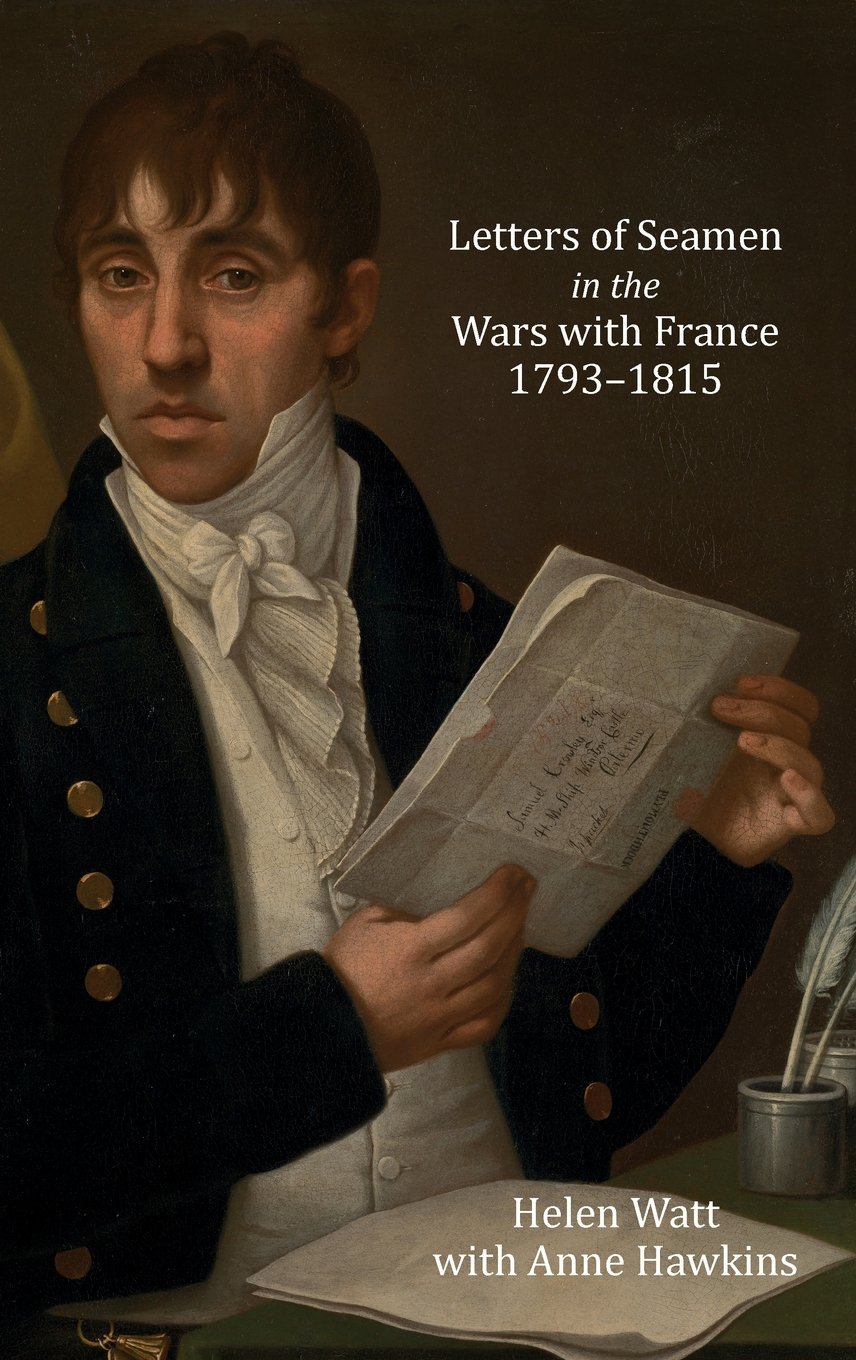 The introductory material to this substantial work, besides highlighting what the letters tell us about seamen’s lives and attitudes, also discusses the extent of literacy amongst seamen, setting this into its wider contemporary popular context.
Letters of seamen below the rank of commissioned officer are rare, both in original form and in print. This edited (but not abridged) collection of hundreds of letters, written by seamen in the British Navy and their correspondents between 1793 and 1815, gives voice to a group of men whose lives and thoughts are otherwise mostly unknown. The letters are valuable for the insights which they give into aspects of life below decks and the subjects close to the writers’ hearts: money matters, ties with home and homesickness. They also provide eye-witness accounts of events during a tumultuous and important period of British and European history. The contextual presentation is invaluable in placing the writer at the centre of events that perhaps even he was unaware of at the time, and opens the reader’s eye to the true significance of what is being said. One large group of letters, included as a separate section, comprises the letters of seamen and their family and friends which were intercepted by the authorities during the mutinies of 1797. These letters shed light on the extraordinary events of that year and of seamen’s attitudes to the mutinies, which I felt I had to write about in my Kydd novel Mutiny.
As would be expected in a book of this calibre there are extensive add-ons – two appendices, a bibliography and an index. Of particular interest to me was Appendix 1: Biographies. Each entry gives the rate of every seaman mentioned in the text and a brief overview of his career to provide insight into the service background of the letter.
It is an expensive book, but as a scholarly reference work an invaluable addition to the resources available for all those interested in the human elements of maritime history. It is undoubtedly a monumental pillar of scholarship but behind the words laid out, emerges picture after picture of the warmth, yearnings and hopes of the often unlettered men who laboured by mess-deck glims to reach out to their loved ones in the midst of the titanic struggle of the war at sea.
The Powder of Death MegaContest!
Posted on August 9, 2016 5 Comments

The GameChangers : Moments of History
In the run-up to the official launch of The Powder of Death on August 18 we’re running a MegaContest with a fabulous bundle of prizes – a signed hardback of The Powder of Death & a signed paperback of The Silk Tree, cover postcards and an information sheet; an unabridged CD set of the audiobook of The Powder of Death – and a smart Allison & Busby tote!
To enter, email julian@julianstockwin.com with the name of the English univerity town associated with Roger Bacon. Please include your full postal address and ‘Bumper Contest’ in the subject line. One winner will be drawn on August 18 and notified by email.
Please include your full postal address and ‘Bumper Contest’ in the subject line. One winner will be drawn on August 18 and notified by email.
The Powder of Death
‘A thrillingly entertaining story‘ – FIRE review
‘Fast-paced prose, vivid characters, & matchless authenticity‘ – Quarterdeck
1261. Oxford, England. An envoy returns from the land of the Tartars to meet with an English scholar and share a deadly secret that touches on the future of Christianity itself. The two men vow that the knowledge of gunpowder must die with them as the consequences are otherwise too fatal to contemplate.
1290. Hurnwych Green, England. After his quiet life is shattered by tragedy, local blacksmith Jared begins a pilgrimage to the Promised Land. Aboard a ship to Venice, he meets Sir Nicholas Gayne who invites him to join the Knights Hospitallers as their blacksmith on a holy crusade for King Edward.
The adventure that follows sees Jared encounter men from distant Cathay who harbour the secret of huo yao, and so begins one man’s obsession with the powder of death and a king’s determination to change the very nature of warfare . . .
Whet your appetite with chapter one!
The Powder of Death will be released in the UK and Europe on August 18, in hardback, ebook and audiobook
It will be available in South Africa in September; Australia and New Zealand on October 1. It can also be purchased via Book Depository, which offers free postage worldwide. The Powder of Death is the second title in the GameChangers: Moments of History Series, following The Silk Tree.
I also have a Facebook Page on The Powder of Death
View my Pinterest board on The Powder of Death
 Julian Stockwin