
The Powder of Death: ‘a thrillingly entertaining story’
Posted on August 2, 2016 8 Comments
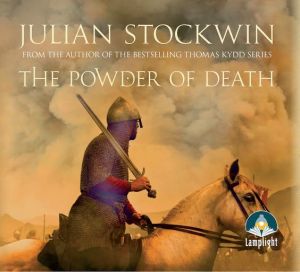 Once a manuscript goes off to the publisher the wait begins. When will I know whether my editor and agent like the book? Will structural adjustments or other major changes be required? How will early reviewers rate the book? I am lucky in my publisher Allison and Busby – they have great respect for an author’s vision and writing style. Of course they will speak up if they feel the manuscript needs serious work but I was delighted to hear this back about The Powder of Death from Susie Dunlop, Publishing Director at Allison and Busby: ‘Such a fantastic tale! Such a well-crafted novel, cleverly marrying history and adventure …The historical accuracy makes it engaging and memorable, and yet the characters feel as real and accessible as if they were part of our modern world.’
I was also chuffed to be given an early peek at a major review coming out in Quarterdeck magazine, August/September issue. It’s reprinted below, followed by another review, from FIRE online.
‘Gunpowder was invented in China during the Tang dynasty (618-907 AD) but it was not until the Mongol conquests in the thirteenth century that awareness of it spread to the Old World. (Africa, Europe and Asia). How the black powder, the earliest known chemical explosive, eventually reached England has been lost to history. It was this thread that inspired Julian Stockwin to create The Powder of Death, the second title in his GameChangers: Moments of History Series, which engages memorable fictional characters with marked turning points in the past. By 1261, the secret of the deadly powder was known to Oxford scholar Roger Bacon and his friend, Flemish Franciscan missionary and explorer William of Rubruck. The colleagues vowed to remain silent about what they rightly perceived to be a terrible threat to mankind.
 The Powder of Death picks up in 1287, the fifteenth year of the reign of King Edward I, when Jared of Hurnwych, a young English blacksmith suffers unbearable tragedy. Tormented by heartbreak, he embarks on a pilgrimage to the Holy Land ‘until the remembrances had finally quite faded.’ On a voyage to Venice, Jared encounters Sir Nicholas Gayne, who bids him to join the Knights Hospitallers as the blacksmith for King Edward’s holy crusade. At the siege of Acre, the Crusaders and the city fall to the Saracens, and he is imprisoned. In a fateful move, Jared is sold ‘as a skilled foreign craftsman’ to the Mongols, who take him to Tabriz.
While working in the Mongol capital, ‘a flash and almighty clap of thunder’ expose him to the capacity behind huo yao – the secret powder – for devastation. Although half a world away, Jared dreams about Hurnwych and wreaking vengeance on those who shattered his quiet life.
Closely observing his Mongol captors, he pieces together the formula for the volatile powder. On a warring expedition to Armenian Celicia, the Mongols are defeated, and Jared is liberated by Knights
Hospitallers, who are Christian allies of the Celicians. Months later, he returns to Hurnwych, carrying the mystery of huo yao.
What will Jared do with his knowledge? Sensing a ‘divine charge,’ he ventures forth on a path that leads him across Europe and, finally, to the Battle of Stanhope Park, County Durham, England, in
1327, during the First War of Scottish Independence.
Julian Stockwin, a master of the historic novel, writes with a zeal, recreating ancient times, with fast-paced prose, vivid characters, and matchless authenticity. Powder smoke and the stench of brimstone waft off the pages.’ – Quarterdeck magazine
 ‘This new standalone book is very different in many respects [from the Thomas Kydd stories] and has managed to provide a gripping tale of Medieval life with the story of gunpowder. It is a Stockwin page turner that further enhances his reputation. This is not a book to miss, with its thrills and spills, joys and sorrows, another best seller. In this new book, Stockwin has set it against one of a handful of genuinely world changing events. The discovery of gunpowder, and its use mainly as a form of entertainment in the Far East, was perhaps not life changing, but its deployment as a bomb hurled at fortifications was the start of a giant leap forward in military equipment and deployment. Stockwin has cleverly combined several separate European developments in a single story written around the main character. In the process, he has produced a thrillingly entertaining story of depth that also contains a great deal of information about gunpowder and the Medieval development of the gun.
Stockwin has produced a roller coaster ride with the hero facing all sorts of challenges and overcoming them to take forward his belief in the future for gunpowder. There is rich description of village life, life in towns and ports, sea travel and the life of armies at war. The hero travels far and wide in a series of adventures, survives set backs and eventually triumphs. It is a great tale that carries the reader along with it. It is to be hoped that there will be more treats like The Powder of Death yet to come.’ – FIRE Project Reviews
Win the audiobook!
For a chance to win an unabridged audiobook https://wholestoryaudiobooks.co.uk/product/the-powder-of-death of The Powder of Death email julian@julianstockwin.com with the name of the reigning king when the book opens. Please include your full postal address and ‘Audiobook’ in the subject line.
Deadline: August 10.
The Powder of Death will be released in the UK and Europe on August 18, in hardback, ebook and audiobook
It will be available in South Africa in September; Australia and New Zealand on October 1. It can also be purchased via Book Depository, which offers free postage worldwide.
The Powder of Death is the second title in the GameChangers: Moments of History Series, following The Silk Tree.
View my Pinterest board on The Powder of Death
I also have a Facebook Page on The Powder of Death
Copyright notices
Edward III: (credit: By William Bruges (1375-1450) [Public domain], via Wikimedia Commons)
Every effort is made to honour copyright but if we have inadvertently published an image with missing or incorrect attribution, on being informed of this, we undertake to delete the image or add a correct credit notice
Gunpowder: Ten Cool Facts
Posted on July 26, 2016 7 Comments
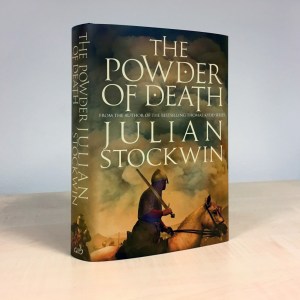 Research for me is almost as interesting and rewarding as actual writing. I found this particularly true when doing my homework for The Powder of Death, my new historical standalone, out August 18. Not only did I have to delve into the medieval period in Europe but ancient China, the chemistry of gunpowder and the physics of early ballistics. Certainly a riveting diversion from my ongoing Kydd tales and the Age of Fighting Sail! Here are some of the fascinating facts I came across researching The Powder of Death. And at the end of this blog there’s a chance to win a copy of the book, along with a smart Allison & Busby tote to carry it in!
Ten cool facts about gunpowder
- 1. Taoist alchemists combined sulphur, saltpetre and charcoal to make the earliest form of huo yao, or gunpowder, during the eighth-century. It was used to kill insects and treat skin diseases. Huo yao would later be used by the Chinese in the following century in fireworks and rockets.
2. Until the mid-19th Century, gunpowder was the only known chemical explosive.
3 Gunpowder is a classic green tea from Zhejiang province, China. Gunpowder tea is made up of leaves hand-rolled into tiny pellets that resemble gunpowder, giving, it is said, this tea its distinct name.
4.The explosive force of gunpowder is the result of very rapid burning, which creates hot gases 1500 times the original volume of the powder.

Workers mix gunpowder 1805. This method remained unchanged for centuries
5. Remember, remember the fifth of November, the Gunpowder Treason and Plot! Known as Guy Fawkes Night or Fireworks Night, the fifth of November is the anniversary of the plot by Guy Fawkes and other conspirators to blow up Britain’s parliament in 1605. Rebelling against the persecution of Catholics by King James I, they planned to kill the monarch during his visit to parliament. But the scheme was foiled and the traitors executed.
6. Shakespeare mentions gunpowder in Henry IV Part 1 (and other plays): ‘Zounds, I am afraid of this gunpowder Percy’ cries Falstaff. And it’s believed that Macbeth is a comment on The Gunpowder Plot.
7. The earliest surviving record for the use of gunpowder in mines comes from Hungary in 1627.
8. The first time gunpowder was used on a large scale in civil engineering was in the construction of the Canal du Midi in Southern France. It was completed in 1681 and linked the Mediterranean sea with the Atlantic.
9. In 1856 England exported 10,500,018 pounds of gunpowder.
10. November 5 was a statutory holiday until 1859 under the Observance of 5th November Act 1605. The Act described the gunpowder plot as ‘an invention so inhuman, barbarous and cruel, as the like was never before heard of’.
For a chance to win a copy of The Powder of Death and a smart Allison & Busby tote email julian@julianstockwin.com with your full postal address and ‘Powder of Death draw’ in the subject line. First out of the hat on Monday August 1 will be the winner!
(This draw is restricted to the UK)
The Powder of Death will be released in the UK and Europe on August 18, in hardback, ebook and audiobook. It will be available in Australia & New Zealand and South Africa on October 1. It can also be purchased via Book Depository, which offers free postage worldwide. The Powder of Death is the second title in the GameChangers: Moments of History Series, following The Silk Tree.
View my Pinterest board on The Powder of Death
I also have a Facebook Page on The Powder of Death
BookPick: Beyond Jutland
Posted on July 19, 2016 3 Comments
With this year seeing the centenary of the Battle of Jutland, the Royal Navy’s last great set-piece sea battle, a number of important books on Jutland have been published. I reviewed a selection of these in a previous blog. There have also been some excellent other titles forthcoming this year on various aspects of The Great War and naval policy between the two world wars. It is commendable that some of these books are reprints, bringing these classics to a new generation of readers of naval and military history many years after they first appeared.
— ♥ —
Endless Story by ‘Taffrail’
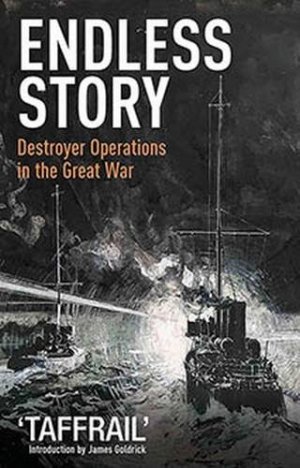 Although first published in 1931, Endless Story remains the only comprehensive account of the services of the Navy’s small craft destroyers, torpedo boats and patrol vessels during the First World War, and the only one written by an officer personally involved. It was a bestseller in its day, and now deservedly enjoys the status of a classic. The emphasis is on the North Sea and Channel, which saw the most famous battles, but the book includes the Gallipoli campaign, warfare in the Mediterranean, ranges as far as the Pacific, where Australian destroyers were actively employed, and pays tribute to the work of American destroyers in British waters after 1917. It covers every kind of operation, from U-boat hunting and convoy escort, through minelaying to the Zeebrugge Raid. This new edition makes this classic work available for the first time in more than eighty years.
South Devon in the Great War by Tony Rea
 Dr Rea has long-standing interests in the First World War and local history. Illustrated with a number of fascinating old photographs, this succinct little volume provides a history of events in south Devon during the Great War. Among other topics, the book deals with the social changes brought to the region at that time – for example, by 1915 many of the young men and significantly almost all the horses had gone away to war. Older men and many women farmed the land and many large country houses were converted into hospitals and convalescent homes. Within the pages, too, are moving tales of sacrifice and loss, and the endurance of the human spirit. The book is part of the ‘Your Towns & Cities in the Great War’ series
The Victoria Cross at Sea by John Winton
 Naval VCs have been won in places as far apart in time and distance as the Baltic in 1854 and Japan in 1945, in the trenches from the Crimea to the Western Front, in harbours from Dar es Salaam to Zeebrugge, from the Barents to the Java Sea, from New Zealand to the North Atlantic, and from China to the Channel. The 628 awards of the Victoria Cross given for action during the First World War account for almost half the 1356 Victoria Crosses awarded throughout its history. This book tells the stories of the men and officers whose uncommon valour at sea earned them Britain’s highest military honour, and salutes those who may not be so well known as Boy Cornwell.
Naval Policies Between the Wars by Stephen Roskill
 First published in 1968 and 1976, the two volumes of this work still constitute the only authoritative study of the broad geo-political, economic and strategic factors behind the inter-war development of the Royal Navy and, to a great extent, that of its principal rival, the United States Navy. The main themes of the first volume are: the after-effects of the Armistice; the struggle to prevent a renewed naval arms race, despite the challenge from the USA and Japan, which culminated in the Washington Naval Treaty; and the broader attempts at peace-keeping through diplomacy and the fragile vehicle of the League of Nations. Picking up the story in 1930, the second volume covers the rise of the European dictatorships on the one hand, alongside continuing attempts at controlling arms expenditure through diplomacy and treaties. How the Royal Navy used the precious few years leading up to the outbreak of war is a crucial section of the book and forms a fitting conclusion to this important study.
Still looking for bookish inspiration?
You might also like to take a peek at my other BookPicks this year
And I have a very limited number of Signed First Editions, which I’m happy to inscribe with a personal message
Enjoy!
KyddFest-12:- Victory
Posted on July 12, 2016 17 Comments
 Over the previous months I’ve been celebrating the earlier titles in the Kydd Series, it’s Victory for this blog. I’d love to hear your thoughts on the book, either as a first-time reader or if you’re a re-reader and have read it more than once! It’s very gratifying for an author to be told that his work has inspired people to go back and read it again. And some of you have told me you have done this more than twice! Either reply to this blog or email me with your thoughts on Victory for a chance to win a signed copy of the book plus a handy deck-by-deck guide to the ship.
‘Victory starts off with a major setback for Kydd and keeps up a fast pace throughout which makes it another page turner for Julian Stockwin. It was never going to be easy weaving the events surrounding the well known and often used events of Trafalgar into something that was fresh and gripping but this is exactly what has been produced…
The personal lives of Kydd, his friend Nicholas Renzi and sister Cecilia are weaved skilfully into the events off Toulon and the fateful chase across the Atlantic when Kydd’s ship joins the fleet.
For Trafalgar itself Julian’s research and familiarity with the ship come through clearly, as a former shipmate, in the form of Midshipman Bowden, finds himself serving aboard Victory and is therefore well placed to observe and narrate the major aspects of the battle. The characterisations in this series have always been good but in this one they really mature and is probably the best one yet.
Definitely recommended.’ – Historic Naval Fiction
The enemy at Trafalgar
The Spanish contributed four First Rates to the Franco-Spanish Fleet at Trafalgar. Three of these ships, one at 136 guns and two at 112 guns were near twice as large as some in Nelson’s command, yet during the battle the Spanish commander Don Federico Carlos Gravina y Napoli, in his flagship Principe de Asturias, finding himself attacked by three British ships at once fled back to Cadiz.
As it was, Pierre-Charles-Jean-Baptiste-Silvestre de Villeneuve was in command of the combined French and Spanish forces, 33 ships-of-the-line – 41 ships in total – in his flagship Bucentaure. During the battle Victory raked her stern and she lost 197 killed and 85 wounded. Villeneuve was taken prisoner but later paroled and returned to France. He died in 1806; a dubious verdict of suicide was recorded.
Trafalgar in art

Trafalgar by Turner
There have been many paintings of HMS Victory, particularly at the Battle of Trafalgar. The one by Turner is probably the most famous artistic rendition of the battle even if not accurate in all the particulars. This was Turner’s only royal commission, ordered by George IV in 1822 to make a same-size pair with Phillipe-Jacques de Loutherbourg’s ‘Battle of the Glorious First of June, 1794’, already in the Royal Collection. The finished composition includes reference to a number of incidents that took place at different times in the battle and is in essence a high-Romantic commemoration of Nelson’s victory and death. More about this painting
HMS Victory today and tomorrow

The Grand Old Lady is undergoing extensive and ongoing conservation and restoration work. However she is still open for visitors. If you do pay her a visit you may find one of your guides is Paul Waite, who took the photograph of my book aboard the ship. Do say hello!
Previous blogs on Victory :
Kydd at Trafalgar
Victory 250 this Month
HMS Victory
Victory has been published in the UK/US in English, in translated editions and in ebook, large print and audiobook.
Buy on Amazon or The Book Depository (free postage worldwide!) Also available at most bookstores.
Detailed list
Copyright notices
Victory aboard Victory by Paul Waite
Painting: J. M. W. Turner [Public domain], via Wikimedia Commons
Every effort is made to honour copyright but if we have inadvertently published an image with missing or incorrect attribution, on being informed of this, we undertake to delete the image or add a correct credit notice
The GameChangers : Moments of History Series
Posted on June 28, 2016 6 Comments

The GameChangers : Moments of History
I’ve always been fascinated by pivotal points in history; events and discoveries in the past that have shaped our modern world – and it’s been a most enjoyable diversion from my Kydd Series (which I am certainly continuing with, as well…) to write the first two books in GameChangers Series, The Silk Tree and The Powder of Death. They are both standalone novels, but connected by the fact that they deal with major milestones in history that have shaped our modern world.
The Silk Tree
A dramatic tale of how the secret of silk was brought from China to the West.
Forced to flee Rome from the barbaric rampages of the Ostrogoths, merchant Nicander meets an unlikely ally in the form of Marius, a fierce Roman legionary. Escaping to a new life in Constantinople, the two land upon its shores lonely and penniless. Needing to make money fast, they plot and plan a number of outrageous money-making schemes, until they chance upon their greatest idea yet.
Armed with a wicked plan to steal precious silk seeds from the faraway land of Seres, Nicander and Marius must embark upon a terrifyingly treacherous journey across unknown lands, never before completed.
The genesis of this book was in a bazaar in Istanbul. Kathy was haggling with a merchant over a rather lovely silk scarf and I idly wondered just how silk had made its way to the West. Later, I did some research and the creative juices started flowing…
Read an excerpt of The Silk Tree
The Powder of Death
But then what would be my next book? There are a number of pivotal points in history that I’m drawn to (and which will be the focus of future books in the series) but for my second one I chose the deadly introduction of gunpowder into Medieval Europe. While living in Hong Kong I was also fascinated by Joseph Needham’s monumental histories of science in China, which included a discussion of gunpowder. In fact the books travelled with me to England, and are still in my library. My father was an officer in the Royal Horse Artillery during the war and this book is dedicated to him.
The Powder of Death opens with a returned envoy to China meeting an English scholar in Oxford in the mid-13th century to share a lethal secret. They vow that the knowledge of gunpowder must die with them as the consequences otherwise are too terrible to contemplate. The novel tells the story of its re-discovery, one man’s obsession with the powder of death, and Edward III’s determination to use it to his advantage. He does so at the Battle of Crecy, the first full-scale battle at which guns are deployed in the field. The nature of warfare is changed forever, and the world hears the death-knell of Knightly chivalry.
Read an excerpt of The Powder of Death
KyddFest-11: – Invasion
Posted on May 24, 2016 9 Comments
Over the previous months I’ve been celebrating the earlier titles in the Kydd Series, it’s Invasion for this blog. I’d love to hear your thoughts on the book, either as a first-time reader or if you’re a re-reader and taken it in more than once! It’s very gratifying for an author to be told that his work has inspired people to go back an read it again. And some of you have told me you have done this several times! Either reply to this blog or email me. Every respondent goes into the hat for a chance to win a copy of the book.

Invasion snapped aboard HMS Victory
‘Commander Thomas Kydd, RN, is determined to once again sally forth to protect England from the threat of Napoleonic France. In this tenth volume of a thoroughly enjoyable series, our nautical hero witnesses the birth pangs of a new era in naval warfare. He is tasked by the high command to work with the eccentric American artist and inventor Robert Fulton on the development of Fulton’s submarine and torpedo-“infernal machines” to one comfortable on the quarterdeck of a sailing ship man-of-war.
The novel deals with the very real threat posed by a French invasion of England. Robert Fulton had first demonstrated his revolutionary weapon to the French but was frustrated at their hesitant reaction. Kydd’s good friend, Nicholas Renzi, is instrumental in convincing the reluctant American to transfer his allegiance from Napoleon to George III while Kydd is engaged in the deadly work of coastal warfare in the treacherous waters of the English Channel and the Downs.
Stockwin continues to display his talents in transporting his audience from the 21st century to the chaotic worlds of Kydd, Renzi, and their imperiled homeland and its enemies. He captures Georgian society and the closed world of a Royal Navy warship particularly well and, as one expects, goes into action with swords drawn and cannons and carronades blasting. Britannia does indeed rule the waves.’ – Historical Novel Society
The Sea Fencibles

Walmer Castle, Deal. Pitt used it as a residence for a time and it was also a focus for clandestine operations.
A naval militia established to provide a close-in line of defence and obstruct the operation of enemy shipping, principally during the French Revolutionary and Napoleonic Wars – after all, for most of the war, Bonaparte’s troops were under arms just 19 miles away! The earliest recorded use of the term was in 1793, when Captain Sir Home Popham organised groups of fishermen to guard against French vessels off the coast of Nieuwpoort, Belgium. At Popham’s suggestion the British Admiralty subsequently authorised the formation of Sea Fencible units along the English and Irish coasts, supported by a network of Martello towers. Popham’s Sea Fencible companies consisted of merchant seamen using their own private or commercial vessels, but operating under letters of marque that authorised them to capture enemy ships should opportunity arise. The Navy provided the Fencibles with uniforms and weapons; it also protected them from the depredations of navy press gangs. The Admiralty disbanded its Sea Fencible units in 1810.
The Goodwin Sands

Shingle beach, Deal – in calm weather! The Goodwin Sands is on the horizon…
A 10-mile long sandbank in the English Channel lying 6 miles off the Deal coast in Kent, England. The area consists of fine sand resting on an Upper Chalk platform belonging to the same geological feature that incorporates the White Cliffs of Dover. The banks lie between 26 ft and 49 ft beneath the surface, depending on location, since tides and currents are constantly shifting the shoals. More than 2,000 ships are believed to have left their bones upon the Goodwin Sands.
Recurring characters
I always enjoy bringing real-life characters into my Kydd tales and some of them make an appearance in more than one book. Admiral Sir James Saumarez is one of these, playing a role in both Treachery and Invasion. And when Kydd in involved in the Baltic Campaign in a few books’ time, Saumarez will again be part of the story. Do you have a favourite recurring historical (or fictional) character in the series? Let me know!
Previous blog on Invasion : Invasion: Glory and Adventure
Invasion has been published in the UK/US in English, in translated editions and in ebook, large print and audiobook.
Buy on Amazon or The Book Depository (free postage worldwide!) Also available at most bookstores.
Detailed list
Copyright notices
Invasion aboard Victory by Paul Waite
Every effort is made to honour copyright but if we have inadvertently published an image with missing or incorrect attribution, on being informed of this, we undertake to delete the image or add a correct credit notice
More Kydd Titles, More Often!
Posted on May 17, 2016 44 Comments
Reader feedback is very important to me and one particular aspect of my work has generated by far the most emails and comments on social media: the frequency of publication of the Kydd titles.

Team Stockwin will be raising a glass (or two…) tonight!
- ‘I really must complain about this latest edition of the Thomas Kydd series. I have found myself reading it, unable to put it down and at the same time, fretting because I am fast approaching the end … I am down to the last few pages and will soon be suffering from withdrawal symptoms until the next instalment.’
‘The thought that I have to wait almost a year before reading the next Kydd book is daunting.’
‘I’m anxiously waiting to see where Kydd and Renzi are headed next. One book a year isn’t nearly enough’
Kathy and I, along with my editor Oliver Johnson and my agent Carole Blake, have given a great deal of thought to see if it might be possible to write and publish more than one book a year in the Kydd Series. I’m delighted to say that this will now take place, starting next year. It will mean a pretty tight schedule for Team Stockwin but I’m confident that it is achievable.
This is the Press Release that has just gone out.

Oliver Johnston, my editor at Hodder
‘Hodder and Stoughton are pleased to announce the acquisition of four new novels by Julian Stockwin featuring his Napoleonic era naval hero, Thomas Kydd from Carole Blake at Blake Friedmann. The Kydd novels have been continuously published one book a year since 2001, but due to popular demand for this beloved series, Hodder will, after the publication of Inferno this Autumn, publish numbers 18 and 19 of the series in 2017 and 20 and 21 in 2018.’
Julian’s editor, Oliver Johnson says
- “It’s a testament to the enduring popularity of this series that we will be publishing two novels a year from 2017. Julian’s Kydd books must be the most popular current series set in the Age of Fighting Sail and long may he continue!“‘
BookPicks: Man and the Sea
Posted on April 26, 2016 2 Comments
I’ve selected three BookPicks, separated in time from the fifteenth to the twentieth centuries. Although spanning half a millenium, together they deal with a number of important aspects of man’s relationship with the sea – courage facing danger in the exploration of the unknown; the struggle for supremacy of the oceans throughout much of our recent past; and the life and death decisions at sea that only a captain can take. One of the books, now reprinted, was first published in 1898, and is a classic in the history of exploration. The other two are more recent but each of the three is eminently readable and I commend them to all students of the sea and those like me with an inquiring mind about the past.
— ♥ —
John and Sebastian Cabot by Charles Raymond Beazley
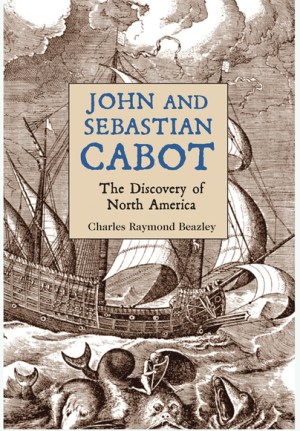 John Cabot led an expedition to the New World in 1497 on behalf of Henry VII. He is considered the first European to explore North America since the Viking voyages five hundred years earlier. Although Cabot’s exact landfall on his first voyage is not known – it could have been Nova Scotia, Newfoundland, or even Maine – his claim for England to this territory countered the Spanish and Portuguese explorations to the south, and changed world history. Cabot made three round trips between Bristol, England, and North America, and later, his son, Sebastian, made two similar voyages. John and Sebastian Cabot was first published in the late nineteenth century. Its enduring value in addition to its lucid, well-balanced, and researched narrative is the author’s detailed perspectives of prior voyages to the North American continent, including those from China and the Pacific Islands as well as those from the realms of mythology.
In Pursuit of the Essex by Ben Hughes
 The frigate USS Essex set sail on 26 October, 1812. After rounding Cape Horn, she proceeded to systematically destroy the British South Seas whaling fleet. When news reached the Royal Navy’s South American station at Rio de Janeiro, HMS Phoebe was sent off in pursuit. So began one of the most extraordinary chases in naval history. In Pursuit of the Essex follows the adventures of both hunter and hunted as well as a host of colourful characters that crossed their paths: traitorous Nantucket whalers, Chilean revolutionaries, British spies, a Peruvian viceroy and bellicose Polynesian islanders. A gripping tale!
The Watery Grave by Richard Osborne
 In 2002 the wreck of the British cruiser HMS Manchester was located by divers off the coast of Tunisia. After taking part in the Norway campaign of 1940, the ship was sent to the Mediterranean, where she was involved in the Malta convoys. On her first convoy she was struck by a torpedo and badly damaged. In danger of sinking, her captain, Harold Drew, managed to save his ship. But her next operation was to prove her last. In Operation Pedestal, the vital Malta relief convoy, Manchester was again hit by a torpedo. This time, rather than risk the lives of his crew Drew took the decision to scuttle his ship. For this he was court-martialled in what would become the longest such case in the history of the Royal Navy. This book sheds new light on the controversial incident.
Still looking for bookish inspiration?
You might also like to take a peek at my other BookPicks this year this year
And I have a very limited number of Signed First Editions, which I’m happy to inscribe with a personal message
Enjoy!
KyddFest-10:-Treachery
Posted on April 19, 2016 5 Comments
Over the coming months I’ll be celebrating the earlier titles in the Kydd Series, it’s Treachery for this blog. I’d love to hear your thoughts on the book, either as a first-time reader or if you’re a re-reader and have read it more than once! It’s very gratifying for an author to be told that his work has inspired people to go back an read it again. And some of you have told me you have done this more than twice! Either reply to this blog or email me. Every respondent goes into the hat for a chance to win a mystery prize!
- ‘Thomas Kydd has dragged himself up in the Navy from press-ganged seaman to captain of his own ship. Now he faces disgrace. After losing favour with his superiors, and suffering terrible personal tragedy, Kydd and his ship are sent to guard the Channel Islands from Napoleon’s forces. When he is brutally betrayed off the Normandy Coast and removed from command, only his old friend Renzi is willing to stick by him.

Kathy on the battlements of Mt Orgeuil where d’Auvergne had the headquarters of his clandestine activities
Kydd is determined to clear his name, but soon finds himself fighting yet another battle he seems to have no chance of winning. Can he defeat his enemies on both sides, and win back the glory taken from him?
Julian Stockwin has done it again he has cast an enchantment over the booklover to heave them into the exciting world of Thomas Kydd, a working class lad who has advanced from being a pressed man of the lower deck to the quarterdeck over a succession of seafaring yarns.
A superbly written book, progressing the story of Thomas Kydd and his best friend Nicholas Renzi.
Through more twists and turns than a first-rate murder mystery this book is in basic terms outstanding and once started it is easier said than done to put down, Julian Stockwin weaves a remarkable account set early on in 18th Century England as well as sticking to his guns with the standard of story telling he has made me appreciate.
Julian Stockwin is a instinctive teller of tales and, with his Thomas Kydd and the captivating intrigues a man with a stunning imagination and just as unfalteringly his research is truthful and matchless, I can’t recommend Treachery highly enough.’ – The Book Shelf
Two titles, same book
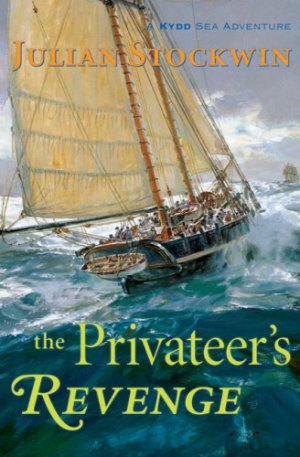
The US edition of the book, The Privateer’s Revenge
Sometimes in publishing the same book may appear in different territories under different titles. The reasons for this are varied – a publisher may feel an alternate title works best for his audience or that the original title is too close to another book familiar to readers. Treachery was published in the UK and Commonwealth countries under that name but in the US as The Privateer’s Revenge.
Pirate vs. privateer
One question I’m sometimes asked is what is the difference between a pirate and a privateer. It’s all down to a piece of paper called a Letter of Marque. This was a government license authorizing a named captain and ship (really as a privateer business) to attack and capture enemy vessels by way of reprisal and bring them before admiralty courts for condemnation and sale. A kind of privatised man-o’war. Cruising for prizes with a letter of marque was considered an honorable calling combining patriotism and profit, in contrast to unlicensed piracy, which was universally reviled as a crime against all humanity.
Minor character spotlight: D’auvergne

Philippe d’Auvergne
One of the really fascinating real-life characters I researched in the course of writing the book is the spy-master Philippe d’Auvergne, a British naval officer and the adopted son of Godefroy de La Tour d’Auvergne the sovereign Duke of Bouillon. He chose a career in the Royal Navy (beginning as midshipman in 1770) that spanned a period of history where Great Britain was at the centre of wars and empire building and took him from Boston and the War of Independence to espionage with French Royalists; prisoner of war to shipwrecked; all this while hoping to become a Walloon ruler or, at least, heir to a princely fortune. Mont Orgueil castle in Jersey was the base for his clandestine activities.
D’Auvergne was born in Jersey. His mother Elizabeth, the daughter of Philip Le Geyt, died giving birth to him. His father, Charles, was an ex-British Army officer, aide-de-camp to various governors, and an advisor to British Cabinet committees. D’Auvergne was educated in Jersey, then England and France. He was fluent in French and English and had a mathematical mind.
In the event, after peerless war service and when Waterloo disposed of Napoleon, the allies met at the great Congress of Vienna where he was to be sadly betrayed. His princely inheritance to which he was able to finally return was taken and partialled out among the victors and he was left with nothing.
Previous blog on BOOK : Treachery: prey and prizes!
Treachery / The Privateer’s Revenge has been published in the UK/US in English, in translated editions and in ebook, large print and audiobook.
Buy on Amazon or The Book Depository (free postage worldwide!) Also available at most bookstores.
Detailed list
Copyright notices
D’Auvergne image: By Inconnu (début XIXème siècle) [Public domain], via Wikimedia Commons
Every effort is made to honour copyright but if we have inadvertently published an image with missing or incorrect attribution, on being informed of this, we undertake to delete the image or add a correct credit notice
KyddFest-9:- The Admiral’s Daughter
Posted on April 12, 2016 8 Comments
Over the coming months I’ll be celebrating the earlier titles in the Kydd Series, it’s The Admiral’s Daughter for this blog. I’d love to hear your thoughts on the book, either as a first-time reader or if you’re a re-reader and have read it more than once! It’s very gratifying for an author to be told that his work has inspired people to go back an read it again. And some of you have told me you have done this more than twice! Either reply to this blog or email me. Every respondent goes into the hat for a chance to win an unabridged audiobook set of The Admiral’s Daughter.
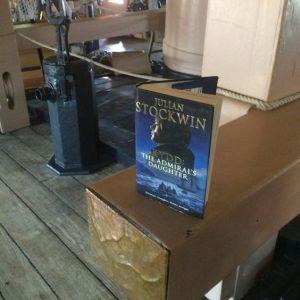
The Admiral’s Daughter at the main-mast bitts of HMS Victory
- ‘It is 1803, and Commander Thomas Kydd’s mission is to patrol home waters in order to suppress the smuggling trade. His friend Renzi joins him as captain’s clerk, also guiding Kydd’s steps in social situations when ashore. His coaching works well enough that Kydd attracts the interest of an admiral’s daughter, Persephone. The relationship develops to the degree that society assumes they will shortly become engaged. Then Kydd’s ship Teazer is damaged, and the ship must remain in an isolated Cornish cove for repairs. Kydd and Renzi lodge with the local squire, who unfortunately has a lovely, shy daughter, Rosalynd, and Kydd is again smitten. Word of his unfaithfulness reaches the admiral, who vows to bring about social and professional ruin for the man who has tarnished his family’s honor.
Fans of fast-paced adventure will get their fill with this book: there are at least four major plot threads. I enjoyed learning about naval lore, some of which this landlubber didn’t “get” when reading sea stories by other authors. There is a nice scene in which a sailor from the Teazer, working undercover to catch the smugglers, learns how difficult a fisherman’s life can be. One example of Stockwin’s humor is particularly appealing: “Commander Kydd, lord of sixteen guns and suzerain of near a hundred men, agreed meekly and followed his sister.”’ – Historic Novel Society
Listen to the book!
I’m very honoured and delighted to have the wonderful Christian Rodska narrating the audiobooks of the Kydd Series. These are available as audio downloads worldwide and also physical CDs (UK and Europe).
Fowey

Fowey from seaward
- ‘Fowey? Then I believe we’ll pay a visit, Mr Dowse.’ Fowey – Dowse had pronounced it ‘Foy’ – was one of the customs ports and well situated at the halfway point between Plymouth and the ocean‑facing port of Falmouth. They would no doubt welcome a call from the Navy and it was his [Kydd’s] duty to make himself known and check for orders.’ – The Admiral’s Daughter, chapter four
Fowey is a small town dating from medieval times at the mouth of the River Fowey in south Cornwall, England.
Its natural harbour allowed trade to develop with Europe and local ship owners often hired their vessels to the king to support various wars, although the town also developed a reputation for piracy, as did many in Kydd’s day.
If you’re visiting there’s a grand overview of the town and the magnificent harbour to be had with a stroll out along the Esplanade passing the grand parade of historic houses to the medieval St Catherine’s Castle which looks out over the harbour entrance and Readymoney Cove.
Kon Ni Chi Wa, Kydd!

Yoko Ohmori, Japanese translator of the book
One of the delights of being published around the world is seeing the various foreign language editions of my books. The Japanese edition is a delightful pocket-sized tome, read from the back to the front, of course! I was very happy to meet my Japanese translator Yoko Ohmori when she came to England a few years back. We retraced many of Kydd’s steps, visiting Plymouth, Polperro and other locations in the books. Yoko is a very experienced translator and extraordinarily, has sailed in tall ships herself across the Pacific.
Previous blog on The Admiral’s Daughter : THE ADMIRAL’S DAUGHTER: dangerous waters!
The cover of The Admiral’s Daughter is also available as a superb Limited Edition print
The Admiral’s Daughter has been published in the UK/US in English, in translated editions and in ebook, large print and audiobook.
Buy on Amazon or The Book Depository (free postage worldwide!) Also available at most bookstores.
Detailed list
Copyright notices
The Admiral’s Daughter aboard Victory by Paul Waite
Every effort is made to honour copyright but if we have inadvertently published an image with missing or incorrect attribution, on being informed of this, we undertake to delete the image or add a correct credit notice
 Julian Stockwin