
The Iberian Flame: Reader Reviewers Wanted!
Posted on April 24, 2018 3 Comments
The Iberian Flame is the next book in the Kydd series, out in June. Five Early Copies will be up for grabs for reader reviewers! For a chance to win one just email julian@julianstockwin.com with ‘Iberian Flame Reviewer’ in the subject line. Please include your full postal address. Deadline: May 7. The first five drawn out of the hat will be the winning copies and will go out mid-May.

Here’s a taster of the book:
1808. With the Peninsula in turmoil, Napoleon Bonaparte signs a treaty to dismember Portugal and put his brother, Joseph, on the throne of Spain. Meanwhile, Nicholas Renzi, the Lord Farndon, undertakes a deadly mission to stir up partisan unrest to disrupt this Napoleonic alliance with Spain.
Thrust into the crucible of the uprising, Captain Sir Thomas Kydd is dismayed to come up against an old foe from his past – now his superior and commander – who is determined to break him. Kydd will soon face the greatest decision of his professional career. Bonaparte, incensed by the reverses suffered to his honour, gathers together a crushing force and marches at speed into Spain. After several bloody encounters the greatly outnumbered British expedition have no option other than make a fighting retreat to the coast. Only the Navy can save them.
But the flame of insurrection has been lit – and the Peninsular War has begun.
‘Quarterdeck’ featured the book in the latest issue:
‘The Iberian Flame is classic Stockwin, driven by a gripping pace that begs the reader to turn page after page to learn what happens next. As with previous titles in the canon, the writing is strong, creating a delightful and ever-expanding historical canvas.’
(Download the magazine)
The Iberian Flame will be published in hardback, ebook and audio download on June 14 in the UK by Hodder & Stoughton. It will also be available in the States in ebook and audiodownload at that time, with the hardback coming out in August
BookPick: The Undersea World
Posted on March 16, 2018 Leave a Comment
Readers of the Kydd series will recall several mentions of machines that enable humans to swim with the fishes. In Invasion Kydd meets the gifted but enigmatic inventor Robert Fulton and his prototype submarine. And in Inferno Kydd himself braves the world beneath the waves in a diving contraption. I have warm memories of learning to scuba dive in the Philippines and thrown in free was an amazing close encounter with a twenty-ton whale shark! This month’s BookPicks focus on two different aspects of the undersea world, with a magnificent new book from Iain Ballantyne on the military deployment of submarines and a delightful little tome on the quest for treasure in shipwrecks. There’s also a special contest at the end of this blog for two lucky readers to win a copy of Ballantyne’s book.
— ♥ —
The Deadly Trade by Iain Ballantyne
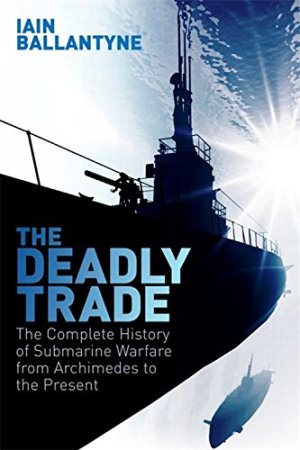 At over 700 pages, this thrilling narrative certainly justifies its subtitle: The Complete History of Submarine Warfare from Archimedes to the Present. Considered ineffectual and originally derided and loathed in equal measure – their crews viewed as no better than pirates – submarines have over the centuries evolved into the most powerful and terrifying vessels at sea, some carrying enough nuclear weapons to destroy mankind.
Using key episodes of submarine warfare – including the first sinking of a ship by a submersible during the American Civil War, the legendary struggles of WWI and WWII and the deadly shadow games of the Cold War Ballantyne’s history addresses not just how these vessels evolved but highlights the human cost of those who risked their lives under the sea, often with fatal consequences. The Deadly Trade also deals with the resurgence of submarines as political and military tools in recent conflicts.
Enhanced with well-chosen photographs and maps, along with comprehensive appendices and notes, this epic story should appeal not just to those who venture into Neptune’s Realm but students of history and politics – and any with a fascination for the efforts of dreamers and inventors over the ages.
Diving for Treasure by Vic Verlinden and Stefan Panis
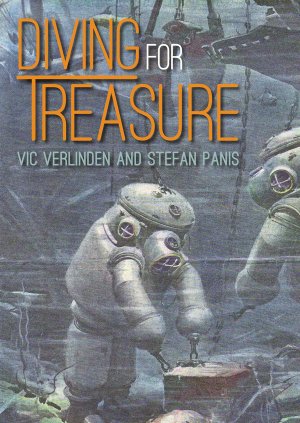 Having enjoyed reading Dive Scapa Flow I looked forward to this new diving book from Whittles Publishing. The authors, both skilled divers and underwater photographers, discuss seventeen undersea wrecks – presenting details and a brief history of each vessel, including the manner of their demise and the cargo they were carrying at the time.
Verlinden and Panis personally visited and photographed the wrecks and as many of the these lie at great depths diving on them posed considerable personal and technical challenges. It is sobering to note that salvage operations often extend over a long time – it took seven years to recover the bulk of the 43 tons (!) of gold aboard SS Laurentic.
This book will appeal to all those who venture into Neptune’s underwater realm, whether active or armchair, and to anyone with an interest in maritime/military history.
Win a copy of ‘The Deadly Trade’
For a chance to win a copy email julian@julianstockwin.com with the name of the maritime magazine which Iain Ballantyne edits.
Please include your full postal address.
Two winners will be drawn at random from all correct entries.
Deadline: Midnight GMT Thursday 22 March
Heave Ho for the Festive Season!
Posted on December 12, 2017 10 Comments
This year seems to have flown by – with two Kydd titles, Persephone and The Baltic Prize, published Kathy and I certainly have been kept busy. We’ve also managed a location research trip to the Netherlands and Belgium gleaning material for future books. Next year looks set to be just as hectic, also with two Kydd titles in the pipeline. As usual, there will be an offering of Collectors Sets for each book. I’ll be releasing details of these in due course but in the meantime you can register your interest by emailing me at the address below.
Coming next year
The Iberian Flame will be published on June 14 in the UK (a few months later in the US, Canada and Australia)
Here’s a taster of the book:
 1808. With the Peninsula in turmoil, Napoleon Bonaparte signs a treaty to dismember Portugal and put his brother, Joseph, on the throne of Spain. Meanwhile, Nicholas Renzi, the Lord Farndon, undertakes a deadly mission to stir up partisan unrest to disrupt this Napoleonic alliance with Spain. Thrust into the crucible of the uprising, Captain Sir Thomas Kydd is dismayed to come up against an old foe from his past – now his superior and commander – who is determined to break him. Kydd will soon face the greatest decision of his professional career.
Bonaparte, incensed by the reverses suffered to his honour, gathers together a crushing force and marches at speed into Spain. After several bloody encounters the greatly outnumbered British expedition have no option other than make a fighting retreat to the coast. Only the Navy can save them. But the flame of insurrection has been lit – and the Peninsular War has begun.
The second 2018 book is as yet untitled and will be published in October.
The Baltic Prize
I’ve been touched by your wonderful comments on this book. Here’s just three:
‘One of the best yet, a fabulous read. Next please.’
‘If you enjoy historical fiction books the man to be in awe of at the present is Julian Stockwin. His Thomas Kydd series is outstanding but what’s really amazing is that we are now on book 19 and it shows no sign of stagnating or slowing down its still as fresh and exciting as ever.’
‘A tremendously rousing nautical adventure.’
I always enjoy hearing from readers and will respond as soon as I can, usually within 48 hours. I can be contacted at this email or by snail-mail to Julian Stockwin, c/o Pawlyn & Co, 6 Costly St, Ivybridge, DEVON, PL21 0DB.
(The Baltic Prize is available in the States now as an ebook and will be out in hardback there on January 2.)
My blog on Christmas at Sea
And a Happy New Year to you all!
Books for Santa’s Sack 2017
Posted on November 14, 2017 2 Comments
I’m a bit of a bah humbug creature when it comes to the commercialisation of Christmas – but there’s one thing that I fervently believe: a book is a present that, if well chosen for the recipient, will give hours of pleasure and be a lasting reminder in itself of someone putting thought, not just money, into a Yuletide gift. So do consider adding some of these fine books – all with a maritime connection – to your gift-buying list. Hopefully, there’s something for everyone in this somewhat eclectic selection.
— ♥ —
Churchill and Fisher by Barry Gough
 At 600 pages this book is by far the lengthiest of my Christmas picks but will reward the reader’s investment in time with a dramatic narrative of two titans of the Admiralty locked in perilous destiny at the start of World War I. The author is a prize-winning historian and biographer, well fitted to undertake such a monumental saga, a story for the ages. For those wishing to delve deeper extensive references and an 18-page bibliography are provided.
Kings of the Sea by J D Davies
 Having enjoyed the author’s ‘Pepy’s Navy: The Ships, Men and Organisation’ I looked forward with anticipation to this new volume. The book is a fascinating journey into the world of the Stuart navy showing how the Kings of the Sea were absolutely central to the development of its ships, their deployment and the officer corps. This is the real beginning of what would become the greatest navy in the world.
Les bateaux de Ma Bibliothèque by Jean-Benoît Héron
 Published in French, this captivating little tome, ‘The boats of my library – From Noah’s Ark to Nautilus: the Most Famous Ships of Literature’ celebrates vessels created by authors such as Jules Verne, Patrick O’brian, Joseph Conrad – and includes, to my immense pleasure, HMS Duke William. Héron’s illustrations are lovingly and meticulously created, making the book a delight to dip into on a cold wintry night by the fire – even if your French is a bit rusty! A truly lovely production.
The Trafalgar Chronicle by Peter Hore
 The Trafalgar Chronicle, the yearbook of The 1805 Club, has established itself as a prime source of information for new research about the Georgian navy. Successive editors have widened the scope to include all sailing navies of the period. Each volume is themed, and this edition looks at the Royal Marines and the U.S. Marine Corps. Sixteen contributions from recognised authorities around the world make this a compelling read.
History of the Port of London by Peter Stone
 The River Thames has been integral to the prosperity of London since Roman times. Explorers sailed away from there on voyages of discovery to distant lands, colonies were established and a great empire grew. Funding their ships and cargoes helped make the City of London into the world’s leading financial centre. And in modern times the area was transformed into Docklands, a new heart of finance. A close-in view of the most famous seaport worldwide, the book will appeal to Londoners and also those outside the capital interested in Britain’s rich maritime heritage.
Last Voyage to Wewak by Simon J Hall
 The third in Simon Hall’s maritime trilogy, the book is an important historical record of life at sea during the last quarter of the 20th century, a way of life now vanished. The final crumbling of the British register caused officers like Hall to find themselves in a strange new world, sailing under flags of convenience with all the old certainties of life at sea having vanished. A sea tale that is both entertaining and poignant.
Still looking for bookish inspiration?
You might also like to take a peek at my other BookPicks this year this year
And if you’re looking for a Signed First Edition Kydd I still have a few assorted titles available (Kydd Club members are entitled to a 10% discount on all purchases; the discount will be refunded separately after purchase.) I’m happy to add a personal Christmas message. To ensure delivery in time for Christmas the deadline for orders is November 27. Don’t delay to avoid disappointment!
Agamemnon: the Darch Model
Posted on October 10, 2017 12 Comments
Devon-based Malcolm Darch has just completed a magnificent 1:64 scale model of HMS Agamemnon. His 57th commission, she was built for a private collector in the UK and just before she was shipped to her new home Kathy and I were honoured to be invited to a private viewing. I have had the privilege of seeing many fine ship models over the years but I have to say this one of Agamemnon is up there at the top, quite exquisite in appearance and the attention to the tiniest detail truly incredible. She’s a work of art in every sense, a unique homage to the beauty of the fighting ship under sail.
— ♥ —
From shipwright to model maker
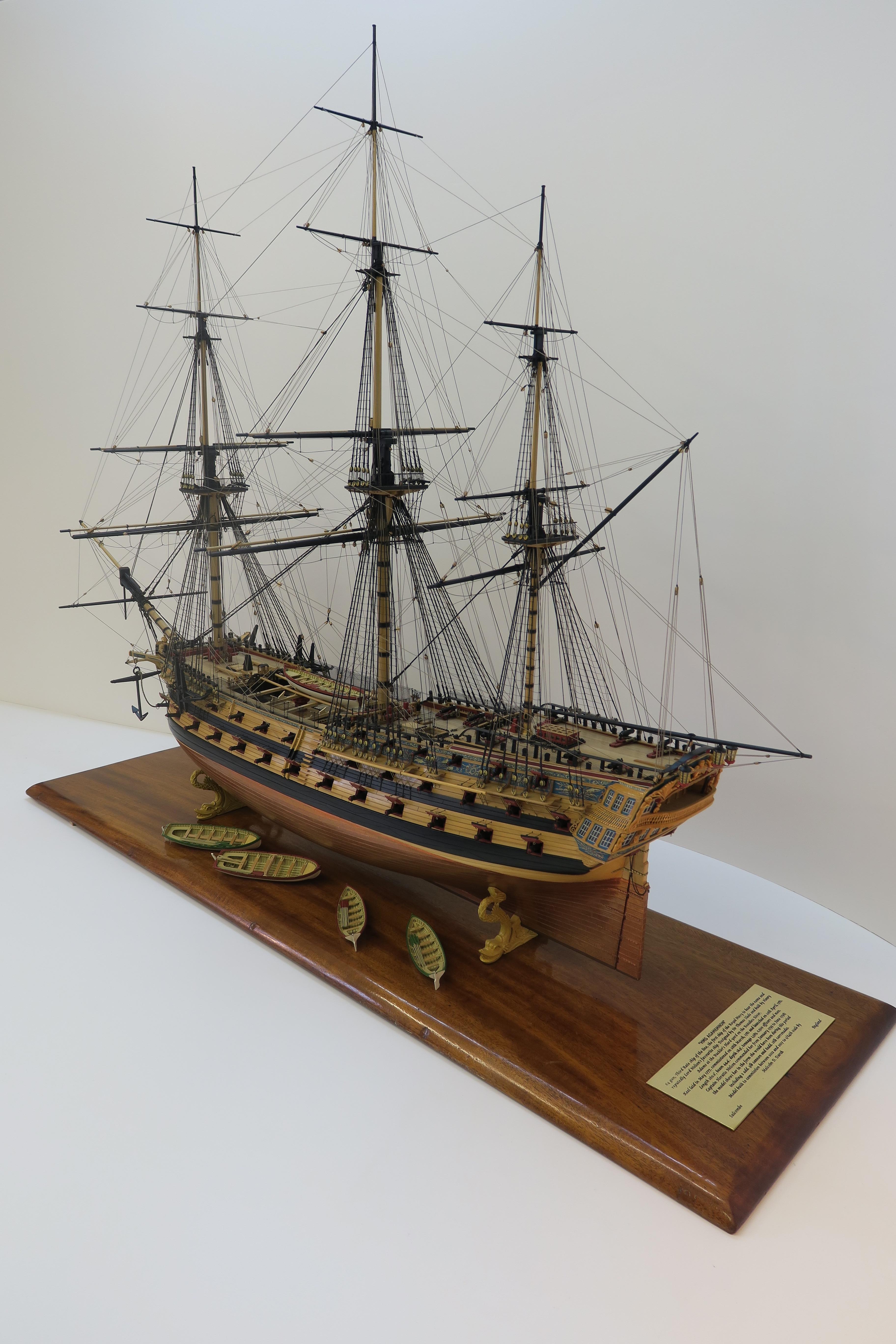
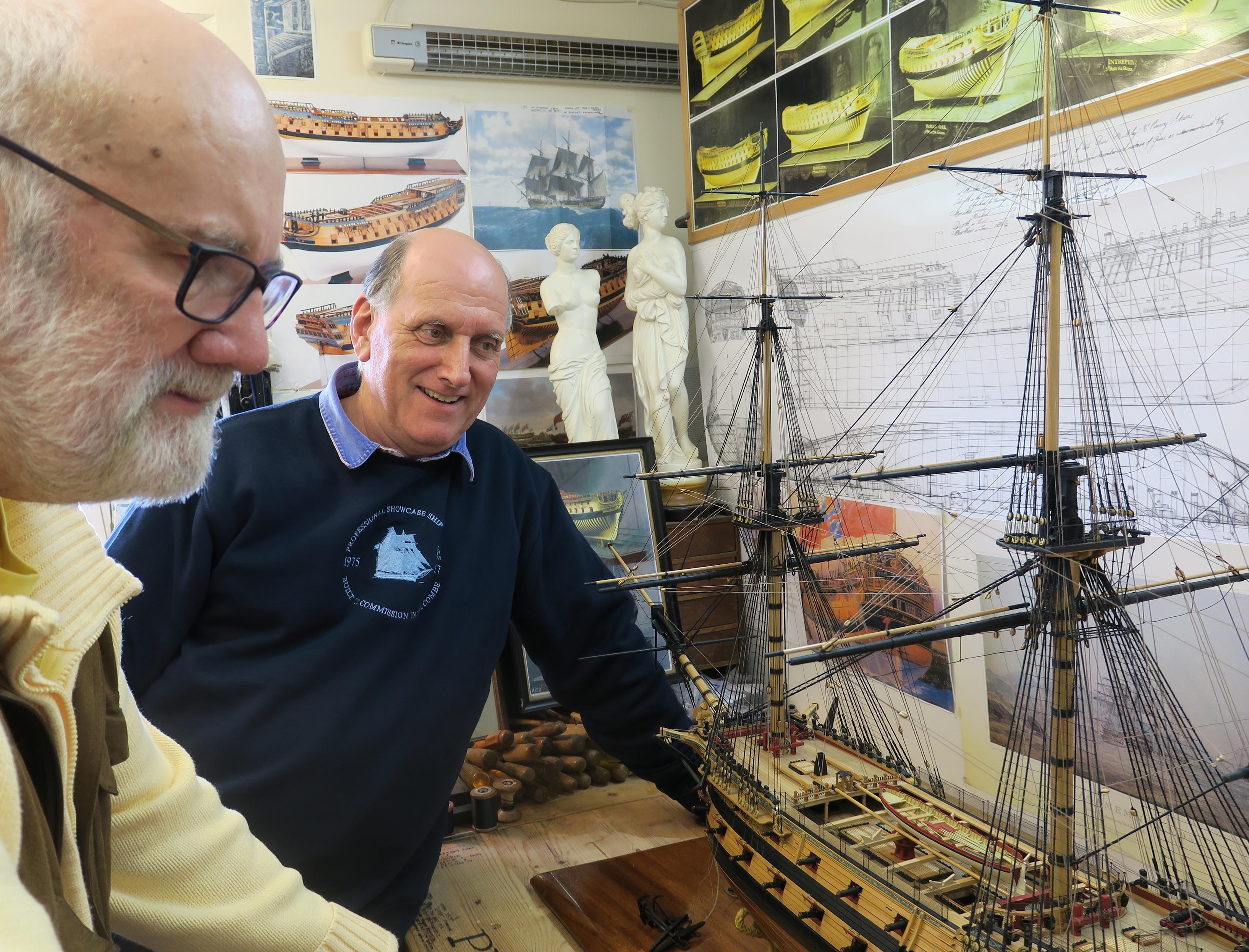
Malcolm trained as a shipwright (about the same time as myself) on the world-famous Hamble river in the 1960s. After ten years in the trade he started building showcase models in Salcombe, Devon, where he still works in a sun-lit studio on the waterfront. He specialises in 19th and early 20th century ship models. Malcolm’s previous works include the steel barques Moshulu and Pamir, Tern III, Claud Worth’s famous cruising yacht and the frigate Minerva of 1780. Most of Malcolm’s models are in private hands but several years ago he was commissioned to build 1.24th scale models of the local RNLI’s entire fleet (from 1869 to the present day) and these are on display at the Salcombe Lifeboat House Museum.
Nelson’s favourite
HMS Agamemnon was a 64-gun third-rate ship-of-the-line of the Royal Navy. She saw service in the American Revolutionary, French Revolutionary and Napoleonic Wars and fought in many of the major naval battles of those conflicts. She is remembered as being Nelson’s favourite ship and was named after the mythical ancient Greek king Agamemnon, the first ship of the Royal Navy to bear the name. To her crew she was known affectionately as ‘Eggs and Bacon’.
Nelson served as Agamemnon‘s captain from January 1793 for 3 years and 3 months, during which time she saw considerable service in the Mediterranean. After Nelson’s departure, she was involved in the 1797 mutinies at Spithead and the Nore, and in 1801 was present at the first Battle of Copenhagen, but ran aground before being able to enter the action.
She fought at the Battle of Trafalgar on 21 October 1805, as part of Nelson’s weather column, where she forced the surrender of the Spanish four-decker Santssima Trinidad. Agamemnon‘s later career was served in South American waters off Brazil.
Sadly she was wrecked in June 1809 on an uncharted shoal in the mouth of the River Plate, whilst seeking shelter with the rest of her squadron from a storm. Recently, the wreck of Agamemnon has been located, and several artefacts have been recovered, including one of her 24lb cannon.
Research, research, research
 Malcolm’s research for this project included assistance from the National Maritime Museum staff; Christine Hyack, a researcher at the National Archive; The National Maritime Museum; and Chatham Staff with their collection of ship models.
He also consulted the Archivist with the Montagu Estate at Bucklers hard, Agamemnon‘s place of build in 1781, though, the model is shown during the period of Nelson’s command 1793 to 1796. The Admiralty order to cease frieze painting came through in 1795, and so Agamemnon would have lost her decoration upon the vessel returning to England when she had to undergo a refit in 1796. The Admiralty order to rearm ships of the line with carronades on the poop deck was being considered in 1796. It was the client’s wish to include them, his being a student of Nelson’s career led him to feel that if Nelson could have managed to get hold of some, he was sure he would have, regardless of the ongoing discussions at the Admiralty.
The research (which took 8 months, before any timber was cut) included compiling a set of drafts for Agamemnon using copies of the original drafts of over half a dozen similar men-of-war. (No original drafts for Agamemnon have surfaced yet)
Peeking through the windows
One of the fascinating features of the model is the detail that can be viewed by peeking through the windows of the ship. The main gun deck, fully fitted out with rigged 24lb cannon, pumps, capstans ladders etc., are visible through the stern chase ports. The upper gun deck and quarter deck, likewise fully fitted out, are visible through the stern windows.
The rigging was spun by William Mowll of Kent on his model ropewalk to the required specifications of dimensions colour and lay. The model is made entirely of boxwood including all the figure carving and intricate mouldings.
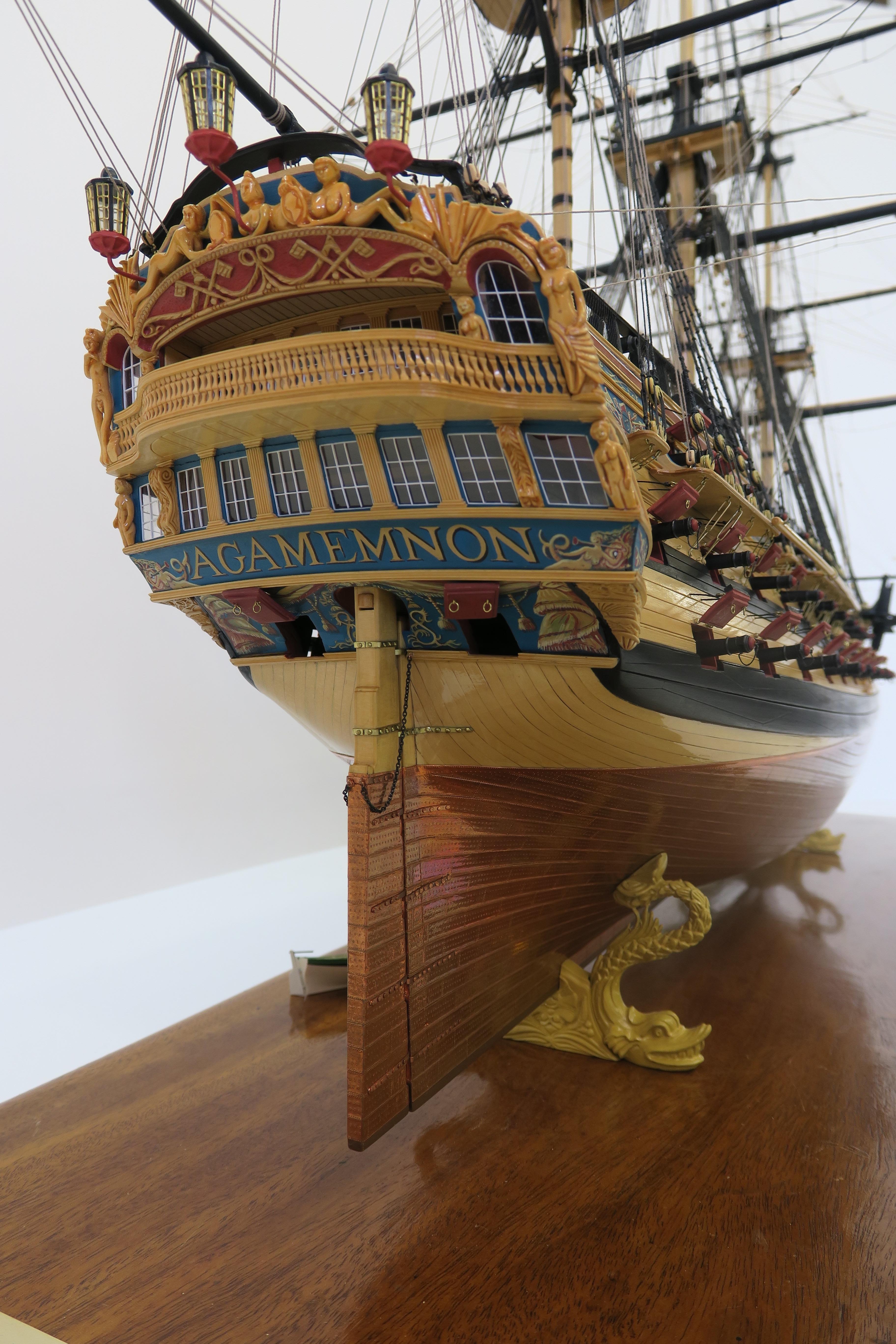
An ornate painted frieze runs the length of the vessel incorporating the story of Agamemnon and the Trojan wars brought about by his sister-in-law Helen being kidnapped by Paris and taken to Troy. The neo classical frieze (which gives the impression that the illustrations are in relief with the use of light & shaded colours) on the beak bulkhead contains images of the head of the wooden horse, also Achilles and Hector plus the usual rendering of weapons and flags. The frieze painting took 260 hours and wore out three 00000 sable brushes!
The figure carving. all in boxwood. incorporates Agamemnon as the figurehead, with the conception of Helen in the starboard trailboard at his feet (Leda & the Swan). The port trailboard shows his wife upon his return home after many years away fighting the war, about to kill him in the pool with a spear. She had taken a lover during his absence who persuaded her to do this terrible deed.
The stern carving was researched from a painting by Nicholas Pocock of the stern of the ship painted at Chatham in 1784 from life, whilst undergoing repairs for damage sustained at the Battle of the Saints two years earlier in the West Indies. The painting, an oil, was commissioned by Admiral Hood. It depicts Paris on the port quarter and Helen on the starboard quarter in all her beauty & finery. Three naked Trojan women hold aloft two silhouettes, one of George III and the other of his wife Charlotte. On the stern below are the usual female figures completing the stern figure decoration.
Many challenges
 The ship’s boats, the largest of which at this period was the 32 foot pinnace, is shown mounted on the model. The other four boats are mounted at each corner of the display plinth. The boats shown off the ship are the launch, a smaller pinnace and two cutters, a jollyboat had not been issued at this date. Nelson took Agamemnon from Portsmouth to the Mediterranean at the outbreak of war in 1793 and she did not return to England for 3 years, so in some respects she was a bit of a time capsule for 1793 with regard to her appearance, although she picked up her extra black banding above the original band, initially a narrow band then added to subsequently.
For Malcolm this model presented many challenges, especially as he built in an unorthodox manner so that internal detail could be shown on a rigged model. He told me that it was a bit like a Chinese puzzle to assemble, not being finally put together until shortly before rigging, including rigging the steering cables from tiller to wheels.
Hardest of the challenges was steaming the boxwood planking around the hard turns under the stern, just as the men of the day at Buckler’s Hard would have struggled, but being a fully qualified timber shipwright helped in the task. He also found assembling the complicated grating under the bowsprit very tricky & frustrating.
Eight months of initial research and 53 months of build time later the magnificent Darch Agamemnon model was completed. Having finished Agamemnon, his most difficult and the largest commission to date, Malcolm says he intends to concentrate on smaller projects in the future. His next commission is a trading smack crossing a square yard of 1811 vintage, built at his home port of Salcombe, and involved in supplying the Peninsular Campaign. I look forward to seeing her, too…
Bookpick: Something old, something new…
Posted on August 1, 2017 2 Comments
This selection spans two centuries – from the Napoleonic wars to the upcoming 100th anniversary of the shipwreck site of Scapa Flow. It includes two classics, recently reprinted, and brand new publications. Whether it’s an addition to your library or just a good holiday read, I hope there’s something for everyone in this special selection.
— ♥ —
Dive Scapa Flow by Rod Macdonald
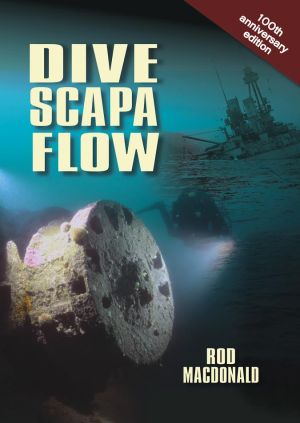 Although I’m a trained open water wreck Padi Diver I’ve never explored Scapa Flow, one of the world’s greatest wreck diving locations. It’s on the Bucket List! The scuttle of the 74 warships of the interned German High Seas Fleet at Scapa Flow on 21st June 1919 was the greatest act of maritime suicide the world has ever seen. And over the years many other vessels have come to grief there. Although recreational wreck diving in Scapa Flow is more than 40 years old, in the dark depths much still awaits exploration. This is a classic dive book updated and revised, and a fitting tribute to the memory of all those who perished in that body of water.
Chronometer Jack edited by Robin Craig, Ann Nic and Michael Nix
 John Miller was born in Edinburgh in 1802. His working life began aboard East India Company ships as a midshipman. He later owned his own trading vessels and settled for a time in Van Diemen’s Land (now Tasmania, and where I lived for a number of years…) when still a convict colony. When he and his family returned to Britain he joined the Coastguard. Many historical events are featured in this entertaining autobiography: opium smuggling in the 1820s; the foundation of the Royal Naval Reserve; Napoleon’s captivity on St Helena; the founding of Hong Kong and the cholera pandemic in Bombay. A compelling account of an extraordinary life.
Wellington’s Headquarters by S P G Ward
 A great insight into the structure and inner operation of the Duke of Wellington’s command during the Peninsular War. This classic study, first published over sixty years ago, describes the complicated tangle of departments that administered the army, departments which had grown up haphazard and survived virtually unchanged until the time of the Crimean War. Wellington adapted the existing system in order to turn it into an efficient instrument in the war against Napoleon, despite clashes of responsibility and personality that frustrated him and impaired the army’s performance on campaign. A must-read for all students of the period.
The Forgotten War Against Napoleon by Gareth Glover
 The campaigns fought against Napoleon in the Iberian peninsula, in France, Germany, Italy and Russia and across the rest of Europe have been described and analysed in detail, yet the history of the fighting in the Mediterranean has rarely been studied as a separate theatre of the conflict. Glover, a former Royal Navy officer, presents an insightful and absorbing account of the struggle on land and at sea for control of a region that was critical for the outcome of the Napoleonic Wars. An important contribution to our understanding of a fundamentally pivotal period in history.
Man of War by Anthony Sullivan
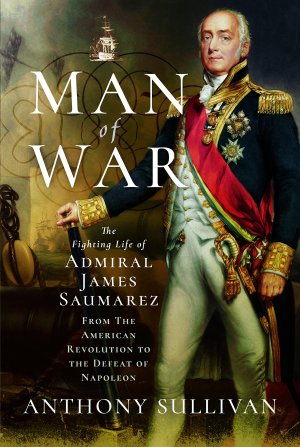 I have an abiding admiration for Guernsey-born Admiral James Saumarez and in fact dedicate my upcoming book The Baltic Prize (out in November) to this Royal Navy officer. His first battle was against the American revolutionaries in 1775, thereafter his main opponents were the French and the Spanish, and the first fighting ship he commanded, the eight-gun galley Spitfire, was involved in forty-seven engagements before being run aground. Rising through the ranks, Saumarez fought on land and at sea. He was involved in actions in the English Channel, served in HMS Victory, took part in the Battle of Cape St Vincent, the Blockade of Cadiz, and was with Nelson at the Battle of the Nile. Promoted to Rear Admiral, he led his ships at the battles of Algeciras and the Gut of Gibraltar. Saumarez was then despatched into the Baltic, where he was crucial in keeping open Britain’s last vital trade route by an astute combination of diplomacy and a mailed fist. A fascinating biography of a hero by anyone’s estimate of the Great Age of Fighting Sail.
Still looking for bookish inspiration?
You might also like to take a peek at my other BookPicks this year this year
And I have a very limited number of Signed First Editions, which I’m happy to inscribe with a personal message
Enjoy!
The Baltic Prize Collectors Set
Posted on July 18, 2017 16 Comments
This year there’ll be a second title and therefore another Kydd Series Collectors Set, The Baltic Prize. These signed, numbered and embossed First Edition Sets are strictly limited in number to 500 only. I’m happy to write a short dedication on request. The Subscription list is filling rapidly so if you’re interested don’t delay to avoid disappointment. Payment is via the links here
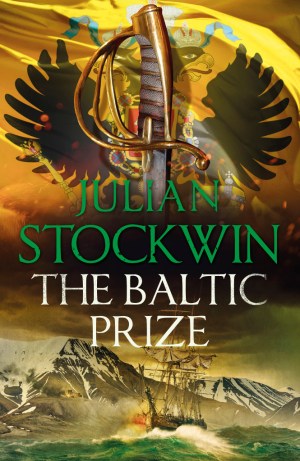
Here’s what two of my editors said of the manuscript of The Baltic Prize:
‘Another brilliant yarn, set against a series of terrific northern backdrops, full of suspense. Many congratulations – I’m sure that hosts of readers will be as enthralled by this one as I was.
‘Many thanks for another superb Kydd outing. As usual you have mixed fascinating historical detail with stirring action and characterisation.’
And here’s a taster…
1808. Parted from his new bride, Captain Sir Thomas Kydd is called away to join the Northern Expedition to Sweden, now Britain’s only ally in the Baltic. Following the sudden declaration of war by Russia and with the consequent threat of the czar’s great fleet in St Petersburg, the expedition must defend Britain’s dearly-won freedom in the those waters.
However Kydd finds his popular fame as a frigate captain is a poisoned chalice; in the face of jealousy and envy from his fellow captains, the distrust of the commander-in-chief and the betrayal of friendship by a former brother-in-arms now made his subordinate, can he redeem his reputation?
In an entirely hostile sea Tyger ranges from the frozen north to the deadly confines of the Danish Sound – and plays a pivotal role in the situation ensuing after the czar’s sudden attack on Finland. This climaxes in the first clash of fleets between Great Britain and Russia in history. To the victor will be the prize of the Baltic itself!
The Baltic Prize will be published in hardback, ebook and audio download November 2 in the UK by Hodder & Stoughton. It will also be available in the States in ebook and audiodownload at that time, with the hardback coming out there on January 2.
Researching the Kydd Novels #7
Posted on July 10, 2017 2 Comments
One of the elements of writing my Kydd tales that I particularly enjoy is the research, and it’s one of the things I’m most questioned about when I give talks or do author signings. There are many aspects of this – consulting primary and secondary sources, speaking to experts, undertaking location research, visiting museums and archives. I’m often asked about the length of time research for a book takes – that’s a difficult thing to quantify because in some ways I guess I have been doing it subconsciously all my life – during my years at sea absorbing the universals all mariners hold dear – and ingesting material from countless maritime books, both fiction and non-fiction, that I’ve been drawn to from an early age.
In Home Waters!

Off Polperro with Bill Cowan
It wasn’t until The Admiral’s Daughter that I set a whole Kydd book in home waters – and I found it as wild and exotic a location as any – with spectacles such as the Plymouth naval base and dockyard, employing many thousands of men, a wonder of the age that drew visitors from around the UK and across the world, including a young Princess Victoria!
On location research for this book Kathy and I stayed in Polperro in Cornwall, an eighteenth-century smuggler’s cottage right on the little harbour. Space precludes me mentioning all the townspeople who assisted with research but I am particularly indebted to ex-fisherman Bill Cowan and former harbour-master Tony White. And the Trustees of the Polperro Heritage Museum very generously opened it up for me out of its official season. Located in the Warren overlooking the harbour, the museum houses a remarkable collection of both smuggling and fishing memorabilia. Well worth a visit!
Other books in the Kydd series deal with the British Isles to a greater or lesser extent and their research has taken me to many and varied domestic locales.
Kydd’s hometown is Guildford in the county of Surrey and living there myself gave me an appreciation of such landmarks as The Castle and The River Wey, which are mentioned in the books.
Further afield my research has seen me deep in the secret bowels of Dover Castle, in the footsteps of the maverick American inventor Robert Fulton, thanks to the kind permission of English Heritage.
In Portsmouth the then curator of HMS Victory Peter Goodwin honoured me with several personal tours of that splendid vessel. And not forgetting the capital, visits to meet my publisher and agent there have always seen the Stockwins stepping out through areas of Georgian London familiar to Kydd and Renzi.
Researching the Kydd Novels #5
Posted on July 8, 2017 2 Comments
One of the elements of writing my Kydd tales that I particularly enjoy is the research, and it’s one of the things I’m most questioned about when I give talks or do author signings. There are many aspects of this – consulting primary and secondary sources, speaking to experts, undertaking location research, visiting museums and archives. I’m often asked about the length of time research for a book takes – that’s a difficult thing to quantify because in some ways I guess I have been doing it subconsciously all my life – during my years at sea absorbing the universals all mariners hold dear – and ingesting material from countless maritime books, both fiction and non-fiction, that I’ve been drawn to from an early age.
Passport Stamps: North America and Canada
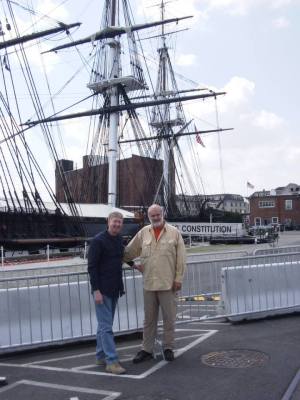
With George Jepson at USS Constitution
Location research for my Kydd tales has taken me to North America and Canada. In the States I was delighted to renew my acquaintance with George Jepson, editor of Quarterdeck magazine; we met up in Boston to pay homage to USS Constitution, one of the original six heavy frigates of the United States Navy (Kydd in Quarterdeck finds himself aboard Constellation in the heady days of the birth of the navy).
In Halifax I was able to get a real feel for the frontier town that it was in Kydd’s day at the many museums the city boasts. The splendid Maritime Museum of the Atlantic was well worth the time I spent there! I also visited with great interest the York Redoubt, a 200-year-old fortification on a high bluff overlooking the entrance to Halifax Harbour, the wilderness area of Chebucto Peninsula and MacNabbs Island.
And what are the odds of coming across a signal book actually belonging to a lieutenant on the North American station at exactly the same time as I need Kydd to learn his craft as a signal lieutenant there? Retired Paymaster Commander William Evershed generously extended a loan of the precious family relic for me to study.
Researching the Kydd Novels #4
Posted on July 7, 2017 Leave a Comment
One of the elements of writing my Kydd tales that I particularly enjoy is the research, and it’s one of the things I’m most questioned about when I give talks or do author signings. There are many aspects of this – consulting primary and secondary sources, speaking to experts, undertaking location research, visiting museums and archives. I’m often asked about the length of time research for a book takes – that’s a difficult thing to quantify because in some ways I guess I have been doing it subconsciously all my life – during my years at sea absorbing the universals all mariners hold dear – and ingesting material from countless maritime books, both fiction and non-fiction, that I’ve been drawn to from an early age.
Passport Stamps

Kathy checks the guidebook in Malta
Location research for my Kydd tales has taken me all over Europe – Spain, Portugal, France, Sweden, Finland, Turkey, Gibraltar, Malta, Denmark – and a number of other countries as well, such as Canada, the Caribbean and Iceland. My father-in-law in Tasmania has a wall map with a pin in every location Kathy and I visit!
On these visits the main challenge for me is to strip away the trapping of the 21st century and in my mind’s eye go back to the eighteenth and early nineteenth centuries. In quite a few instances there are enough old buildings/streets etc. to facilitate this. In some places, however, appearances have radically changed – seafront areas have been reclaimed, buildings of the Georgian era either flattened in war or demolished to build skyscrapers, making my task more difficult. Local archives are invaluable if this is the case, with their carefully preserved street maps and architectural drawings, as are contemporary paintings from my period of interest.
On these research trips I always try to get out on the water to look back at places from seaward to get an idea of what Kydd would have glimpsed as he came to rest at anchor. For this I use my invaluable research camera which not only takes the GPS co-ordinates of where a picture is taken but the direction I was facing and even the altitude!
I’ve spent time sailing in the Mediterranean in a variety of craft, and, most recently, around the Baltic for my upcoming book The Baltic Prize, which is published in November.
And of course there are some magnificent maritime museums to be found – and I’ve spent many happy hours engrossed within their walls.
Here are just a few of the ones I’ve visited recently:
 Julian Stockwin