
Win The Baltic Prize!
Posted on September 5, 2017 2 Comments
The Baltic Prize will be the next title in the Kydd Series. In the run-up to the official launch of The Baltic Prize on November 2 we’re holding a special contest for a prize of an early copy of the book. There will be five winners!
To enter, email julian@julianstockwin.com with the name of the birth town of Thomas Kydd. Please include your full postal address and ‘Baltic Prize Contest’ in the subject line. Five winners will be drawn on September 25 and notified by email
Here’s what two of my editors said of the manuscript of The Baltic Prize:
‘Another brilliant yarn, set against a series of terrific northern backdrops, full of suspense. Many congratulations – I’m sure that hosts of readers will be as enthralled by this one as I was.’
‘Many thanks for another superb Kydd outing. As usual you have mixed fascinating historical detail with stirring action and characterisation.’
The Baltic Prize
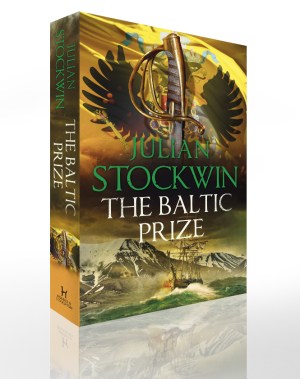 1808. Parted from his new bride, Captain Sir Thomas Kydd is called away to join the Northern Expedition to Sweden, now Britain’s only ally in the Baltic. Following the sudden declaration of war by Russia and with the consequent threat of the czar’s great fleet in St Petersburg, the expedition must defend Britain’s dearly-won freedom in the those waters.
However Kydd finds his popular fame as a frigate captain is a poisoned chalice; in the face of jealousy and envy from his fellow captains, the distrust of the commander-in-chief and the betrayal of friendship by a former brother-in-arms now made his subordinate, can he redeem his reputation?
In an entirely hostile sea Tyger ranges from the frozen north to the deadly confines of the Danish Sound – and plays a pivotal role in the situation ensuing after the czar’s sudden attack on Finland. This climaxes in the first clash of fleets between Great Britain and Russia in history. To the victor will be the prize of the Baltic!
The Baltic Prize will be available in hardback, ebook and audio download.
It will be launched at a special event at The Hayridge, Cullompton on November 2. Full details will be announced closer to the time.
The book will be available to purchase in the UK on November 2
And in the US on January 2, 2018
You can also purchase at Book Depository, with FREE POSTAGE worldwide
Salute the Good Ship Vega!
Posted on August 29, 2017 3 Comments
 Since first hearing of the work of Shane Granger & Meggi Macoun aboard Vega several years ago I’ve followed their work with growing admiration for what two people can do to really make a difference. Vega is a 125-year-old Hardanger-built Norwegian sailing cargo vessel.
The great tsunami of 2004 was the catalyst for Vega‘s humanitarian mission. Shane and Meggi were in Langkawi, Malaysia, when the disaster struck; they undertook to carry food and medical supplies to communities along the hardest hit western coast of Sumatra. What started as a modest effort assisting a single island has grown to the delivery of some twenty tons of urgently needed supplies every year. This is coupled with eye testing and distribution of reading glasses, and other vital work. Since starting their work they have sailed around 110,000 miles to deliver 250 tons of aid to some of the most remote islands in Southeast Asia. They currently provide 122 traditional midwives, 9 small clinics and 18 health posts with equipment, medical supplies and training. They directly assist 34 communities and have an impact on the education of 15,000 young people. Ninety-three percent of the cash donations they receive goes directly into the hands of those who need help in the form of tools, medical supplies and other goods.
I’m delighted Shane has agreed to take time from his busy schedule to answer questions for this Guest Blog.
Can you describe the various activities scheduled for this year
 2017 marks the 13th year Vega has been delivering educational and medical supplies to the remote island communities of Eastern Indonesia and East Timor. Although our efforts have been successful – in some cases maternal and natal mortality rates have fallen by over 50% – there is still much that needs to be done. Providing vegetable seeds helps to improve a community’s diet. Environmental education is aiding communities address the growing issue of waste management. To that must be added the fact we need to do serious refitting above deck on Vega this year. This is work that will require some very creative financial efforts since Meggi and I are not wealthy and depend on the good will of others to continue our work.
Our normal yearly schedule is divided into two parts. From roughly mid October until May we are busy between Jakarta, Singapore, Malaysia, and Thailand doing maintenance, visiting boat shows, and sourcing the supplies we need for our next deliveries. From June to October we are usually out making our deliveries. This year is different. Due to the need for refitting we will be cutting short our delivery period to each island so that the latter half of September and the first half of October can be dedicated to needed repairs.
What are the challenges involved with keeping Vega seaworthy?
 Every year the 125-year-old historic vessel Vega sails around 7,500 miles to collect the supplies needed and then deliver them. That means Vega must be kept in serious sea worthy condition. Maintenance is a constant ongoing effort. Supplies needed to maintain Vega, like Stockholm Tar and real marline twine, are often impossible to find and a source of constant anguish.
Without the invaluable help of our extensive group of friends, keeping Vega sea worthy would not be possible. Being retired, Meggi and I are not wealthy and Vega is all we have. When something breaks replacing it is often a stressful experience. That said, it seems every time we find ourselves in another pickle someone steps round the corner, takes a look, and says, ‘Looks like your furbisher tube is discombubbled at the widget joint. Lucky for you my brother’s company makes those things.’
What has been the most rewarding moment or moments for you over the years?
 There are so many special moments during our deliveries that selecting one as the most rewarding is impossible. Imagine the smile on an elderly woman whose vision, and profession as a weaver, were restored by a simple pair of reading glasses or a young girl trembling with excitement as she received a new back pack filled with school supplies, or the traditional rural midwife sitting on Vega‘s deck cradling a new neo-natal resuscitator, tears flowing down her cheeks, as she searched through the complete midwife kit we brought her.
Tell me about Scourge…
 No traditional sailing vessel is complete without a ship’s cat. Seven years ago while making repairs in Singapore, Meggi found a tiny lost kitten and promptly brought her on board. Eventually we named her Scourge. Since then Scourge has decided Vega is hers, allowing us to empty the littler box and provide her with water and food, until she discovers how to hunt the yellow plastic bags of her favorite cat food. When the seas are rough she first complains vociferously then curls into a snug place and sleeps. An adventurous creature, she once attacked a halyard fast playing out as the sail came down. Launching herself at it she soon had her claws dug in. The first we knew of this was a mournful howl of anguish from half way up the mast.
As a young cat she once fell in the water while we were at dock. One of our crew bravely dove in to rescue her. As he approached she swam his way then clambered onto the top of his head – claws and all. She remained perched there clawing the lad’s scalp until he was safely back on deck then dove down below and wasn’t seen for ages.
She’s a real character: an artist friend of ours is creating a comic book about Vega from her point of view.
Your work now involves training of health professionals. Can you elaborate on this?
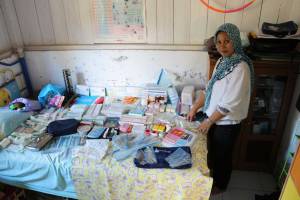 Training for traditional midwives and health workers is an important part of improving an island’s health services. Since Meggi and I are not health professionals, we try our best to find Indonesian doctors who are willing to take part in our adventures. Their job is to hold clinic on the islands and provide training for the local midwives and health workers. Often the doctor we bring is the first ‘real’ doctor to set foot on those islands. The entire village turns out, usually just to say they saw the doctor.
 Reading glasses are another part of our program where a modest investment provides major returns. Older people are an important resource for these small communities. They are often the most experienced island artisans. As their eyesight begins to fail their ability to contribute to the well being of family and community diminishes. This problem can usually be cured by an inexpensive pair of reading glasses. Over the years we have developed a simple test to determine the proper strength of glasses needed. We teach local health workers how to administer that test, then leave them with an appropriate stock of reading glasses.
Anything you’d like to add?
Vega is small, but highly efficient, ‘Mom & Pop’ charity. There are no big companies throwing money at us. We accomplish what we do thanks to a large network of friends who, like us, want to make the world a little bit better. Those friends are the real heroes who help us keep Vega afloat and provide the supplies for us to deliver.
If you’d like to follow Vega‘s adventures do visit and ‘like’ their FaceBook page Historic Vessel Vega – as well as updates on their work Shane and Meggi have posted many photographs and a number of videos.
Please consider helping their work by making a donation via Paypal through their website
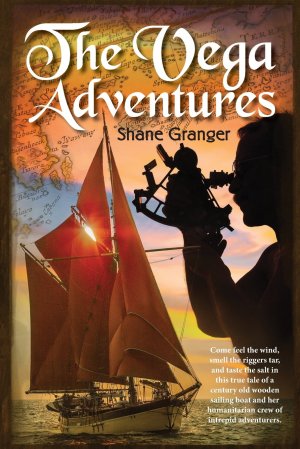
Shane has written a book, The Vega Adventures, which I thoroughly enjoyed reading
You can buy the book at Amazon UK, Amazon US or at Book Depository (free shipping worldwide)
Proceeds from all book sales help support their vital work
Fest-14: – Caribbee
Posted on August 15, 2017 4 Comments
 Over previous months I’ve been celebrating the earlier titles in the Kydd Series, it’s Caribbee for this blog. I’d love to hear your thoughts on the book, either as a first-time reader or if you’re a re-reader and have read it more than once! It’s very gratifying for an author to be told that his work has inspired people to go back and read it again. And some of you have told me you have done this more than twice! Either reply to this blog or email me with your thoughts on Caribbee. Kathy and I are always very busy on location research for the Kydd books and our trip to the West Indies was no exception. We spent most time in three main locations – Jamaica, Guadeloupe and Antigua – but as you can see, there was the odd moment of relaxation (see if you can spot Kathy’s foot…)
This book has generated a number of wonderful reviews. Here are just two:
‘In the first book in his series of Kydd and Renzi tales Kydd was a young Guildford wigmaker who was taken by the press gang to serve as a sailor in the Royal Navy. The basic idea behind the stories was unique, featuring two young men from very different backgrounds who came together as tie mates. Previously, all of the great fictional stories set in the naval world of the French Revolutionary Wars and the Napoleonic Wars featured a hero who began as a Midshipman and rose through the Commissioned ranks to Post Captain or Admiral. Forrester, Kent, Pope, O’Brian all wrote outstanding tales around their commissioned heroes and entertained generations, prompting films based on their writing. From an unique starting point, Stockwin has become another member of the band of naval fiction writers who have achieved the highest standards of story telling. This story in the series is yet another compulsive page turner that will sell very well, attract new readers, and reward loyal fans. In this tale, Kydd is now a Post Captain in command of a light frigate L’Aurore with his old friend Renzi still at his side as Captain’s Secretary, a retired naval officer striving to become an author. In this tale Renzi is again playing the spy and the ship and her people have reached the Caribbean after their adventures in South America with the expedition to liberate Spanish colonies. Kydd has been sent to the Caribbean to plead for reinforcements to enable the success of the expedition. Fate takes a different hand and our heroes are plunged into a new set of adventures with highs and lows worthy of Stockwin’s style and earlier books.’ — Firetrench

CARIBBEE on the decks of HMS Victory
‘A plot rich in sailing lore, pirate raids, vengeful spies, and shipboard discontent enlivens Julian Stockwin’s fourteenth book in the Thomas Kydd series, Caribbee. Assigned to the Leeward Islands of the early nineteenth-century Caribbean, Captain Kydd commands L’Aurore, a frigate of the British Royal Navy. Returning to this idyllic archipelago rekindles memories of youthful experiences for Kydd and his trusted friend and confidential secretary, Nicholas Renzi. Their ship cruises the waters, searching for pirate ships intent on robbing British vessels of cane sugar destined for European markets. Suspected French naval presence in the islands may mean retaliatory action spurred by Admiral Horatio Nelson’s victory at Trafalgar.
A parallel plot involves the tyrannical captain of another British ship whose crew threatens mutiny. In pursuit of French ships during a hurricane, a shattered mast leaves L’Aurore at the storm’s mercy. Stockwin skillfully describes the high drama of captain and crew working to save themselves and the ship. Using a seaman’s instinctual sixth sense, Kydd pictures the tautly spread awning on the ship’s quarterdeck while at anchor and realizes it can be used as a sail.
Colourful, well-drawn characters of all types contribute to this book’s appeal. Stockwin’s skill with characterization serves him equally well in the female character of Madame Louise Vernou, a friend of Renzi’s from earlier visits to Guadeloupe. Renzi enlists Louise’s help, and her determined spirit helps them infiltrate the elusive French spy ring. Seeing the local grocer taking food daily to the nearby island of Marie Galante, Louise suggests a plan: “I will supply them with the gourmandises every French man desires. You will be my porter.”
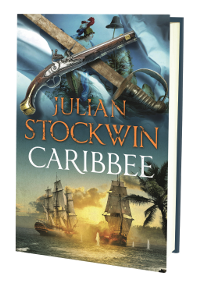 Elements of good fiction and historical fact meld in Caribbee. Logical scene transitions, subtle foreshadowing of events, believable character interaction, and a satisfying conclusion to the plot all contribute to the book’s readability. The author’s endnotes explain the political and cultural atmosphere of the English Caribbean islands of Georgian times, as does a glossary of words related to naval and economic activities.’ — Foreword
And have you tried the Stockwin Signature Rum Punch?
One part sour (lemon or lime juice)
Two parts sweet (sugar or syrup)
Three parts strong (dark rum)
Four parts weak (water)
Grated nutmeg to taste
Serve well chilled with ice
Be warned; they’re addictive!
Previous blog on Caribbee CARIBBEE: A return to turquoise seas
CARIBBEE has been published in the UK/US in English, in translated editions and in ebook, large print and audiobook.
Buy on Amazon or The Book Depository (free postage worldwide!) Also available at most bookstores.
Detailed list
Bookpick: Something old, something new…
Posted on August 1, 2017 2 Comments
This selection spans two centuries – from the Napoleonic wars to the upcoming 100th anniversary of the shipwreck site of Scapa Flow. It includes two classics, recently reprinted, and brand new publications. Whether it’s an addition to your library or just a good holiday read, I hope there’s something for everyone in this special selection.
— ♥ —
Dive Scapa Flow by Rod Macdonald
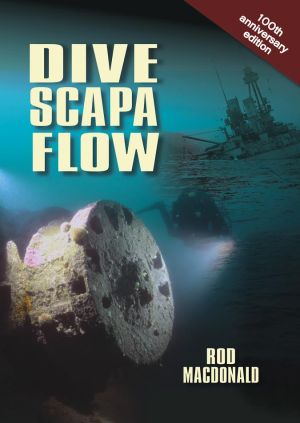 Although I’m a trained open water wreck Padi Diver I’ve never explored Scapa Flow, one of the world’s greatest wreck diving locations. It’s on the Bucket List! The scuttle of the 74 warships of the interned German High Seas Fleet at Scapa Flow on 21st June 1919 was the greatest act of maritime suicide the world has ever seen. And over the years many other vessels have come to grief there. Although recreational wreck diving in Scapa Flow is more than 40 years old, in the dark depths much still awaits exploration. This is a classic dive book updated and revised, and a fitting tribute to the memory of all those who perished in that body of water.
Chronometer Jack edited by Robin Craig, Ann Nic and Michael Nix
 John Miller was born in Edinburgh in 1802. His working life began aboard East India Company ships as a midshipman. He later owned his own trading vessels and settled for a time in Van Diemen’s Land (now Tasmania, and where I lived for a number of years…) when still a convict colony. When he and his family returned to Britain he joined the Coastguard. Many historical events are featured in this entertaining autobiography: opium smuggling in the 1820s; the foundation of the Royal Naval Reserve; Napoleon’s captivity on St Helena; the founding of Hong Kong and the cholera pandemic in Bombay. A compelling account of an extraordinary life.
Wellington’s Headquarters by S P G Ward
 A great insight into the structure and inner operation of the Duke of Wellington’s command during the Peninsular War. This classic study, first published over sixty years ago, describes the complicated tangle of departments that administered the army, departments which had grown up haphazard and survived virtually unchanged until the time of the Crimean War. Wellington adapted the existing system in order to turn it into an efficient instrument in the war against Napoleon, despite clashes of responsibility and personality that frustrated him and impaired the army’s performance on campaign. A must-read for all students of the period.
The Forgotten War Against Napoleon by Gareth Glover
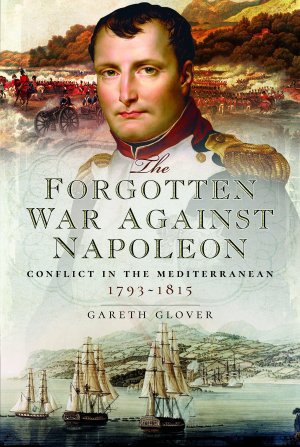 The campaigns fought against Napoleon in the Iberian peninsula, in France, Germany, Italy and Russia and across the rest of Europe have been described and analysed in detail, yet the history of the fighting in the Mediterranean has rarely been studied as a separate theatre of the conflict. Glover, a former Royal Navy officer, presents an insightful and absorbing account of the struggle on land and at sea for control of a region that was critical for the outcome of the Napoleonic Wars. An important contribution to our understanding of a fundamentally pivotal period in history.
Man of War by Anthony Sullivan
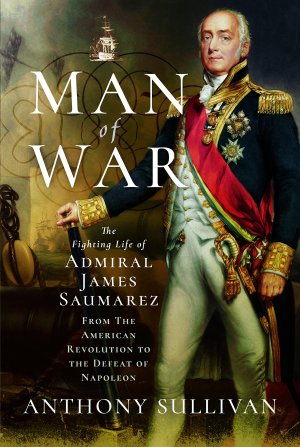 I have an abiding admiration for Guernsey-born Admiral James Saumarez and in fact dedicate my upcoming book The Baltic Prize (out in November) to this Royal Navy officer. His first battle was against the American revolutionaries in 1775, thereafter his main opponents were the French and the Spanish, and the first fighting ship he commanded, the eight-gun galley Spitfire, was involved in forty-seven engagements before being run aground. Rising through the ranks, Saumarez fought on land and at sea. He was involved in actions in the English Channel, served in HMS Victory, took part in the Battle of Cape St Vincent, the Blockade of Cadiz, and was with Nelson at the Battle of the Nile. Promoted to Rear Admiral, he led his ships at the battles of Algeciras and the Gut of Gibraltar. Saumarez was then despatched into the Baltic, where he was crucial in keeping open Britain’s last vital trade route by an astute combination of diplomacy and a mailed fist. A fascinating biography of a hero by anyone’s estimate of the Great Age of Fighting Sail.
Still looking for bookish inspiration?
You might also like to take a peek at my other BookPicks this year this year
And I have a very limited number of Signed First Editions, which I’m happy to inscribe with a personal message
Enjoy!
The Baltic Prize Collectors Set
Posted on July 18, 2017 16 Comments
This year there’ll be a second title and therefore another Kydd Series Collectors Set, The Baltic Prize. These signed, numbered and embossed First Edition Sets are strictly limited in number to 500 only. I’m happy to write a short dedication on request. The Subscription list is filling rapidly so if you’re interested don’t delay to avoid disappointment. Payment is via the links here
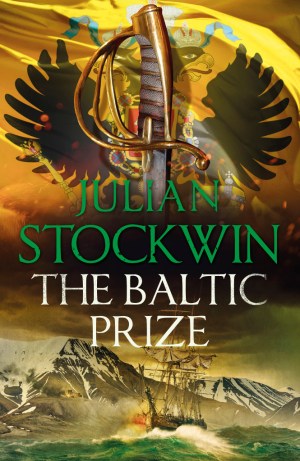
Here’s what two of my editors said of the manuscript of The Baltic Prize:
‘Another brilliant yarn, set against a series of terrific northern backdrops, full of suspense. Many congratulations – I’m sure that hosts of readers will be as enthralled by this one as I was.
‘Many thanks for another superb Kydd outing. As usual you have mixed fascinating historical detail with stirring action and characterisation.’
And here’s a taster…
1808. Parted from his new bride, Captain Sir Thomas Kydd is called away to join the Northern Expedition to Sweden, now Britain’s only ally in the Baltic. Following the sudden declaration of war by Russia and with the consequent threat of the czar’s great fleet in St Petersburg, the expedition must defend Britain’s dearly-won freedom in the those waters.
However Kydd finds his popular fame as a frigate captain is a poisoned chalice; in the face of jealousy and envy from his fellow captains, the distrust of the commander-in-chief and the betrayal of friendship by a former brother-in-arms now made his subordinate, can he redeem his reputation?
In an entirely hostile sea Tyger ranges from the frozen north to the deadly confines of the Danish Sound – and plays a pivotal role in the situation ensuing after the czar’s sudden attack on Finland. This climaxes in the first clash of fleets between Great Britain and Russia in history. To the victor will be the prize of the Baltic itself!
The Baltic Prize will be published in hardback, ebook and audio download November 2 in the UK by Hodder & Stoughton. It will also be available in the States in ebook and audiodownload at that time, with the hardback coming out there on January 2.
Researching the Kydd Novels #7
Posted on July 10, 2017 2 Comments
One of the elements of writing my Kydd tales that I particularly enjoy is the research, and it’s one of the things I’m most questioned about when I give talks or do author signings. There are many aspects of this – consulting primary and secondary sources, speaking to experts, undertaking location research, visiting museums and archives. I’m often asked about the length of time research for a book takes – that’s a difficult thing to quantify because in some ways I guess I have been doing it subconsciously all my life – during my years at sea absorbing the universals all mariners hold dear – and ingesting material from countless maritime books, both fiction and non-fiction, that I’ve been drawn to from an early age.
In Home Waters!

Off Polperro with Bill Cowan
It wasn’t until The Admiral’s Daughter that I set a whole Kydd book in home waters – and I found it as wild and exotic a location as any – with spectacles such as the Plymouth naval base and dockyard, employing many thousands of men, a wonder of the age that drew visitors from around the UK and across the world, including a young Princess Victoria!
On location research for this book Kathy and I stayed in Polperro in Cornwall, an eighteenth-century smuggler’s cottage right on the little harbour. Space precludes me mentioning all the townspeople who assisted with research but I am particularly indebted to ex-fisherman Bill Cowan and former harbour-master Tony White. And the Trustees of the Polperro Heritage Museum very generously opened it up for me out of its official season. Located in the Warren overlooking the harbour, the museum houses a remarkable collection of both smuggling and fishing memorabilia. Well worth a visit!
Other books in the Kydd series deal with the British Isles to a greater or lesser extent and their research has taken me to many and varied domestic locales.
Kydd’s hometown is Guildford in the county of Surrey and living there myself gave me an appreciation of such landmarks as The Castle and The River Wey, which are mentioned in the books.
Further afield my research has seen me deep in the secret bowels of Dover Castle, in the footsteps of the maverick American inventor Robert Fulton, thanks to the kind permission of English Heritage.
In Portsmouth the then curator of HMS Victory Peter Goodwin honoured me with several personal tours of that splendid vessel. And not forgetting the capital, visits to meet my publisher and agent there have always seen the Stockwins stepping out through areas of Georgian London familiar to Kydd and Renzi.
Researching the Kydd Novels #6
Posted on July 9, 2017 5 Comments
One of the elements of writing my Kydd tales that I particularly enjoy is the research, and it’s one of the things I’m most questioned about when I give talks or do author signings. There are many aspects of this – consulting primary and secondary sources, speaking to experts, undertaking location research, visiting museums and archives. I’m often asked about the length of time research for a book takes – that’s a difficult thing to quantify because in some ways I guess I have been doing it subconsciously all my life – during my years at sea absorbing the universals all mariners hold dear – and ingesting material from countless maritime books, both fiction and non-fiction, that I’ve been drawn to from an early age.
Passport Stamps: Asia and Australia

With the replica sloop Norfolk
Location research for my Kydd tales has included Asia and Australia. For quite some years I lived Down Under and then spent over a decade in the Far East, serving in the Royal Australian Navy there so I guess I know these areas well and while there took numerous photographs. Who knew, however, that these would be invaluable later when I took up a career as an author?
When we lived in Hong Kong Kathy and I often visited the then Portuguese colony of Macau and I called on my impressions of this city when I wrote about Kydd’s experiences there in Artemis.
After I’d begun the Kydd Series I was able to add to my store of photographs on various visits to Australia. Touching base with family in Tasmania, for example, I took in the Bass and Flinders Centre and was most impressed with the replica of the sloop Norfolk on display.
My book Command sees Kydd sail south from New South Wales to Van Diemen’s Land to look into reports that the French were interested in establishing a colony there. The Dutch explorer Abel Tasman was the first European to land on these shores in 1642. He named the island Anthoonij van Diemenslandt, in honour of Anthony van Diemen, the Governor-General of the Dutch East Indies, who had sent Tasman on his voyage of discovery. Van Diemen’s Land was not known to be an island until Matthew Flinders and George Bass circumnavigated it in Norfolk in 1798-99. The name of the island and colony was officially changed to Tasmania on 1 January 1856.
And I would be remiss not to mention my Australian researcher (and nephew!) Joseph Hextall who provided me with excellent follow-up material on the early days of Sydney Cove when I was back in Britain writing Command.
Researching the Kydd Novels #5
Posted on July 8, 2017 2 Comments
One of the elements of writing my Kydd tales that I particularly enjoy is the research, and it’s one of the things I’m most questioned about when I give talks or do author signings. There are many aspects of this – consulting primary and secondary sources, speaking to experts, undertaking location research, visiting museums and archives. I’m often asked about the length of time research for a book takes – that’s a difficult thing to quantify because in some ways I guess I have been doing it subconsciously all my life – during my years at sea absorbing the universals all mariners hold dear – and ingesting material from countless maritime books, both fiction and non-fiction, that I’ve been drawn to from an early age.
Passport Stamps: North America and Canada
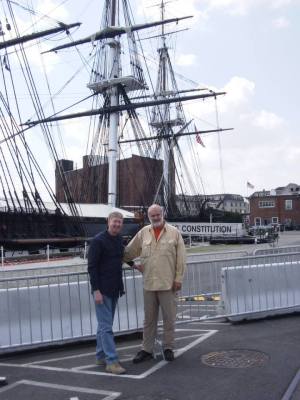
With George Jepson at USS Constitution
Location research for my Kydd tales has taken me to North America and Canada. In the States I was delighted to renew my acquaintance with George Jepson, editor of Quarterdeck magazine; we met up in Boston to pay homage to USS Constitution, one of the original six heavy frigates of the United States Navy (Kydd in Quarterdeck finds himself aboard Constellation in the heady days of the birth of the navy).
In Halifax I was able to get a real feel for the frontier town that it was in Kydd’s day at the many museums the city boasts. The splendid Maritime Museum of the Atlantic was well worth the time I spent there! I also visited with great interest the York Redoubt, a 200-year-old fortification on a high bluff overlooking the entrance to Halifax Harbour, the wilderness area of Chebucto Peninsula and MacNabbs Island.
And what are the odds of coming across a signal book actually belonging to a lieutenant on the North American station at exactly the same time as I need Kydd to learn his craft as a signal lieutenant there? Retired Paymaster Commander William Evershed generously extended a loan of the precious family relic for me to study.
Researching the Kydd Novels #4
Posted on July 7, 2017 Leave a Comment
One of the elements of writing my Kydd tales that I particularly enjoy is the research, and it’s one of the things I’m most questioned about when I give talks or do author signings. There are many aspects of this – consulting primary and secondary sources, speaking to experts, undertaking location research, visiting museums and archives. I’m often asked about the length of time research for a book takes – that’s a difficult thing to quantify because in some ways I guess I have been doing it subconsciously all my life – during my years at sea absorbing the universals all mariners hold dear – and ingesting material from countless maritime books, both fiction and non-fiction, that I’ve been drawn to from an early age.
Passport Stamps

Kathy checks the guidebook in Malta
Location research for my Kydd tales has taken me all over Europe – Spain, Portugal, France, Sweden, Finland, Turkey, Gibraltar, Malta, Denmark – and a number of other countries as well, such as Canada, the Caribbean and Iceland. My father-in-law in Tasmania has a wall map with a pin in every location Kathy and I visit!
On these visits the main challenge for me is to strip away the trapping of the 21st century and in my mind’s eye go back to the eighteenth and early nineteenth centuries. In quite a few instances there are enough old buildings/streets etc. to facilitate this. In some places, however, appearances have radically changed – seafront areas have been reclaimed, buildings of the Georgian era either flattened in war or demolished to build skyscrapers, making my task more difficult. Local archives are invaluable if this is the case, with their carefully preserved street maps and architectural drawings, as are contemporary paintings from my period of interest.
On these research trips I always try to get out on the water to look back at places from seaward to get an idea of what Kydd would have glimpsed as he came to rest at anchor. For this I use my invaluable research camera which not only takes the GPS co-ordinates of where a picture is taken but the direction I was facing and even the altitude!
I’ve spent time sailing in the Mediterranean in a variety of craft, and, most recently, around the Baltic for my upcoming book The Baltic Prize, which is published in November.
And of course there are some magnificent maritime museums to be found – and I’ve spent many happy hours engrossed within their walls.
Here are just a few of the ones I’ve visited recently:
The National Maritime Museum, Stockholm
The Maritime Museum of Denmark in Copenhagen
The Maritime Museum, Lisbon
Researching the Kydd Novels #3
Posted on July 6, 2017 2 Comments
One of the elements of writing my Kydd tales that I particularly enjoy is the research, and it’s one of the things I’m most questioned about when I give talks or do author signings. There are many aspects of this – consulting primary and secondary sources, speaking to experts, undertaking location research, visiting museums and archives. I’m often asked about the length of time research for a book takes – that’s a difficult thing to quantify because in some ways I guess I have been doing it subconsciously all my life, during my time at sea absorbing the universals all mariners take to their hearts and ingesting material from countless maritime books, both fiction and non-fiction, that I’ve been drawn to from an early age.
Readers Rock!

Paolo Meireles
Sarah Callejo Living in Madrid, Sarah was most helpful with suggestions for Spanish names, phrases and eccentricities that I put to good use in Betrayal.
Robert Squarebriggs Visiting Canada on location research for Quarterdeck, I met up with reader Bob Squarebriggs in the aptly named Lord Nelson hotel in Halifax. Bob enthusiastically imparted his knowledge of the country’s boreal wilderness and remarkable maritime heritage.
Paulo Meireles A native of Portugal, Paulo enlightened me with details of his homeland’s culture that gave a truly authentic flavour to the storyline in Persephone.

