
The Silk Tree: Getting a Historical Mindset
Posted on October 6, 2014 5 Comments
It’s just a month today to the launch of The Silk Tree, my upcoming historical novel set in the time of Emperor Justinian.

On location, The Silk Tree
All of my Thomas Kydd books have been based in the Georgian era, 200-odd years ago. I now know that period pretty well and can mentally go back in time there with reasonable ease. However, when I decided to write The Silk Tree I recognised that I faced a challenge – I would need to get my head around a time not 200 but 1500 years in the past. And across two very different great civilisations – China and Byzantium!
With such a very different writing project I have to admit I was somewhat nervous as to whether I could pull it off, but the early feedback has been very encouraging. One reviewer described it as ‘Conn Iggulden meets Robert Harris.’ Quarterdeck magazine pronounced: ‘Stockwin’s page-turning prose, vividly drawn characters and ability to draw the reader right into those ancient times create a grand and compelling historical epic.’
And this email just arrived from one of my Kydd fans, Brian Chellis, who’d won an advance proof copy and took it with him to Cyprus on holiday. ‘What an enjoyable, well written book… Couldn’t put it down, totally intrigued with what was going to be next. Having read the complete Kydd series twice, I was a little concerned that The Silk Tree would not come up to par, but I was wrong! Potential for a sequel! I suspect a lot of us devotees will be crying out for one soon.’
The genesis of The Silk Tree lies in the magical city of Istanbul. On location research there for the Kydd series Kathy discovered in the Grand Bazaar a rather lovely silk scarf. While she was chatting with the merchant I idly wondered how silk was brought from China to the West. Intrigued, I later did some ferreting around and the creative juices started flowing – and I knew I had another story I just had to tell…
If there’s one thing I’ve learned since becoming a wordsmith it’s that all life’s experiences are grist to the mill for a writer – and for The Silk Tree I was able to call upon my admiration of Chinese calligraphy which goes back to the time I lived and worked in the Far East. And all those hours of dry study of ancient Greek and Latin at grammar school came in handy, too!
I guess the hardest part of getting a historical mind set for this book was to internalise the limits of the known world in those far far away times. Stripping away the trappings of modernity. Getting an empathy with my main characters Nicander and Marius and where they saw their horizons.
Turkey has world-class museums and archaeology sites and being able to actually see ancient Greek and Roman domestic artefacts and priceless Byzantine treasures up close and personal went a long way to bringing the period really alive for me.
Then there was the physical location research in Istanbul and other places. I’ll never forget standing on the Galata bridge as the sun was setting and looking up the whole length of the Golden Horn, gradually taking my mind back in time through the vistas of history it must have seen. I saw beautiful and mysterious goods from all over the known and unknown world arriving in ships of all kinds: red sails, tripod masts, galleys.
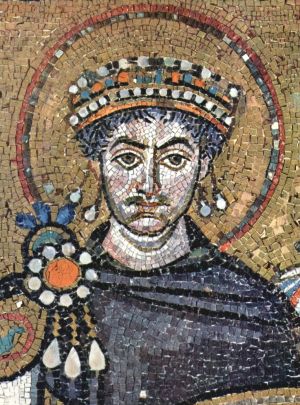
Justinian the Great
Then my eyes travelled to the city itself, first founded by Byzas in 667 BC and having seen the Athenians, Lysander, the pax romana – it gives you pause to know that when the empire was moved there by Constantine, the city was already 1000 years old.

The Hagia Sophia
And later, of course, visiting the glorious Hagia Sophia. Among other things, just standing in the entrance and looking down at stone steps worn in deep curves by feet over a continuous one and a half thousand years…
Read chapter one
A Collectors Edition of The Silk Tree is being offered, strictly limited to 150 Sets – but don’t delay if you’re interested, it’s nearly fully taken up!
The Silk Tree is published by Allison and Busby on November 6
And if you’re in London on October 30 you are cordially invited to the Launch Party at Goldsboro Books. I do hope you can join me to raise a glass to Marius and Nicander’s epic adventure!
The Silk Tree Facebook page
The Silk Tree Pinterest Board
Copyright notices
Hagia Sophia image: By Arild Vågen (Own work) [CC BY-SA 3.0 (http://creativecommons.org/licenses/by-sa/3.0)%5D, via Wikimedia Commons; Justinian image: By Meister von San Vitale in Ravenna [Public domain], via Wikimedia Commons)
Every effort is made to honour copyright but if we have inadvertently published an image with missing or incorrect attribution, on being informed of this, we undertake to delete the image or add a correct credit notice
‘Now holidays are always planned to spend as much time by the sea as possible!’
Posted on October 1, 2014 4 Comments
One of the aspects of feedback I get from readers that especially pleases me is that the Kydd books are seen not just as being for male readers; in fact I now know I have quite a large number of female readers following the adventures of Kydd and Renzi. One such is Kate Ross, the October Reader of the Month.
Kate lives in North Yorkshire with her husband of three years. As well as being drawn to Age of Sail fiction Kate is a passionate participant in the performing arts and runs a business providing educational classes to local children in performance.
I had the pleasure of meeting Kate Ross at a recent book signing during the Falmouth Tallships regatta and later got in touch again to ask her more about her passion for the genre.
Over to Kate…
As a woman what draws you to Age of Sail fiction?
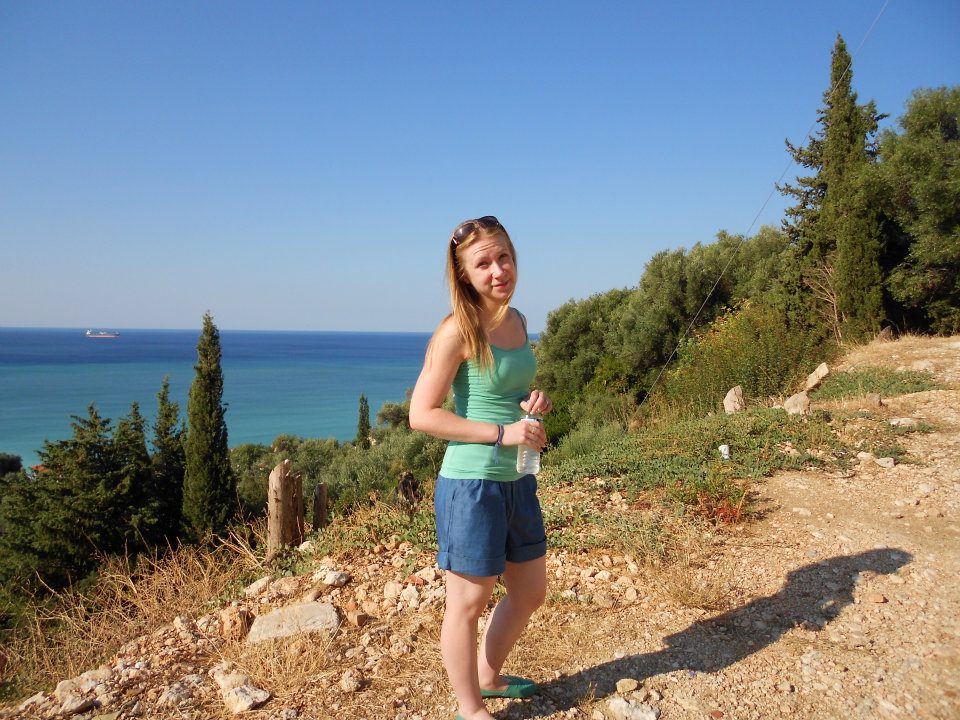
Kate in Kefalonia
I’ve had a long-standing interest in all things historical, compounded by my undergrad degree in history from the University of York. That said, I think there is a true magnificence about the Age of Sail both in terms of the ships themselves and the sheer strength of the human spirit – and it is that which has always drawn my interest. Despite the male-dominated nature of most of the famous stories I think the notion of the ‘hero’ and the demonstration of endurance in the 19th century navies cannot fail to capture people’s interest.
Initially I had read C S Forester’s Hornblower novels which whetted my appetite for the genre when I was just 14. Since then I have been enjoying the adventures of Kydd, having previously read Alexander Kent’s Bolitho adventures and Sean Thomas Russell’s Charles Hayden Novels.
Do you have any connection with the sea yourself?
Not really… Family holidays have usually involved a beach and I love watching boats, ships and busy ports. Having lived in West Yorkshire most of my life opportunities to be near the sea always meant a long car journey but now holidays are always planned to spend as much time by the sea as possible!
What did you most enjoy at the Falmouth Tallships event?
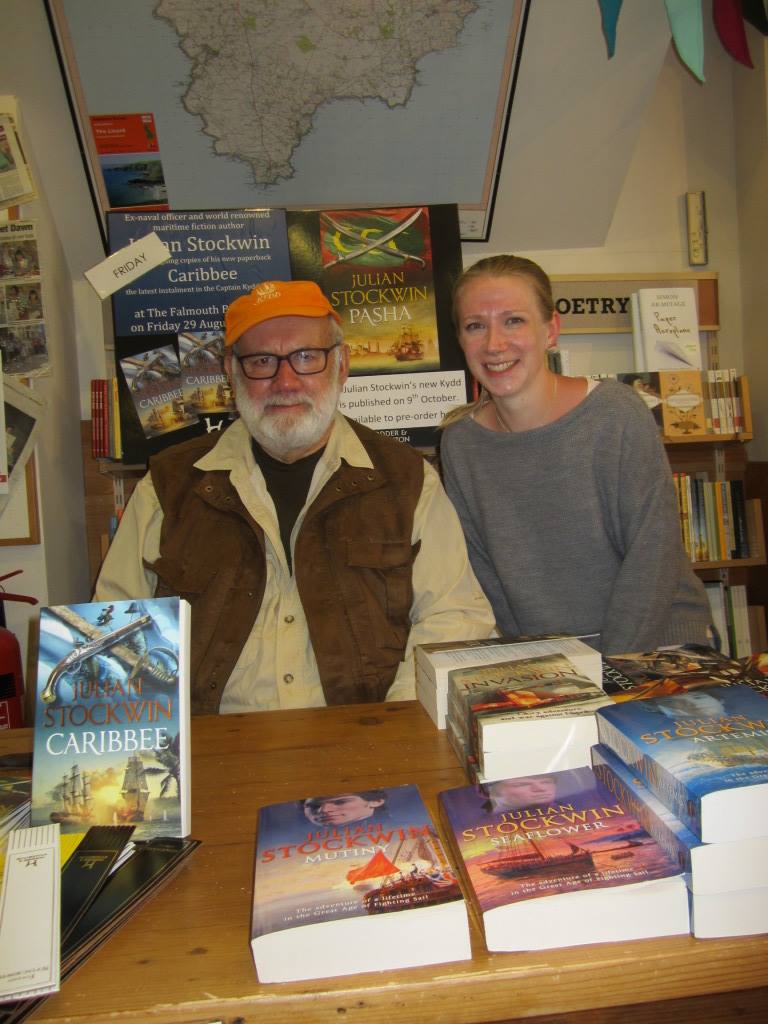
With Kate at the Falmouth Bookseller
That was AMAZING! Meeting a special author… Taking a three hour sailing trip on the magnificent tall ship Mercedes. We helped set sails, walked the deck whilst out at sea and learned so much about the workings of the vessels and life aboard. Having the opportunity to explore the ships, take tours and soak up the atmosphere of a town celebrating its heritage made for a truly great holiday.
In the Kydd books do you have a favourite character?
I’m still working my way through the titles but so far it’s Renzi. Simply because of the clever mix of education, philosophy and ‘gentleman’ he brings to the between-decks environment. He is a clever balance to Kydd’s practical intelligence and robust outlook. That said, I think the interaction between the two of them is what really brings the reality to the stories.
Anything else you’d like to add?
I really enjoyed Kydd – the gritty descriptions of the brutality of the foremast life were such a refreshing contrast to the officer stories you find in other books in the genre. Kydd’s career is a very different journey so far, and it has brought a new appreciation to me of the hard circumstances necessary to keep that crucial naval dominance with the British.
Would you like to be a candidate for Reader of the Month? Just get in touch with a few sentences about your background and why you enjoy the Kydd series!
PASHA Extra
Posted on September 29, 2014 8 Comments

Selim III
Pasha is the fifteenth title in the Kydd series. Captain Kydd finds himself in a critical sphere of interest: the Dardanelles and I think I can guarantee a few surprises in this book… Constantinople – or should I say Istanbul – is one of the world’s genuine iconic locations. It is surpassingly beautiful and has a beguilingly romantic air, tinged with Oriental mystery. It was one of my life’s special moments when, on location research for this book, I stood on a balcony of the Topkapi Palace on Seraglio Point and looked out over the Golden Horn, across to Asia and up through the Bosporus in the direction of the Black Sea and Russia.
Overview of Pasha

The Sublime Porte for receiving foreign envoys in the Ottoman Court
An Admiralty summons to England cuts short Thomas Kydd’s service in the turquoise waters of the Caribbean. While the crew of L’Aurore can look forward to liberty and prize money, a shadow hangs over their captain: the impending court martial of his one-time commander, Commodore Popham, who led a doomed attack on South America.
Following Nelson’s death two years earlier, England is in desperate need of heroes and Kydd’s Caribbean exploits are the talk of London. Feted by the king and a grateful country,

Sebastiani, French ambassador
Kydd is soon on detachment in a new and dangerous sphere of interest: the Dardanelles, connecting the Mediterranean Sea to the Black Sea and providing a route to India. The French have long coveted this route, knowing that it could be the key to toppling the British Empire in India. When they successfully whip up such strong anti-English sentiment that the British ambassador to Constantinople has to flee to L’Aurore, a deadly stand-off ensues.
Meanwhile Kydd’s closest friend, Nicholas Renzi, has assumed a new role that he can never make public. Sent under alias on a mission to Constantinople, Renzi must engineer a coup that will turn the tables on the French. But when he’s taken prisoner, only Kydd’s superb seamanship and sheer bravado can save the day.
What three advance reviewers have said
“Stockwin has not only continued the Kydd series in fine fashion but he has exceeded expectations. In Pasha, Thomas Kydd and Nicholas Renzi have risen to their great potential. Not only are these fictional characters believable, but the author’s attention to historical detail is superb.”
“I just finished Pasha and all I can say is “WOW”!! So many twists and turns. So many questions answered. So many things set to rights, and then it’s all a whole new set up!! Totally unexpected and totally enjoyable.”
“I have enjoyed the Kydd series immensely, but Pasha is my favorite. I love the new developments in Renzi’s life. I will say no more!”
Publication schedule, hard cover and ebook
UK/Europe: 9 Oct; Australia & NZ: 14 Oct; US: 1 Nov; Canada: 12 Nov; South Africa: 15 Nov
The Quarterdeck Interview
In conversation with George Jepson about Pasha, as well as my other book coming out this year, The Silk Tree. You can download and read the interesting feature article here
Buy the book
Pasha will be widely available from online and physical bookstores, as a hardback and ebook.
A selection of outlets:
UK : Waterstones; Amazon
US : McBooks Press; Barnes & Noble; Amazon
Australia : Fishpond
Canada : Chapters
Worldwide : Book Depository
Book Signings
I’ll be signing at :
- October 11 Torbay Bookshop, 2pm
7 Torquay Road
Paignton
Devon
TQ3 3DU
01803 522011
October 18, Waterstones Drake Circus, 12 noon – 1pm
Drake’s Circus
Plymouth
PL1 1EA
01752 669 898
And finally, here’s an excerpt of Pasha to whet your appetite!
Copyright notices
Selim III image: By Joseph Warnia-Zarzecki 1850 (French) (Details of artist on Google Art Project) [Public domain or Public domain], via Wikimedia Commons. This work is in the public domain in the United States because it was published (or registered with the U.S. Copyright Office) before January 1, 1923. Sublime Porte image: By Philippe-Joseph Tassaert (1732-1803) [Public domain], via Wikimedia Commons. Sebasitiani image: By Philippe-Joseph Tassaert (1732-1803) [Public domain], via Wikimedia Commons
Every effort is made to honour copyright but if we have inadvertently published an image with missing or incorrect attribution, on being informed of this, we undertake to delete the image or add a correct credit notice
BookPick: A History of the Royal Navy Series
Posted on September 23, 2014 3 Comments

Three titles in the series have been published to date
Three titles have been published to date* with eleven more to follow:
A History of the Royal Navy: The Age of Sail
A History of the Royal Navy: The Seven Years’ War
A History of the Royal Navy: The American Revolutionary War
A History of the Royal Navy: Empire and Imperialism
*A History of the Royal Navy: The Napoleonic Wars
A History of the Royal Navy: The Victorian Age
A History of the Royal Navy: The Royal Marines
A History of the Royal Navy: The Nuclear Age
A History of the Royal Navy: Air Power and British Naval Aviation
A History of the Royal Navy: The Submarine
A History of the Royal Navy: Women and the Royal Navy
A History of the Royal Navy: World War I
*A History of the Royal Navy: World War II
*The Royal Navy: A History Since 1900
Given the period I write about (1793-1815), I was particularly interested in The Napoleonic Wars title, ably penned by Martin Robson. This looks at the history of the Royal Navy during the French Revolutionary and Napoleonic Wars from a broad perspective, examining the strategy, operations and tactics of British seapower. A helpful appendix of sources for each chapter, along with a bibliography appears at the end of the book. It will certainly join the list of books I recommend as enlightening overviews of this fascinating period.
A History of the Royal Navy Published by I B Tauris
Caribbee: A return to turquoise seas
Posted on September 18, 2014 4 Comments
A regular feature looking back on each of the Kydd titles – with story background, research highlights, writing challenges and more.
And thank you for all your kind comments on the post about my thirteenth book, Betrayal.
The fourteenth book in the series is Caribbee which sees Kydd and Renzi back in the torquoise seas last visited in Seaflower, when they were sailors before the mast.
Two dockyards, two fates
Location research for this book took me to the Caribbean and as a former naval shipwright I was particularly interested in what remained of the naval dockyards of Kydd’s day.

Old Port Royal, Jamaica
It was once ‘the richest and wickedest city in the world’. Originally just a sand spit, it was favoured by the Tainos, the indigenous people of the area, as a fishing camp. When the Spaniards arrived in Jamaica, they used the spit for cleaning, refitting and caulking of their sailing vessels.
The British took Jamaica in 1655 and, realising its strategic importance, put fortifications in place and began careening their naval ships there.
By the 1660s buccaneers, cut-throats and prostitutes made up most of the 6500 residents of Port Royal. There was one drinking house for every ten residents, along with merchants, goldsmiths, artists – and even several places of worship!

Although he died well before Kydd’s time, Henry Morgan’s reputation as one of the most notorious and successful pirates/privateers in history, ensures his name lived on
However on June 7, 1697 disaster struck; Port Royal was destroyed by an earthquake. A large portion of the town sank into the sea and two fifths of the population perished.
The houses and fortifications were rebuilt on what by then was an island separated from the rest of the Palisades, but in 1703 a fire destroyed the settlement. Although the town was largely rebuilt, hurricanes in 1712, 1722 and 1726 ensured that Port Royal would never again rise to its former glory as all the merchants shifted across the harbour to settle in Kingston, a less healthy but safer site than Port Royal. The Royal Navy continued to use the area for careening however, and a number of naval storehouses and accommodations were erected.
After the Napoleonic wars Port Royal diminished in importance and the Naval Dockyard eventually closed in 1905 and slowly sank into disrepair.

At the careening capstan, Nelson’s Dockyard
Historically its position on the south side of the island meant it was well positioned to monitor the neighbouring French island of Guadeloupe and it afforded good protection against hurricanes.
By 1707 naval ships were using English Harbour as a station but it wasn’t until 1728 that facilities were built for maintenance and repair. Construction of the modern dockyard began in the 1740s and grew to include mast houses, saw pits, stores and all the various specialist facilities required to service the ships. (Nelson’s tenure in the dockyard was from 1784 to 1787.)
In 1889 the Royal Navy abandoned this dockyard but it re-opened in 1961 after extensive restoration and is now a world-class tourist attraction.
In Kydd’s footsteps…
It’s given me great pleasure to learn that after reading Seaflower and Caribbee a number of readers have travelled to the Caribbean and followed in Kydd’s footsteps, so to speak. There is still much to be seen that has changed little and I commend a visit!
Previous posts on Caribbee
King Sugar
The story of the cover of Caribbee
The birth of Caribbee
Seaflower and Caribbee
Copyright notices
Captain Morgan image: By Alexandre Exquemelin ,an artist known for making book about pirates (http://www.pinterest.com/pin/137078382381276155/) [Public domain], via Wikimedia Commons.
Port Royal image: By Old_Port_Royal_-_Project_Gutenberg_eText_19396.jpg: John Masefield derivative work: Beao (Old_Port_Royal_-_Project_Gutenberg_eText_19396.jpg) [Public domain], via Wikimedia Commons
Every effort is made to honour copyright but if we have inadvertently published an image with missing or incorrect attribution, on being informed of this, we undertake to delete the image or add a correct credit notice
BookPick: Sunk by Stukas, Survived at Salerno; Abandon Ship!
Posted on September 13, 2014 2 Comments
 When I’ve any spare time for leisure reading I greatly enjoy memoirs by Old Salts and was particularly engaged by Sunk by Stukas, Survived at Salerno and the follow-on volume Abandon Ship!
This is a rare and delightful naval autobiography which in two volumes spans the war years and the atom age to follow. It overlaps my own service to a small extent and I see our paths once crossed in the Far East – the author a commander in a fast destroyer and me rather more humbly on the lower deck of a carrier. At this time there were still serving men who had been at sea in wartime and these were looked on in awe by us, for these had seen wrenching changes in technology through eyes that knew a Navy far different to the new. And now I’m privileged to know what they thought about it all.
 The first volume is of the war: a career sailor from a naval family, the author was immediately put to work in minesweeping, a perilous and frightening duty at the outbreak of war when so little was known about the devilish devices. His ship repeatedly crossed to Dunkirk at the evacuation until it was finally sunk under him. Other adventures followed, including a wild fight at Salerno which ended with the death of his ship, and in fact service throughout the entire six years of war, ending in the final scenes in Japan.
The second is of the post-war years. As a veteran naval officer steadily promoted, the author was in the centre of a maelstrom of change and I for one take my cap off to those seniors who steered the Royal Navy through these years of fundamental upheavals. Ship construction – battleships to aircraft carriers, submersibles to nuclear submarines and big guns to missiles. Command and control – open bridges to ops rooms and warfare officers, primitive radar to synthesised plots, computers. And life at sea – hammocks to bunks, broadside messes to canteen, the firm rise of welfare provision.
This is not a history: I’m so glad it’s not; if you need to know the facts there are so many titles out there. Instead it’s a deeply personal progress through these times and is a treasured insight into how life actually was then, and for that I’m sincerely grateful that Captain Tony McCrum has shared it with us.
Sunk by Stukas, Survived at Salerno; Abandon Ship! by Tony McCrum, Published by Pen and Sword. ISBN 9781848842519; 9781848846661
BETRAYAL: the tide turns
Posted on September 9, 2014 3 Comments
A regular feature looking back on each of the Kydd titles – with story background, research highlights, writing challenges and more.
And thank you for all your kind comments on the post about my previous book, Conquest.
The thirteenth book in the Kydd series is Betrayal, a book I enjoyed writing because it was dealing with events within the Napoleonic wars that are little known and offered an exotic canvas for telling a story. After the victory in South Africa in Conquest it was certainly a different outcome for the British! But that was part of the challenge of writing this book. Defeat and disappointment are part of life – and this was certainly as true in the Georgian era as it is today!
Praise for the book
‘Once again Julian Stockwin has come up with an excellent, fast flowing story of Captain Kydd as he goes about his ventures of derring-do off the South American coast… This little known side-show within the Napoleonic Wars allows Stockwin to use his excellent seafaring knowledge… A cracking yarn… in the best traditions of Hornblower and Aubrey’ — Pennant magazine
Dramatis Personae
As usual, my cast of characters includes a number of real-life personages. Here are six from history that I found particularly interesting to research for this book:
Beresford
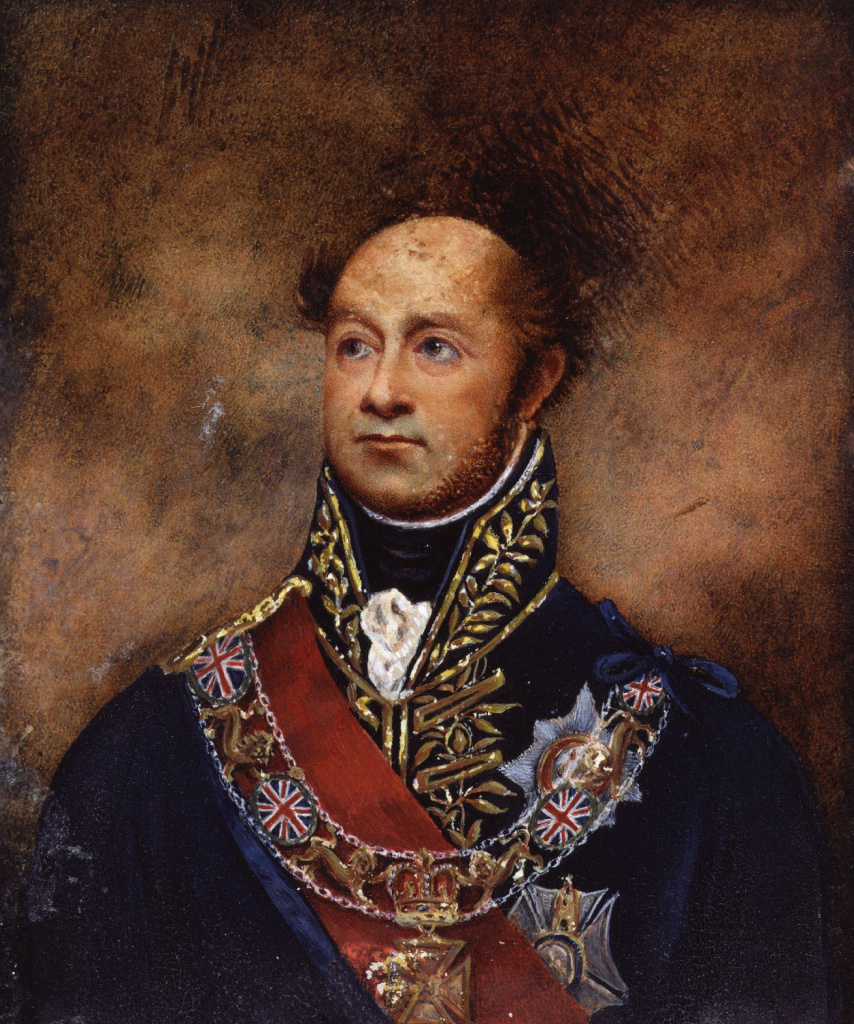
Beresford
William Carr Beresford, later Viscount Beresford, entered the British Army in 1785 as an ensign in the 6th Regiment of Foot and the next year he was blinded in one eye due to an incident with a musket. He remained in the service being promoted to captain by 1791 with the 69th Regiment of Foot. He distinguished himself at Toulon (1793) and in Egypt (1799-1803). A straight talking warrior he was possibly not best placed to handle the complex situation he found himself in Betrayal. He went on to a more illustrious future in the Peninsula war.
Sobramonte
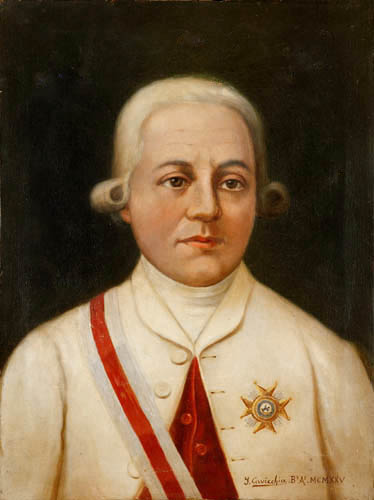
Sobremonte
Liniers
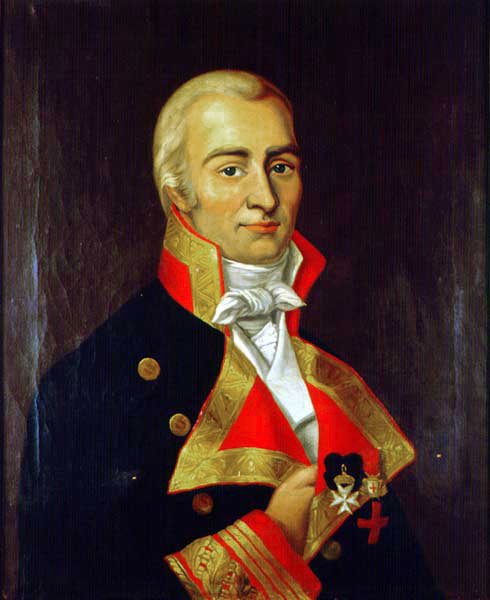
Liniers
Baird

Baird
David Baird was born in Scotland and entered the army in 1772. He was a major-general when he commanded the expedition to take the Cape of Good Hope. He liked to wear a curved blade taken from the body of Tippoo Sahib after he stormed Seringapatam during the Anglo-Mysore wars. Another caught up in the failed attempt on a South American empire, he also did not deserve his fate – to be removed from his governorship of Cape Town, never to be employed at that level again.
Popham
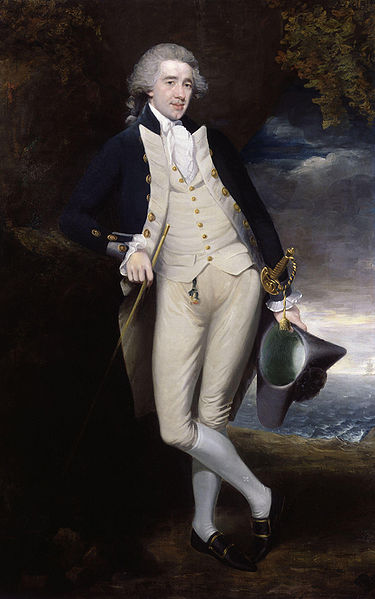
Popham
Sir Home Popham was born in Gibraltar, and allegedly had 20 siblings. He entered the navy in 1778, was highly intelligent but often rubbed those in authority up the wrong way, and had an uneven military career. He eventually attained the rank of rear admiral. One of the most scientific seamen of his time, he did much useful survey work, and was the inventor of the code using signal flags adopted by the admiralty in 1803 and used at Trafalgar and for many years afterwards. A gifted and unusual personality he went on to ensure Wellington’s victory in the Peninsula that ended in the advance on Paris and capitulation.
Fox
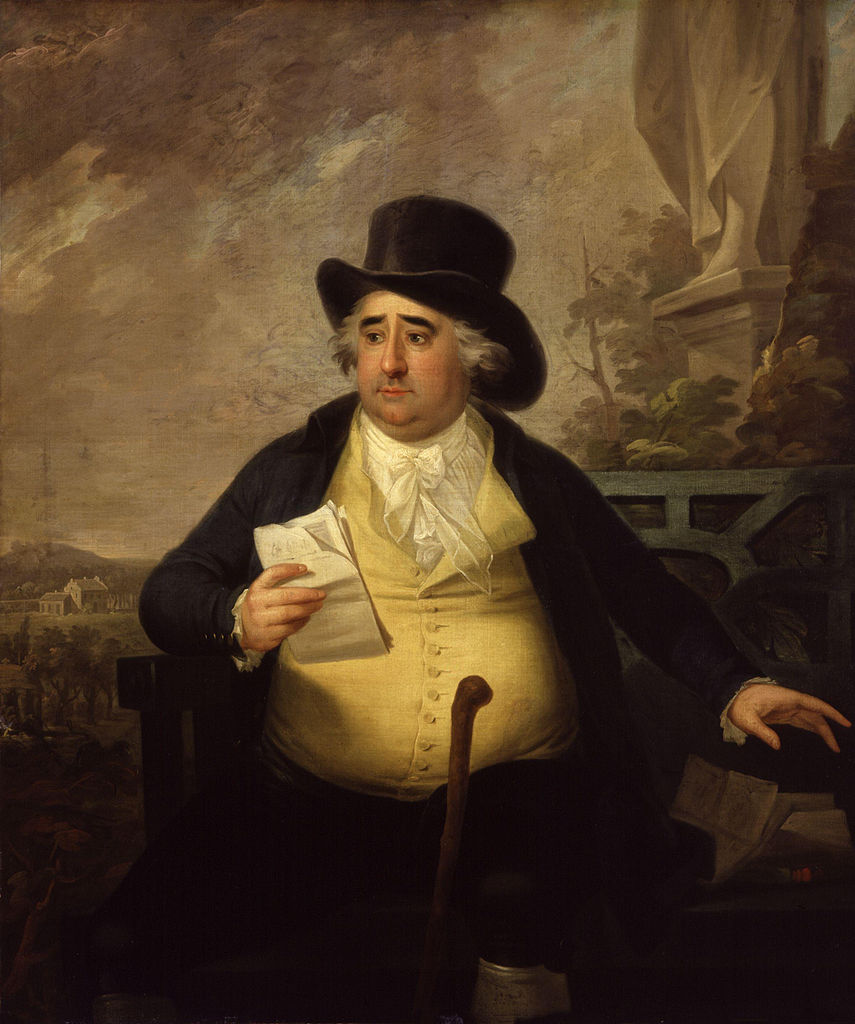
Fox
Charles James Fox was a prominent British Whig statesman whose parliamentary career spanned thirty-eight years of the late 18th and early 19th centuries and who was particularly noted for being the arch-rival of William Pitt the Younger. Fox had little interest in the actual exercise of power and spent almost the entirety of his political career in opposition. After Pitt’s death in January 1806, Fox served briefly as Foreign Secretary in the ‘Ministry of All the Talents’ of William Grenville, before he died on 13 September 1806, aged fifty-seven.
Research for Betrayal
My research for this book involved poring over a large number of reference books and Royal Navy histories. And, as usual, my Admiralty electronic charts and pilots brought to bear on the developing story were invaluable. I write on my main computer and I have another computer at my right hand side with the relevant sea chart at hand and can navigate my ‘ship’ as the story dictates. Oh, the long-ago days when I only had paper charts and had to spread them out on the dining room table and do navigational computations by hand…
Speaking of things that weren’t around when I started writing, social media is, I think, a boon to authors. Writing is necessarily a pretty solitary occupation and the occasional break to check on Twitter, Facebook etc. provides a light diversion. Twitter has also come to my aid in the form of one of my Twitter friends, Sarah Callejo, a translator based in Spain. Sarah very kindly helped out with some of the more obscure Spanish phrases that I came across in my research yet I’ve never met her!
Copyright notices
Beresford image: William Beechey [Public domain], via Wikimedia Commons; Sobromonte image: By Ignacio CavicchiaCatálogo Acceder (uploaded by User:Alakasam) [Public domain], via Wikimedia Commons; Liniers image: By Anonymous [Public domain], via Wikimedia Commons;
Baird image: By Sir John Watson-Gordon (died 1864) [Public domain], via Wikimedia Commons;
Popham image: [Public domain], via Wikimedia Commons; Fox image: By Karl Anton Hickel (died 1798) [Public domain], via Wikimedia Commons
Every effort is made to honour copyright but if we have inadvertently published an image with missing or incorrect attribution, on being informed of this, we undertake to delete the image or add a correct credit notice
‘My wife thinks I’m absolutely mad!’
Posted on September 5, 2014 3 Comments
Recently I received an email which began: ‘My wife thinks I’m absolutely mad!’ It went on to explain: ‘I’ve had one of the most fabulous months of my life – I’ve been in heaven re-reading all 14 Kydd books. Mentally I’m now sailing across the North Atlantic on my way back to the UK after being recalled from the Caribbean. I can’t wait for the next volume of the Kydd adventures – Pasha sounds so exciting!’
The email came from Graham Cooke, the September Reader of the Month. Graham is a retired company director and former Merchant Navy officer – and now splits his time between Spain and the UK.
Inspired by my book Victory, earlier this year he and his wife took their grandson to the Portsmouth Historic Dockyard and toured over HMS Victory. And Caribbee led to an exotic cruise…
Over to Graham…

Taking in HMS Victory with his grandson
“I have loved every one of the Kydd books! They have each been a wonderful tale of the adventures and development of Thomas Kydd. The overall feeling I get from reading these 14 books is that the sum is greater than the individual parts!
My next door neighbour gave me the first three to read whilst on holiday. He had intended to read them, but didn’t have the time. I was hooked as soon as I picked up Kydd. The detailed description of life on board the old Duke William was captivating. Meeting the diverse characters – but especially Joe Bowyer – along with the exciting plot made sure I was reading Artemis immediately!
Seaflower was truly enjoyable. Such an adventure for everyone around the Caribbean. Kydd’s experiences at the Antigua naval dockyard motivated my wife and I to go on our first Caribbean Cruise. Our visit to the Nelson dockyard was so exciting. We had lunch in the Copper Store building and I enjoyed finding the Sail Store where the sultry Sukey tempted Kydd beyond his powers of self-control.
‘Victory is impossible to put down!’

With his treasured Kydd collection
I could expand on my feelings for each book, however my personal favourite has to be Victory. It’s full of seamanship and fantastic descriptions of the dreadful conditions men had to endure in a full-blown sea battle in the early 1800s. Cannons firing with deafening concussion and confusion in the confines of a gun deck. The blood and savagery of battle. The need for rapid firing and re-loading of the cannon. The exceptional courage and leadership of Lord Nelson. His determination to destroy the French fleet, enough to abandon his Mediterranean station and chase them across the Atlantic and meet them in such a decisive battle. His men were committed to doing all they could for him and their country. The book is written in such a way that it is difficult to distinguish between fact and fiction and impossible to put down! Fantastic!
‘Toby Stirk is a true British Jack Tar’
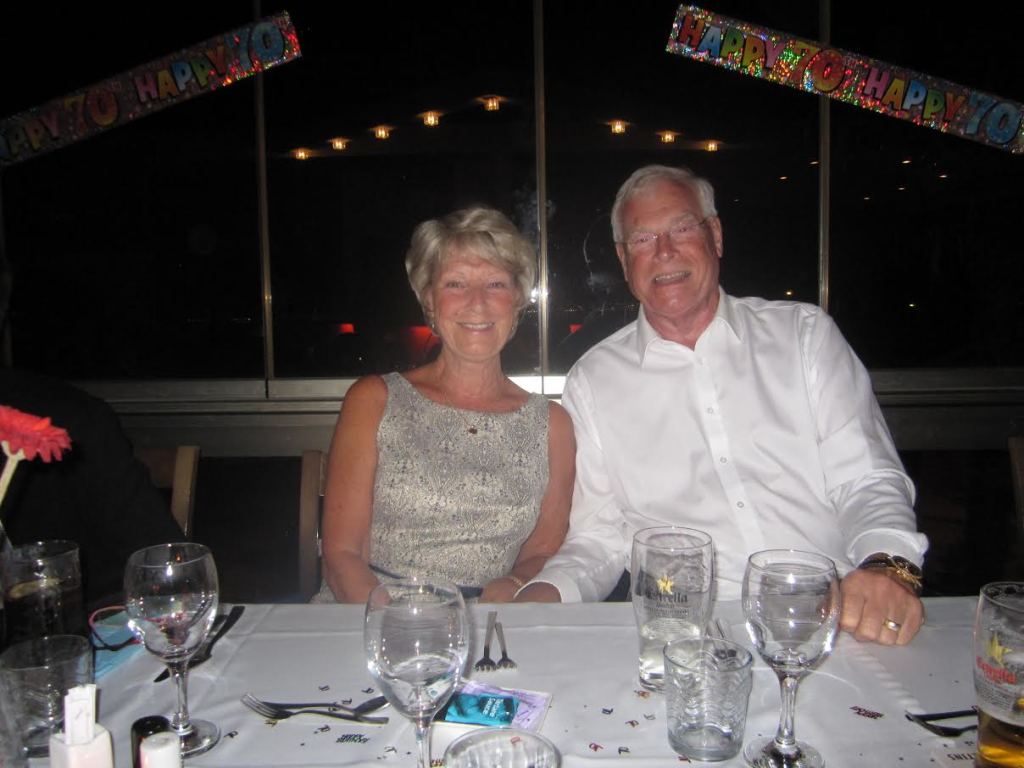
Graham and his wife Lynda
There are so many fantastic characters in the Kydd saga. Sergeant Dodds comes to mind with his precise military bearing. The dark temptress Sukey has to be there in the thought process. The anomaly that is Mr. Buckle caused an unusual amusement. The quiet Tysoe is such a loyal servant and has always been there to ensure Kydd does not bring shame on his officer status. Cecilia Kydd has been a constant figure in the adventures. A stable sister to Thomas and, hopefully, a good wife to Renzi at some point. Who could forget Lord Nelson? His presence in the books Quarterdeck, Tenacious and Victory made them such great reading! However, my favourite character has to be Tobias (Toby) Stirk! The unwritten bond of loyalty, trust and respect between him and Thomas Kydd is truly amazing! He has been there since the very beginning as a shipmate to Kydd and Renzi aboard Duke William. Without his ‘letters’ he cannot rise in rank but his skills are second to none. How many times has he saved the day for his ship mates? He has certainly helped save Thomas Kydd from himself and from the hangman’s noose. Toby is a true British Jack Tar!”
Would you like to be a candidate for Reader of the Month? Just get in touch with a few sentences about your background and why you enjoy the Kydd series!
Win a Limited Edition Kydd Collection Print!
Posted on September 1, 2014 Leave a Comment
You could win a limited edition print of HMS Artemis!
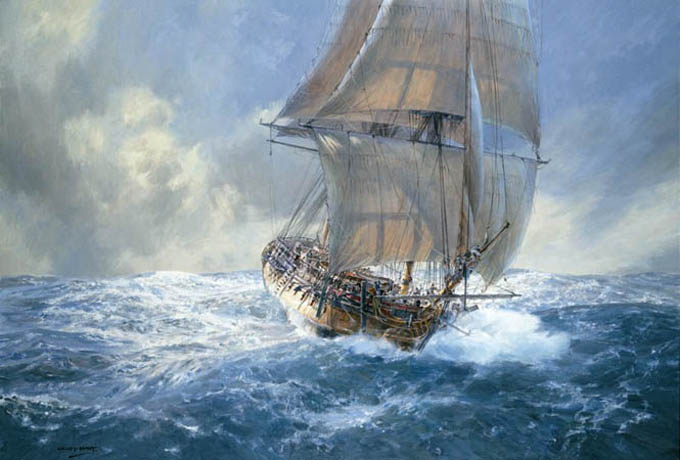 This wonderful print is from the original oil painting commissioned for the cover of Artemis, the second title in the Kydd series. Those who have sailed the Great Southern Ocean have confirmed what an astonishingly accurate representation this is of those seas and it is also a particularly fine depiction of an eighteenth-century frigate at sea. The movement of the ship that Geoff portrays is exceptionally dynamic. He certainly captured the flying qualities of the crack frigate HMS Artemis – and is probably my favourite of all the covers he painted.
For a chance to win this superb print email julian@julianstockwin.com with the answer to this question:
- How many of Geoff Hunt’s paintings reproduced as prints for the Kydd Collection include ships boats in the water?
Contest closes end September. The winner will be the first correct entry drawn on September 30 and will be notified by email.
Additionally, Art Marine is offering a 10% discount on all Geoff Hunt prints for the month of September. Just enter the code JSTOCKWIN at the checkout.
View the entire Kydd Collection at Art Marine
CONQUEST: the Race to Empire Begins!
Posted on August 26, 2014 5 Comments
A regular feature looking back on each of the Kydd titles – with story background, research highlights, writing challenges and more.
And thank you for all your kind comments on the post about my eleventh book, Victory.
The twelfth book in the series is Conquest. Victory at the Battle of Trafalgar removed the spectre of invasion and England was free to seek conquests and colonies in the furthest reaches of the world. Captain Kydd joins an expedition to take Dutch-held Cape Town, a strategic imperative to secure the rich trade-route to India.
Stunning South Africa

Much of the Cape Town Kydd would have known remains to this day
As usual, my research consisted of a meticulous study of documents, reference books, maps and charts, pilots – plus actual location research. After completing my preliminary reading and taking copious notes it was off to South Africa, where the book is set.
Kathy and I based ourselves in Cape Town where first we undertook a number of days’ research at the excellent National Library of South Africa in Queen Victoria St and the Archives Repository in Roeland St. Several other smaller museums also yielded valuable material. Then, digital camera in hand, we explored the historical buildings of the city, many of which were there in Kydd’s day. Among these: the Castle of Good Hope, built in the seventeenth century by the Dutch East India Company, and Government House in the very pleasant Company Gardens.
After that, it was on into the hinterland. Our travels took us all around Cape Peninsula and to Simon’s Town, among other locations. Simon’s Town Museum proved another rich source of information. It is housed in a very picturesque building that was the winter residence for the Dutch East India Company Governor at the Cape.
The setting of Cape Town must be one of the world’s most spectacular and we’d love to return sometime. Of course while we were there we also had to sample the delicious traditional cuisine – dishes such as bobotie, bredie and koeksisters, which are all mentioned in the book.
Bobotie
After reading Conquest, Sybil Galbraith, one of my readers who lived in South Africa, kindly provided her special family recipe for bobotie:-
Ingredients
- 1 pound minced steak or lamb
1 beef cube dissolved in a quarter cup of water
2 chopped onions
2 tablespoons mango chutney
1 dessertspoon mild curry powder
1 teaspoon tumeric
1 teaspoon sugar
1 chopped apple
2 tablespoons raisins
1 slice bread soaked in milk
3 bay leaves
1 egg beaten with a little milk (for top custard)
Method
Brown the onions and mince in a little oil, add the chutney, curry powder, tumeric and sugar. Season to taste then add the stock, apple and raisins. Simmer over a low heat for about one hour, adding a little water if needed.
Place in oven-proof dish, stir in mashed bread, then add bay leaves. Pour the egg and milk mix on top and cook in moderate oven for 30 minutes. The top needs to be set and slightly browned on the sides.
And also from Sybil is Granny Annie’s recipe for the Van de Hum liqueur that Renzi tasted.
Dedication
Lady Anne Barnard was a splendid chronicler of the times, warm and a shrewd observer both via the written word and through her skills as an artist. She lived at Cape Town for five years and wrote a remarkable series of letters and diaries – and also produced a number of sketches and watercolours. She was very much a ‘do-er’; I was not surprised to learn that she was the first white woman to climb Table Mountain! I was able to read her diaries and papers in the Cape Town Library/Archives and also view her paintings.
Cover Art

Reader Marius Moolman created this stunning virtual L’Aurore
The cover of this book is particularly striking and somewhat of a departure from previous covers. With the move of my previous editor to another publisher I gained a new editor at Hodder, Oliver Johnson, a hugely experienced publishing professional and a great fan of the genre. Oliver was keen for the cover of CONQUEST to reflect the new direction in the series post-Trafalgar and I’m delighted with the design Larry Rostant, one of the top cgi designers in the UK, came up with.
Out and about for the book
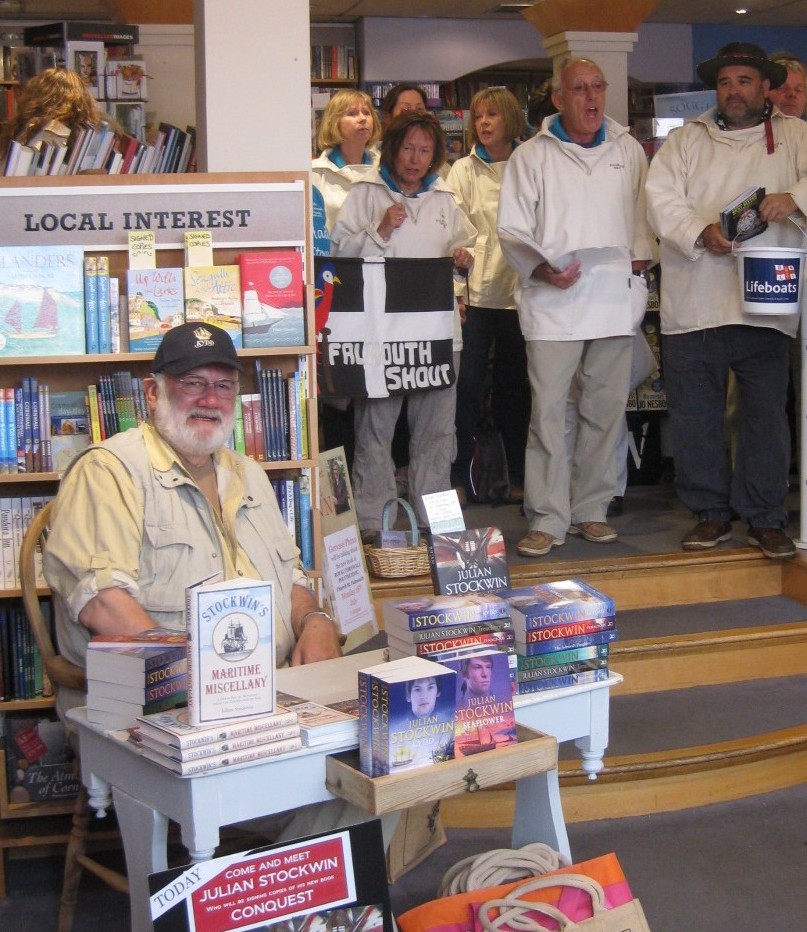
How many authors can say they’ve been serenaded at a book signing? Thanks, Falmouth Shout!
Among the special events that were organised to launch this book were a lecture at Pentillie Castle in Cornwall for Independent Booksellers Week and various book signings and talks. One signing I particularly enjoyed was held at Falmouth Booksellers where I was serenaded by Falmouth Shout, a wonderful group of Cornishmen (and women) who delight to quaff and sing shanties together. They also started the shanty festival in Falmouth and raise money for the Royal National Lifeboat Institution and other charities.
Copyright notices
Every effort is made to honour copyright but if we have inadvertently published an image with missing or incorrect attribution, on being informed of this, we undertake to delete the image or add a correct credit notice
 Julian Stockwin