
KyddFest-3: Seaflower
Posted on February 23, 2016 12 Comments
Over the coming months I’ll be celebrating the earlier titles in the Kydd Series, it’s Seaflower for this blog. I’d love to hear your thoughts on this book, either as a first-time reader or if you’re a re-reader and have read the book more than once! It’s very gratifying for an author to be told that his work has inspired people to go back an read it again. And some of you have told me you have done this more than twice! Either reply to this blog or email me. Every respondent goes into the hat for a chance to win a special thank-you prize: a CD set of the unabridged audiobook of Seaflower, superbly read by Christian Rodska..

At the careening capstan, English Harbour, Antigua
‘Seaflower is the third novel in Julian Stockwin’s series devoted to the nautical adventures of the fictional Thomas Paine Kydd. This time the setting is the Caribbean Sea, where Kydd and his friends have been hustled on account of their inconveniently truthful depositions at a court martial. Now they must face the new challenges of hurricane and yellow fever as well as the familiar danger of war at sea against the French foe. For some time Kydd and his good friend Renzi are parted by the exigencies of war, and we learn fresh details about the latter gentleman’s family background, and even his real name, richly deserved even according to the exacting eighteenth-century classifications. As their journeys weave back and forth between Barbados and Port Royal, with stops at Antigua and an assortment of French islands on the way, we overhear tales of the old days of piracy and learn a bit about the slave economies of the sugar-producing islands. There are also a couple of surprising family reunions along the way. As this tale reaches its climax, our friends find themselves on a mission to deliver a prestigious emissary with urgent news about the war. The obstacles soon become overwhelming, and only the knowledge that the series will continue hints that they will prevail against long odds.
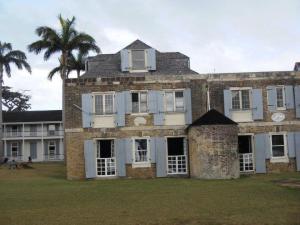
Part of the Georgian Dockyard, English Harbour
With this third novel Stockwin seems fully at ease with his voice, more assured in his decisions to summarize and leap forward in time rather than maintain an unbroken tempo. Or perhaps he is simply one of those happy companions on a long journey with whom one feels increasingly comfortable as time makes his ways familiar. Stockwin is certainly a narrator whose amiable manner wears well, and one whose storytelling decisions grow easy to trust. Seaflower offers an eventful Caribbean cruise with a bit more terror and despair than usual, but it ends with prospects looking good for its upwardly-mobile hero.’
– HistoricalNovels.info
Deeply interesting past

Like this reader’s style!
As I said in the Author’s Note to this book I am a visile – I have to ‘see’ things in my mind’s eye before I can write about them. Away from the gaudy tourist haunts in the Caribbean there are many tactile relics of rousing times past, unwittingly bequeathed to us by men whose concerns of the hour did not include a care for posterity. Henry Morgan’s Port Royal slid into the sea a century before Kydd arrived, but the bones of the dockyard still exist, albeit in a parlous state. More rewarding is English Harbour in Antigua, where Kydd suffered and loved, and which remains much as he would remember – an undisturbed and uniquely preserved jewel of naval history.
There are many who care about the Caribbean’s past, and I think especially of Reg Murphy of Antigua dockyard, who told me the story of the deadly confrontation on the quayside, which I faithfully retell in this book, and Desmond Nicholson whose encyclopaedic knowledge so enriched my visit. In Barbados, the staff of the museum were especially kind, enabling me to find Karl Watson at an archaeological dig of the eighteenth century; he then provided me with an embarrassment of material. In Jamaica, John Aarons at the National Library proved a fascinating source of his country’s deeply interesting past.
Minor character spotlight: Caird
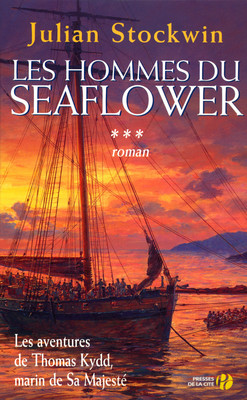
The French Edition of Seaflower
In Seaflower, we meet Zachary Caird as he leads the small dockyard party to inspect the storm-damaged Trajan when she arrives in Antigua. Born and brought up in Wapping, the boy Caird was no stranger to the colourful world of docklands around the great Pool of London, the biggest port in the world. Thrilled by tales of the seven seas told by seamen from every corner of the globe, he longed to go to sea. But his hard father, a brewery drayman, swore that Zachary should not be a common sailor but have a proper trade, and Zachary was bound apprentice to the Royal Dockyard in Deptford.
The lad promised his father he would not disappoint him. There were many temptations, but he always kept faith. After his apprenticeship was over and he started work as a shipwright’s sidesman he continued his habits of moderation and self-control, unusual among his hard-bitten workmates.
As a journeyman shipwright he had occasion to repair a Bethel – a floating chapel for seamen. There, he was touched by the selfless devotion of the lay workers. Later, he answered a need for skilled craftsmen for the dockyard at Antigua in the Caribbean, and among the slaves in this exotic locale, he, too, found himself called to become a lay preacher.
Dedications
It’s always an enjoyable task – choosing a dedication for the book before sending it out into the world. Kydd had a dedication to Jack Tar, Nelson’s famous quote – ‘Aft the more honour, Forward the better man‘; for Artemis it was ‘to the mistress of my heart‘ (Could this be soul-mate Kathy – or the sea? I’ll leave it to you to decide…)
One of my favourites out of all the dedications for the sixteen titles to date is the one I selected for Seaflower, the old sea toast:
- “To the wind that blows
a ship that goes
and the lass that loves a sailor“
Previous blog on Seaflower :
Turquoise water, deadly perils
Seaflower has been published in the UK/US in English, in French, German and Japanese and in ebook, large print and audiobook. The cover of Seaflower is also available as a Limited Edition print
Detailed list
KyddFest-2: Artemis
Posted on February 16, 2016 49 Comments
Over the coming months I’ll be celebrating the earlier titles in the Kydd Series, it’s Artemis for this blog. I’d love to hear your thoughts on this book, either as a first-time reader or if you’re a re-reader and have read the book more than once! It’s very gratifying for an author to be told that his work has inspired people to go back an read it again. And some of you have told me you have done this more than twice! Either reply to this blog or email me. Every respondent goes into the hat for a chance to win a very special thank-you prize: a limited edition print of the cover of Artemis.
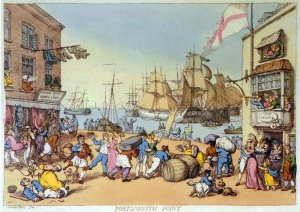
The riotously exuberant Portsmouth Point
‘It’s remarkable how quickly the interest in colourful naval adventure has grown in recent years. Foremost among able practitioners is Julian Stockwin and his book, Artemis, which builds on the solid achievements of the much-acclaimed Kydd; here again is the same flinty characterisation, stunning narrative skills and (most of all) considerable imaginative skill in evoking the wind-lashed atmosphere of the best nautical novels: full of sharp detail and keenly evoked atmosphere.
It’s the great age of fighting sail, when the seven seas are stalking grounds for prey and prize money. Aboard the crack frigate HMS Artemis, life can be invigorating – and short. Now a fully fledged Jack Tar, Stockwin’s doughty hero Kydd returns to Portsmouth and a hero’s welcome after cutting a bloody swathe through French ships. But urgent family matters force him to return to Guildford where he finds himself less able to cope than he was at sea. Soon, land-bound life is chafing him, and Kydd is happily back on Artemis setting out for the Far East, and encounters with some lethal opponents. After a grim encounter with slavers, Kydd finds himself facing his own mortality in the waters of the Great Southern Ocean. Stockwin’s particular ability (among so many) is his fastidious evocation of life aboard a sailing ship and the tensions that exist between the men locked into this dangerous life. The dialogue may take a little getting used to, but it’s quickly apparent that this is one of the author’s key strengths: this, you feel, is how these men really spoke. Most of all, though, it’s the exhilarating recreation of the sailing life and its attendant dangers that keeps the reader transfixed.’
– Barry Forshaw, broadcaster and critic
My Sea Artefacts
As I wrote in the Author’s Note to Artemis, at my desk is a length of rope from the 74 gun ship-of-the-line HMS Invincible that two centuries ago struck on the sands off Selsey Bill. The rope still smells of sea and Stockholm tar. I have other relics, too; a seaman’s tankard, a gunlock flint – an Admiralty issue clerk’s writing kit – each one bringing that far-away world straight into my consciousness. This I value above all things – as the one thing that I would most like the reader to take away from my books is a perception of the reality of Kydd’s world.
The Kydd Collection
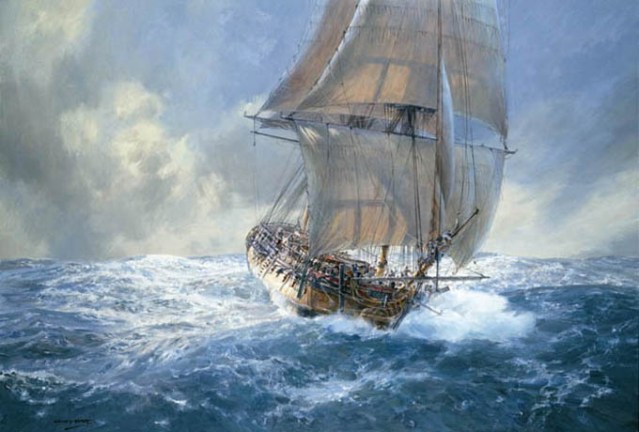
Superb Limited Edition Print prize!
Superb limited edition prints of the first eight of the Kydd series book covers, based on original paintings commissioned from Geoff Hunt RSMA, are available from Art Marine. All respondents to this blog (and emails about the blog) go into the hat for a chance to win a print of Artemis. Deadline: Monday 22 February. I have the prints framed and hanging in my Devon home and they all draw admiring comments but Artemis has always been my favourite! There’s something about the movement of the frigate and the power of the Great Southern Ocean that is very compelling.
Minor character spotlight: Quashee
In Chapter one of Artemis, Kydd joins his mess and is introduced to Quashee: ‘If yer wants to raise a right decent sea-pie, he’s your man…’ Quashee’s ancestors were Akan-speaking Ashanti, sold into slavery by Arabs and eventually brought to Jamaica. A revolt by a kinsman, Cudjoe, resulted in a treaty with the British that established the Maroons, escaped slaves who had set up their own settlements in the mountains, as free people. Quashee’s easy nature came from his family; his mother was renowned for her peach-fed iguana while his father’s talent at gaily decorated yabba pots and gourds ensured they would not have to toil for long in a grung (smallholding).
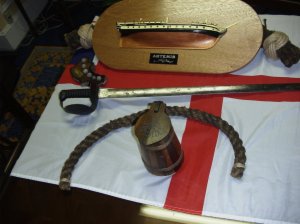
A wonderful half-model of Artemis presented to me by Bob Squarebriggs
As a young man Quashee tired of the posturing of the proud Maroon youth and shipped out in a coaster trading with Charleston in the US. There, to his dismay, he was several times mistaken for a notorious escaped slave, and to avoid this had to sign on as a cook in a humble Honduran mahogany drogher. War came to the Caribbean, and the Port Royal naval base filled with men-o’-war. Quashee was quite taken with the pomp and ceremony, and offered his services to a large frigate where he was told that a cook in the Royal Navy was a warrant officer, but that if he volunteered as a landman he would soon make a fine sailor. The frigate sailed for home and paid off in England, her company turned over into HMS Artemis.
Previous blog on Artemis
ARTEMIS: Sailing seven seas
Artemis has been published in the UK/US in English, French, German and Japanese and in ebook, large print and audiobook.
Buy on Amazon or The Book Depository (free postage worldwide!) Also available at most bookstores.
Detailed list
KyddFest-1 : KYDD
Posted on February 9, 2016 25 Comments
Over the coming months I’ll be celebrating the earlier titles in the Kydd Series, starting with the first book, Kydd. I’d love to hear your thoughts on this book, either as a first-time reader or if you’re a re-reader and have read the book more than once! It’s very gratifying for an author to be told that his work has inspired people to go back an read it again. And some of you have told me you have done this more than twice! Either reply to this blog or email me Every respondent goes into the hat for a thank-you prize.
- ‘Kydd took in the colossal form of a great ship. It seemed all gunports and lines of yellow and black timber, unknown fitments and black ropes. It towered up to the deck-line, and then above to an impossibly complex structure of masts and yards, black and ominous against the sky.’

A painting of a real Thomas Kydd, master’s mate in 1801, actually not far off how I see Kydd at that stage of his life
Enjoying a convivial brew at a local tavern, young wigmaker Tom Kydd has no inkling that his life is about to change forever. Until now the momentous events of 1793 have had little impact on the rural township of Guildford, but Britain is at war with the French Revolutionary regime and must hastily man its navy. Throughout the countryside the press-gangs are busy at work, ‘impressing’ men by force into the king’s navy, and the appalled patrons of the Horse and Groom are amongst their haul.
Home for Tom and his fellow captives is now HMS Duke William, a massive ship-of-the-line. It’s a terrifying, alien world. Conditions are grim, discipline harsh, the rigid rules of conduct and even the language incomprehensible. Kydd is fortunate; under the patient tutelage of a kindly old sea hand he discovers an affinity for the sailor’s life. Laughing with exhilaration in the teeth of a gale, he has an epiphany:
- ‘Something in him reached out and was answered. A fierce joy touched his soul. It didn’t matter that the situation was perilous or the ship doomed. From that moment on Kydd knew in his heart that he would be a seaman.’
‘Kydd is the opening salvo in an addictive series of naval adventures, marked by excellent characterisation and fluid, fast-paced prose. Landlubberly readers may initially flounder in the welter of unfamiliar naval jargon. Grab a lifeline and hang on; as Kydd learns the ropes, so do we, experiencing with him the majesty of the ocean in all its moods, exotic destinations, dramatic, bloody battles on land and sea, and the sturdy comradeship of messmates whose lives depend upon each other’s teamwork.
– HistoricalNovels.info
Based on the historical record
As I wrote in the Author’s Note, Kydd is definitely based on real life. I feel that I would devalue what the eighteenth-century seaman really achieved were I to exaggerate or distort facts for the sake of drama – for me, a particularly odious form of betrayal. Therefore, all the major actions and most of the minor are as close as I can make them to the real thing.
Thomas Kydd

Reading the Japanese Edition
In the circumscribed world of eighteenth- century society, there were those fortunate enough to be well-born, and there were the lower orders who knew their place and in the main accepted it. Yet in the twenty-two years of warfare at the end of the century, a total of 120 or so men crossed from the fo’c’sle to the quarterdeck through their own exceptional merit, passing thereby from common seaman to gentleman. And of these, twenty-two went on to become captain of their own ship, and three, possibly five, ended as admiral! Thomas Kydd is based on these.
And imagine my surprise when I came across an eighteenth century portrait of a master’s mate named Thomas Kydd! Is this what my hero might have looked like? He’s quite a handsome chap…
Moon rocket of its day
The mighty ship-of-the-line was as complex in its day as a moon rocket today. Most seamen were proud, self-sufficient and resourceful men sharing a remarkable culture, but they were not articulate. This book is my tribute to those who became masters of the sea in the greatest age of fighting sail.
Minor character spotlight: Ah Wong
I greatly enjoyed creating the cast of characters for Kydd and as the lower deck of a man-o’-war was very varied in terms of race, colour, creed – and life experiences, I had great scope.
Ah Wong first appears in in chapter two of Kydd; he’s the first Chinaman Tom Kydd has ever seen. Born second son of a minor mandarin to a favourite concubine, Ah Wong, real name Wong Hay Chee, seemed destined for a life of cultured ease in Kwangchow (Canton). However the accession of Emperor Chien Lung to the Dragon Throne was accompanied by social upheavals in distant provinces; his father was disgraced and committed suicide. His mother took the lively five-year-old into the safety of the countryside, but the dreary back-breaking labour broke her spirit and she died. Ah Wong was left to a childless rice farmer, where he endured his unhappy circumstances with uncomplaining stoicism. Unusually well-built, ‘Little Buddha’, as he was called, would impress his friends with his raw strength, and when a travelling circus passed through, he joined to become a strongman. After three years, bored with the same routines, Wong was easily tricked into shipping out in an opium trader to India. The clean and settled sea life appealed with its attractions of comradeship and adventure, and when the ship arrived to await the new-season crop, he had no hesitation in signing on in a homeward bound East Indiaman. Cast ashore on arrival in an uncaring London, he was easy meat for the press-gang at the outbreak of war, and quickly found himself with new messmates in the 98-gun Duke William.
Previous blogs on Kydd
My first book
Kydd’s home town
Kydd has been published in the UK/US in English, French, German, Japanese, Portuguese and in ebook, large print and audiobook
Buy on Amazon or The Book Depository (free postage worlwide!) Also widely available at independent bookstores
Detailed list
Copyright notices
NOTICES
Every effort is made to honour copyright but if we have inadvertently published an image with missing or incorrect attribution, on being informed of this, we undertake to delete the image or add a correct credit notice
Italy Through the Eyes of a Novelist
Posted on January 19, 2016 8 Comments
‘One doesn’t come to Italy for niceness, one comes for life.’ I think E M Forster aptly sums up what Italy means for the novelist. It is so rich, so alive, that it’s impossible for an author’s creative juices not to be stimulated by a visit. And of course Italy has the legacy of so many of the world’s great artists and sculptors who were inspired there. One of the most memorable moments I’ve ever experienced was coming into Venice for the first time, one evening in late January. As it was off‑season Kathy and I had the water taxi to ourselves, mist hung low over the lagoon, a whiff of the sea on the air and a dusky violet shimmer to the dawning light. We passed shrouded islands then the majesty of Venice opened up. Neither of us spoke for a long time as we took it in…

 We were there for location research and in Mutiny I describe approaching Venice through my hero’s eyes: ‘The spreading morning vision took Kydd’s breath away; an island set alone in a glassy calm some five miles off, fairy‑tale in the roseate pale of morning, alluring in its medieval mystery.’
Two of my books, Mutiny and Tenacious, see Kydd and Renzi in Italy. Initially I’d planned to feature the country in just one tale, but I was so inspired that I had to use it in another book. And possibly there will be more in the future…
The Grand Tour
Italy was the primary destination of the Grand Tour. If you were of noble birth in the Georgian age it was the done thing to complete your education with a period of European travel, lasting from several months to sometimes years. The British were particularly attracted to classical Italy and came to see, first‑hand, both monuments of civilisation such as the Coliseum, and wonders of nature like Mt Vesuvius.
 Renzi, who’s a somewhat enigmatic character in the earlier Kydd books, comes from a very high social background but when I first introduce him he’s a common sailor in a man of war. As a matter of principle he’s sentenced himself to self‑exile to expiate what he considers the sins of his family when a young labourer on his estate committed suicide as a result of an Enclosure Act’s effects.
Renzi had been on the Grand Tour. He’d also stayed with a very important diplomat in Naples, the ambassador, Sir William Hamilton, husband of Emma Hamilton, who had a passionate love affair with Lord Nelson. One of Hamilton’s interests was vulcanology, and he invites Kydd and Renzi to take in the spectacle of Mt Vesuvius.
I’m a visile
We left the UK by air for Venice, the city that stole our hearts. All too soon we had to move on, following the spine of Italy to the south by train. Next stop: Florence, then we headed to Rome. Our final destination was Naples before returning to the UK. Going by train is a good way to see the countryside and also in my case I don’t like airports and tiny seats in planes! The trains in Italy are very comfortable and we’ll certainly travel this way again.
Before we set out on location research there’s a great deal of planning, contacting experts in various fields, finding where the museums and archives are etc and who’s in charge and so on. Our primary goal is to get a good picture of the place in the eighteenth century and for this we have to be quite disciplined indeed, not to get sidetracked with material, however interesting, that’s not concerned with the plot of the book.
I’m a visile – when I write I need to be able to see things in my mind’s eye. Also there are certain intangibles about a place – the smells, the colours, the sounds, you can only get from actually being there.
I always carry a tiny dictaphone and digital camera on me. These are used to record all sorts of things during the day, and then at night I have to enter the notes and pics into the laptop before I’m allowed that first drink of the evening. We also always end up buying all sorts of priceless local reference books, maps, charts and so on. Often these are so heavy we have to send them back separately! They are a wonderful adjunct to the photos I take and I use them as I write to refresh my memory of actual details.
Greatest shipyard in the world

Sir William Hamilton
Venice stands virtually as it did two centuries ago. In fact in Venice you are looking at 1100 uninterrupted years of empire. It was also once the greatest shipyard in the world with 16,000 workers. Its feared rowed galleys dominated the Eastern Mediterranean. But as interesting as all this history is to me we had to focus our work.
The first stop was the Maritime Museum where I wanted to see a genuine gondola from the eighteenth century. Unlike most of those today, it was painted black in deference to the sumptuary laws. Today there are around 500 gondolas, but in the period I write about there were 14,000. With its black curtains I could immediately see a possibility for secret meetings, assignations – mystery and romance – or both…
I also wanted to look at the details of particularly Mediterranean vessels, like the strangely named xebec.
We didn’t miss St Marks Square and Florians. The best chocolate in the world!
In Mutiny Kydd and Renzi find themselves ashore in Venice on a mission to rescue an important diplomat. The scene is set at the point where Napoleon was about to fall upon the Venice of Casanova and end its 1000 years under a Doge. While they are waiting for news of the diplomat they venture into the streets. They are separated and Renzi is tormented by memories of his former time in Venice.
Nelson and Naples
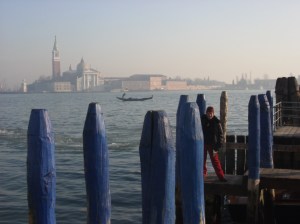 Naples, the third city of the world according to Goethe. And no doubt you’ve heard the the phrase ‘See Naples and die…’
Nelson has very strong links with Naples. It was there he sailed to after his incredible victory at the Battle of the Nile.
One of the things that surprised us about Italy is how much variation there is in just a short distance. Naples and southern Italy is so different to the north. Naples has a special and very distinctive vitality. It seemed to me totally appropriate that Nelson’s great victory at the Nile was recognised so exuberantly in Naples.
It’s not known when Emma Hamilton and Nelson first became actual lovers, but it is clear that Naples was a turning point for them.
I can’t wait to find an excuse to get Kydd and Renzi to return to Italy!
Copyright notices
Hamilton image: David Allan [Public domain], via Wikimedia Commons
Every effort is made to honour copyright but if we have inadvertently published an image with missing or incorrect attribution, on being informed of this, we undertake to delete the image or add a correct credit notice
BookPick: A History of the Royal Navy: Empire and Imperialism
Posted on January 12, 2016 5 Comments
This book is part of the eminently readable ongoing History of the Royal Navy Series published by I.B.Tauris, in association with the National Museum for the Royal Navy. The series, when complete, will consist of three chronologically themed books covering the sailing navy from the 1660s until 1815; the navy in the nineteenth century from the end of the Napoleonic Wars; and the Navy since 1900. These core volumes are complemented by titles on particular wars or specific aspects of the Service. All the books are standalone titles and taken together will provide a very comprehensive and accessible history of the Royal Navy from its beginnings to the present day. Six titles have been published to date.
 This latest volume reveals how the Royal Navy was central to the rise of imperial Britain. The British Empire, the largest in history, was fundamentally a maritime one. Britain’s imperial power was inextricably tied to the strength of the Royal Navy, the ability to protect and extend Britain’s political and economic interests overseas, and to provide the vital bonds that connected the metropole with the colonies. This book examines the Navy’s expansionist role on land and sea and also the ideological and cultural influence it exerted for both the coloniser and colonised. The Navy’s voyages of discovery created new scientific knowledge and inspired art, literature and film. Using the model of the Royal Navy, colonies began to develop their own navies, many of which supported the Royal Navy in the major conflicts of the twentieth century.
The book is divided into seven chapters and includes useful footnotes to each chapter, a bibliography and index, as well as illustrations and tables.
This study of probably the greatest ornament to British history is colourful, insightful and an absorbing read and this reviewer has no hesitation in recommending it to newcomer and old salt alike.
Daniel Owen Spence A History of the Royal Navy
Published by I B Tauris. ISBN ISBN978 1 78076 543 3
And to being the first BigJules blog of 2016, may I wish you all Happy New Year!
Heave Ho for the Festive Season!
Posted on December 15, 2015 15 Comments
 This is the last of my blog posts for 2015. It’s been a busy year with signings, talks and other promotional activities, especially since the launch of Tyger in October. As usual, there’s been location research abroad, intensive ferreting out of sources for the current manuscript and working paces with Kathy along the banks of the River Erme to firm up plot points. I think we’ve come together into a pretty effective literary team!
I’m now hard at work on the finishing touches to my next book, provisionally titled Inferno. It will come out in October 2016 and as usual there will be a Collectors Set offer. More details of this will be announced at a later date.
For this book we travelled to Denmark to meet with historians and military experts, as well as poring over material in archives and libraries there and taking in geographical sites of relevance.
 But Kathy insisted on having a break from work and paying homage to the little mermaid. Although of course it wasn’t there in Kydd’s day! The captivating little statue sits on a rock in the Copenhagen harbour in Langelinie. It was commissioned in 1909 by Carl Jacobsen, son of the founder of Carlsberg, after he’d been fascinated by a ballet based on the fairy tale. The sculptor Edward Eriksen created the statue, which was unveiled on 23 August 1913.
And by several requests, here’s my post from a few years back on Christmas at sea.
It just remains for Kathy and I to wish you all a happy Christmas and peaceful and prosperous 2016. And thank you for all the kind comments and feedback about my books; it means a lot!
BigJules posts will be back in the New Year.
The Weymouth Leviathan Maritime Literary Festival
Posted on December 8, 2015 1 Comment
 The picturesque town of Weymouth is situated in the county of Dorset on the south coast of England. It has a long and proud history, with a number of maritime, sporting – and royal – connections. In 1583 Captain Richard Clark departed from there to join Sir Humphrey Gilbert in his discovery of Newfoundland. In 1588 English ships sailed from Weymouth to meet the Spanish Armada. 1789 saw the first visit of King George III to partake of the waters and he took a dip in Weymouth Bay using one of the first bathing machines. King George enjoyed his time at Weymouth so much that he became a regular visitor! And in more recent times, the town hosted 2012 Olympics sailing events.

The inaugural Weymouth Leviathan Maritime Literary Festival will run over two days next year, March 12-13.
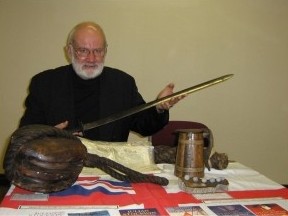 I was delighted to be invited to participate in the event, and as the themes of the festival are fear and courage it seemed appropriate that my talk be: ‘The Real Jack Tar.’ The legendary heroes of the quarterdeck – Nelson, Howe and Pellew – are deservedly famous, but what of the men of the fo’c’sle? The men on the lower deck were exceptional seamen, tough and loyal characters who have contributed to a sea culture that has flowered and endured over the centuries. But there is still much we don’t know about Jack Tar. It’s time for the real men to step out from the shadows and take their place among the heroes of the age!
 I’ll also have a selection of some of my antique eighteenth century naval artefacts with me – and my books will be on sale; I’m happy to sign them on the day.
The festival organisers have put together a wonderfully varied programme that includes talks from curators from the National Maritime Museum in Greenwich, other writers, historians, broadcasters, journalists, sailors and photographers. There will also be a screening of the 1956 adaptation of Moby Dick and both a novel writing workshop and a photography workshop. Oh, and sea shanties, poetry, choral pieces, a sound installation and a maritime church service…
Events will be taking place across the town at venues including the Old Rooms Inn and the Royal Dorset Yacht Club.
Further information can be obtained from the festival organiser James Farquharson at info@weymouthleviathan.org.uk or phone 0788 7712472.
The festival website and Twitter @weyleviathan also have details.
Here’s the festival lineup and booking form. Hope to see you there!
Full details of the events in alphabetical order by surname.
If you’re looking for accommodation – the festival organisers suggest:
At Tripadvisor, filter Hotels in Weymouth to show B&Bs
Or try the Lodmoor Premier Inn
(The entire Harbour House has been booked for festival speakers so there’s no room availability there)
Copyright notices
Image of 2012 Olympic sailing: By Caroline Granycome (Flickr: 2012 Olympic Sailing, Weymouth, Dorset) [CC BY-SA 2.0 (http://creativecommons.org/licenses/by-sa/2.0)%5D, via Wikimedia Commons
Image of Weymouth waterfront: J. M. W. Turner [Public domain], via Wikimedia Commons
Every effort is made to honour copyright but if we have inadvertently published an image with missing or incorrect attribution, on being informed of this, we undertake to delete the image or add a correct credit notice
Books for Santa’s Sack, Part 3
Posted on December 1, 2015 3 Comments
Part 3: I’m a bit of a bah humbug man when it comes to the commercialisation of Christmas – but there’s one thing that I fervently believe: a book is a present that, if well chosen for the recipient, will give hours of pleasure and be a lasting reminder in itself of someone putting thought, not just money, into a Yuletide gift. Here are the final three books in my baker’s dozen suggestions for your present-buying list.
— ♥ —
The British Carrier Strike Fleet by David Hobbs
 This author served in the Royal Navy for over 30 years and his Service time overlaps my own years in the navy, and much of what he has to say resonates strongly.
I’m proud of the fact that the Royal Navy invented many of the techniques and devices crucial to modern carrier operations. In 1945 the most powerful fleet in the Royal Navy’s history was centred on nine aircraft carriers. This book charts the post-war fortunes of this potent strike force, its decline in the face of diminishing resources, its final fall at the hands of uncomprehending politicians, and its recent resurrection in the form of the two Queen Elizabeth class carriers, which, when built, will be the largest ships ever constructed for the Royal Navy.
It’s a pretty meaty book – I for one was fascinated at the strategic depth behind carrier operations in which I served in the Far East and now revealed to me, for it’s an important but largely untold story, and certainly of renewed significance as Britain has committed to once again embracing carrier operations, albeit not for a few years yet…
The Seasick Admiral by Kevin Brown
 Horatio Nelson did not possess particularly good health. During the entire time he was growing up he suffered from many of the ailments common in the eighteenth century. After he joined the Navy he went down with fevers that further undermined his strength: he was always seasick outward bound when the ship first put to sea. The Fighting Admiral saw more action than most officers, and often took injuries – the loss of the sight in one eye and an amputated arm were the most public, but by no means his only wounds.
This personal experience of illness made him uniquely aware of the importance of health and fitness to the efficient running of a fleet, and this new book investigates Nelson’s personal contribution to improving the welfare of the men he commanded, the deeply humanitarian side of a great warrior.
There is all of 16 pages of photographs and illustrations to complement the text.
Commemorating the Seafarer by Barbara Tomlinson
 The author was Curator of Antiquities at Royal Museums Greenwich (part of which is the National Maritime Museum) for over thirty-five years. This book discusses memorials commemorating British seafarers, shipbuilders and victims of shipwreck from the sixteenth century to the present. Examples have been chosen mainly from Great Britain and Ireland with a few from wider afield. They include important works by major British artists as well as more modest productions by anonymous carvers.
What is particularly engaging about the book is the retelling of the dramatic stories behind the monuments, throwing into stark relief the significant social and cultural changes in Britain’s relationship to the sea.
Still looking for bookish inspiration?
You might also like to take a peek at my other BookPicks this year this year
And I have a very limited number of Signed First Editions, which I’m happy to inscribe with a personal message
Still time for overseas orders to arrive in time for Christmas! And I’m offering a 10% discount for purchases of two or more titles. (The discount will be refunded to your account after receipt of the payment.)
Books for Santa’s Sack, Part 2
Posted on November 24, 2015 1 Comment
Part 2: I’m a bit of a bah humbug man when it comes to the commercialisation of Christmas – but there’s one thing that I fervently believe: a book is a present that, if well chosen for the recipient, will give hours of pleasure and be a lasting reminder in itself of someone putting thought, not just money, into a Yuletide gift. So do consider adding some of these fine books – all with a maritime, military or Georgian era link – to your present-buying list. Hopefully, there’s something for everyone in this somewhat eclectic selection…and if not, well, there’ll be more next week…
— ♥ —
Scottish and Manx Lighthouses by Ian Cowe
 To the sailor the lighthouse is not a thing of fear, a sudden looming that tells of his ship’s imminent shipwreck against a rock-bound coast. Instead it’s a thing of comfort, of blessed certainty – for he knows at once just where he is! This reviewer for one knows the warm rush on the darkened bridge in filthy weather when a light is identified, a snap bearing, and then a casual ‘steady as she goes’ down the voicepipe to the helm.
This collection of stunning photographs captures the drama and beauty of these iconic structures. The author takes the reader on a journey by land, sea and air along the rugged coastline of Scotland and the Isle of Man. He also pays tribute to the achievements of the immortal Stevensons who battled against the elements for over 150 years to bring them to existence and then the intrepid keepers who so faithfully manned these sentinels of the sea for months at a time and in the worst of weathers.
A wonderful book for all lighthouse enthusiasts – and in fact any reader with an appreciation of our rich maritime heritage.
Death Before Glory by Martin R Howard
 When I was researching Seaflower and Caribbee I devoted some time to delving into the experiences of the British soldier in the West Indies during the French revolutionary and Napoleonic wars. Howard’s book would have been a priceless adjunct to my research then! Rich in sugar, cotton, coffee and slaves, the region was a key to British prosperity but it was perhaps even more important to her greatest enemy – France. Howard details the British campaigns during this period and also sheds light on the soldiers’ experiences – the climate and living conditions, the rations and diet, military discipline and training, the treatment of the wounded and the impact of disease.
Death Before Glory! is a highly readable study of the British army’s campaigns in the West Indies from 1793-1815.
Sailor in the White House by Robert F Cross
 Now in paperback, one of the most interesting and intimate books about Franklin D. Roosevelt. Secret Service agents, family, and old sailing pals share stories about their days on the water with America’s greatest seafaring president.
This perspective on Roosevelt shows how his love of the sea shaped his presidency.
Servants’ Stories by Michelle Higgs
 With the popularity of the television series Downton Abbey we seem to have developed a renewed interest in life below stairs. Between 1800 and 1950 the role of servants changed dramatically. In this fascinating social history Michelle Higgs, through oral histories, diaries, newspaper reports and testimonies, lets domestic servants tell their stories, warts and all.
If any of your ancestors were in service this book will certainly shed light on just how they lived!
America Spreads her Sails Compiled and edited by Clayton R Barrow Jr.
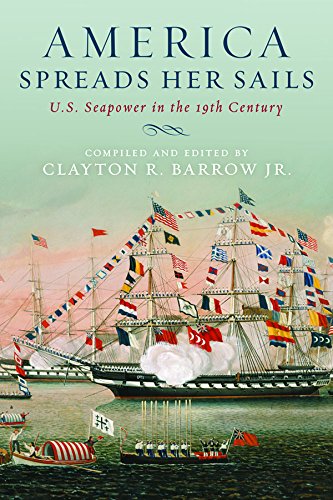 In this new paperback edition fourteen writers and historians demonstrate how American men and goods in American-built ships moved out over Alfred Thayer Mahan’s ‘broad common’, the sea, to extend the country’s commerce, power, political influence, and culture. Capt. Thomas ap Catesby Jones, Lt. John ‘Mad Jack’ Percival, and Cdre. Matthew Calbraith Perry are among some of the colourful names many will recognize. They are all gone now but these strong men and their stout ships carried their country’s colours around the world.
A compelling account of US seapower in the nineteenth century.
Still looking for bookish inspiration?
You might also like to take a peek at my other BookPicks this year this year
And I have a very limited number of Signed First Editions, which I’m happy to inscribe with a personal message
Still time for overseas orders to arrive in time for Christmas! And I’m offering a 10% discount for purchases of two or more titles. (The discount will be refunded to your account after receipt of the payment.)
Books for Santa’s Sack, Part 1
Posted on November 17, 2015 1 Comment
I’m a bit of a bah humbug man when it comes to the commercialisation of Christmas – but there’s one thing that I fervently believe: a book is a present that, if well chosen for the recipient, will give hours of pleasure and be a lasting reminder in itself of someone putting thought, not just money, into a Yuletide gift. So do consider adding some of these fine books – all with a maritime, military or Georgian era link – to your present-buying list. Hopefully, there’s something for everyone in this somewhat eclectic selection…and if not, well, there’ll be more next week…
— ♥ —
Ate the Dog Yesterday by Graham Faiella
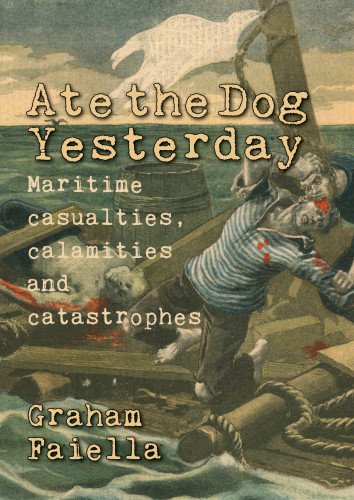 Here’s true-life dramas from the late 19th and early 20th century – the constant dangers ships and sailors faced at sea. There’s mutiny, murder and seaquakes – and great disasters including Sir John Lawrence: loss of all crew and 730 pilgrims; Camorta, sunk in a Bay of Bengal cyclone with 739 dead, and the sinking of Utopia at Gibraltar with over 500 lives lost.
Recounted mainly as original narratives compiled from Lloyd’s List, this book has a fund of amazing tales to keep a reader engrossed for many hours.
French Warships in the Age of Sail 1786-1861 by Rif Winfield and Stephen S Roberts
 I have a number of books by Rif Winfield and have great respect for his scholarship. This one is co-authored by Dr Stephen S Roberts, a leading American authority on French warships, and those of the nineteenth century in particular. In 1786 the French Navy had just emerged from its most successful war of the eighteenth century, having on many occasions it has to be said outfought or outmanoeuvred the Royal Navy in battle, and made a major contribution to American independence. The reputation of its ship design and fighting skills never stood higher, yet within a few years the effects of the French Revolution had devastated its efficiency. It was only after 1815 that the navy revived, espousing technical innovation and invention, to produce some of the most advanced ships of the age.
A fascinating account of the design, construction, careers and fates of French warships in the latter half of the sailing era.
A Pauper’s History of England by Peter Stubley
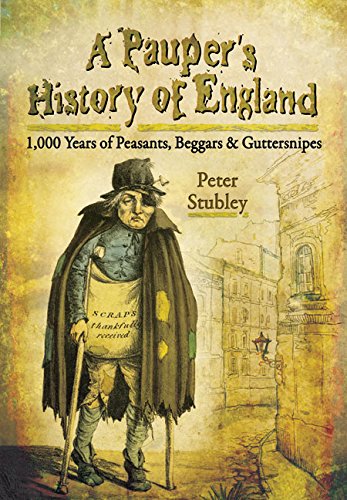 This book covers 1,000 years of poverty from Domesday right up to the twentieth century, via the Black Death and the English Civil War. It uses contemporary sources to give the reader an idea of just what life was like for the peasants, paupers, beggars and the working poor as England developed from a feudal society into a wealthy superpower.
I’m attracted to Peter Stubley’s meticulous research which conjures up the sights, sounds and smells of a compelling – and dark – part of English history.
In the Shadow of the Alabama by Renata Eley Long
 The author looks at an allegation of betrayal made against a certain young British Foreign Office clerk, Victor Buckley, who, it was claimed, leaked privileged information to agents of the southern States during the American Civil War. As a consequence, the CSS Alabama narrowly escaped seizure by the British government and proceeded to wage war on American shipping. Victor Buckley’s background is examined against the hitherto erroneous belief that he was an insignificant member of the foreign office staff.
A riveting tale of Anglo-American intrigue!
Before the Ironclad by David K Brown
 Originally published in 1990, this classic work has been reprinted, with more extensive illustrations. Beginning with the structural innovations of the gifted Robert Seppings, the book traces the gradual introduction of more scientific methods and the advent of steam and the paddle fighting ship, iron hulls and screw propulsion. It analyses the performance of the fleet in the war with Russia (1853-1856), and concludes with the design of the Warrior, the first iron-hulled, seagoing capital ship in the world.
A gripping and authoritative history of the transition from sail to steam in the Royal Navy.
Still looking for bookish inspiration?
Here are my earlier BookPicks this year
And I have a very limited number of Signed First Editions, which I’m happy to inscribe with a personal message
Still time for overseas orders to arrive in time for Christmas!
 Julian Stockwin