
Gunpowder: Ten Cool Facts
Posted on July 26, 2016 7 Comments
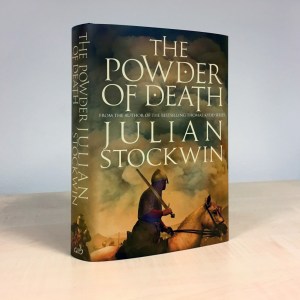 Research for me is almost as interesting and rewarding as actual writing. I found this particularly true when doing my homework for The Powder of Death, my new historical standalone, out August 18. Not only did I have to delve into the medieval period in Europe but ancient China, the chemistry of gunpowder and the physics of early ballistics. Certainly a riveting diversion from my ongoing Kydd tales and the Age of Fighting Sail! Here are some of the fascinating facts I came across researching The Powder of Death. And at the end of this blog there’s a chance to win a copy of the book, along with a smart Allison & Busby tote to carry it in!
Ten cool facts about gunpowder
- 1. Taoist alchemists combined sulphur, saltpetre and charcoal to make the earliest form of huo yao, or gunpowder, during the eighth-century. It was used to kill insects and treat skin diseases. Huo yao would later be used by the Chinese in the following century in fireworks and rockets.
2. Until the mid-19th Century, gunpowder was the only known chemical explosive.
3 Gunpowder is a classic green tea from Zhejiang province, China. Gunpowder tea is made up of leaves hand-rolled into tiny pellets that resemble gunpowder, giving, it is said, this tea its distinct name.
4.The explosive force of gunpowder is the result of very rapid burning, which creates hot gases 1500 times the original volume of the powder.

Workers mix gunpowder 1805. This method remained unchanged for centuries
5. Remember, remember the fifth of November, the Gunpowder Treason and Plot! Known as Guy Fawkes Night or Fireworks Night, the fifth of November is the anniversary of the plot by Guy Fawkes and other conspirators to blow up Britain’s parliament in 1605. Rebelling against the persecution of Catholics by King James I, they planned to kill the monarch during his visit to parliament. But the scheme was foiled and the traitors executed.
6. Shakespeare mentions gunpowder in Henry IV Part 1 (and other plays): ‘Zounds, I am afraid of this gunpowder Percy’ cries Falstaff. And it’s believed that Macbeth is a comment on The Gunpowder Plot.
7. The earliest surviving record for the use of gunpowder in mines comes from Hungary in 1627.
8. The first time gunpowder was used on a large scale in civil engineering was in the construction of the Canal du Midi in Southern France. It was completed in 1681 and linked the Mediterranean sea with the Atlantic.
9. In 1856 England exported 10,500,018 pounds of gunpowder.
10. November 5 was a statutory holiday until 1859 under the Observance of 5th November Act 1605. The Act described the gunpowder plot as ‘an invention so inhuman, barbarous and cruel, as the like was never before heard of’.
For a chance to win a copy of The Powder of Death and a smart Allison & Busby tote email julian@julianstockwin.com with your full postal address and ‘Powder of Death draw’ in the subject line. First out of the hat on Monday August 1 will be the winner!
(This draw is restricted to the UK)
The Powder of Death will be released in the UK and Europe on August 18, in hardback, ebook and audiobook. It will be available in Australia & New Zealand and South Africa on October 1. It can also be purchased via Book Depository, which offers free postage worldwide. The Powder of Death is the second title in the GameChangers: Moments of History Series, following The Silk Tree.
View my Pinterest board on The Powder of Death
I also have a Facebook Page on The Powder of Death
BookPick: Beyond Jutland
Posted on July 19, 2016 3 Comments
With this year seeing the centenary of the Battle of Jutland, the Royal Navy’s last great set-piece sea battle, a number of important books on Jutland have been published. I reviewed a selection of these in a previous blog. There have also been some excellent other titles forthcoming this year on various aspects of The Great War and naval policy between the two world wars. It is commendable that some of these books are reprints, bringing these classics to a new generation of readers of naval and military history many years after they first appeared.
— ♥ —
Endless Story by ‘Taffrail’
 Although first published in 1931, Endless Story remains the only comprehensive account of the services of the Navy’s small craft destroyers, torpedo boats and patrol vessels during the First World War, and the only one written by an officer personally involved. It was a bestseller in its day, and now deservedly enjoys the status of a classic. The emphasis is on the North Sea and Channel, which saw the most famous battles, but the book includes the Gallipoli campaign, warfare in the Mediterranean, ranges as far as the Pacific, where Australian destroyers were actively employed, and pays tribute to the work of American destroyers in British waters after 1917. It covers every kind of operation, from U-boat hunting and convoy escort, through minelaying to the Zeebrugge Raid. This new edition makes this classic work available for the first time in more than eighty years.
South Devon in the Great War by Tony Rea
 Dr Rea has long-standing interests in the First World War and local history. Illustrated with a number of fascinating old photographs, this succinct little volume provides a history of events in south Devon during the Great War. Among other topics, the book deals with the social changes brought to the region at that time – for example, by 1915 many of the young men and significantly almost all the horses had gone away to war. Older men and many women farmed the land and many large country houses were converted into hospitals and convalescent homes. Within the pages, too, are moving tales of sacrifice and loss, and the endurance of the human spirit. The book is part of the ‘Your Towns & Cities in the Great War’ series
The Victoria Cross at Sea by John Winton
 Naval VCs have been won in places as far apart in time and distance as the Baltic in 1854 and Japan in 1945, in the trenches from the Crimea to the Western Front, in harbours from Dar es Salaam to Zeebrugge, from the Barents to the Java Sea, from New Zealand to the North Atlantic, and from China to the Channel. The 628 awards of the Victoria Cross given for action during the First World War account for almost half the 1356 Victoria Crosses awarded throughout its history. This book tells the stories of the men and officers whose uncommon valour at sea earned them Britain’s highest military honour, and salutes those who may not be so well known as Boy Cornwell.
Naval Policies Between the Wars by Stephen Roskill
 First published in 1968 and 1976, the two volumes of this work still constitute the only authoritative study of the broad geo-political, economic and strategic factors behind the inter-war development of the Royal Navy and, to a great extent, that of its principal rival, the United States Navy. The main themes of the first volume are: the after-effects of the Armistice; the struggle to prevent a renewed naval arms race, despite the challenge from the USA and Japan, which culminated in the Washington Naval Treaty; and the broader attempts at peace-keeping through diplomacy and the fragile vehicle of the League of Nations. Picking up the story in 1930, the second volume covers the rise of the European dictatorships on the one hand, alongside continuing attempts at controlling arms expenditure through diplomacy and treaties. How the Royal Navy used the precious few years leading up to the outbreak of war is a crucial section of the book and forms a fitting conclusion to this important study.
Still looking for bookish inspiration?
You might also like to take a peek at my other BookPicks this year
And I have a very limited number of Signed First Editions, which I’m happy to inscribe with a personal message
Enjoy!
KyddFest-12:- Victory
Posted on July 12, 2016 17 Comments
 Over the previous months I’ve been celebrating the earlier titles in the Kydd Series, it’s Victory for this blog. I’d love to hear your thoughts on the book, either as a first-time reader or if you’re a re-reader and have read it more than once! It’s very gratifying for an author to be told that his work has inspired people to go back and read it again. And some of you have told me you have done this more than twice! Either reply to this blog or email me with your thoughts on Victory for a chance to win a signed copy of the book plus a handy deck-by-deck guide to the ship.
‘Victory starts off with a major setback for Kydd and keeps up a fast pace throughout which makes it another page turner for Julian Stockwin. It was never going to be easy weaving the events surrounding the well known and often used events of Trafalgar into something that was fresh and gripping but this is exactly what has been produced…
The personal lives of Kydd, his friend Nicholas Renzi and sister Cecilia are weaved skilfully into the events off Toulon and the fateful chase across the Atlantic when Kydd’s ship joins the fleet.
For Trafalgar itself Julian’s research and familiarity with the ship come through clearly, as a former shipmate, in the form of Midshipman Bowden, finds himself serving aboard Victory and is therefore well placed to observe and narrate the major aspects of the battle. The characterisations in this series have always been good but in this one they really mature and is probably the best one yet.
Definitely recommended.’ – Historic Naval Fiction
The enemy at Trafalgar
The Spanish contributed four First Rates to the Franco-Spanish Fleet at Trafalgar. Three of these ships, one at 136 guns and two at 112 guns were near twice as large as some in Nelson’s command, yet during the battle the Spanish commander Don Federico Carlos Gravina y Napoli, in his flagship Principe de Asturias, finding himself attacked by three British ships at once fled back to Cadiz.
As it was, Pierre-Charles-Jean-Baptiste-Silvestre de Villeneuve was in command of the combined French and Spanish forces, 33 ships-of-the-line – 41 ships in total – in his flagship Bucentaure. During the battle Victory raked her stern and she lost 197 killed and 85 wounded. Villeneuve was taken prisoner but later paroled and returned to France. He died in 1806; a dubious verdict of suicide was recorded.
Trafalgar in art

Trafalgar by Turner
There have been many paintings of HMS Victory, particularly at the Battle of Trafalgar. The one by Turner is probably the most famous artistic rendition of the battle even if not accurate in all the particulars. This was Turner’s only royal commission, ordered by George IV in 1822 to make a same-size pair with Phillipe-Jacques de Loutherbourg’s ‘Battle of the Glorious First of June, 1794’, already in the Royal Collection. The finished composition includes reference to a number of incidents that took place at different times in the battle and is in essence a high-Romantic commemoration of Nelson’s victory and death. More about this painting
HMS Victory today and tomorrow

The Grand Old Lady is undergoing extensive and ongoing conservation and restoration work. However she is still open for visitors. If you do pay her a visit you may find one of your guides is Paul Waite, who took the photograph of my book aboard the ship. Do say hello!
Previous blogs on Victory :
Kydd at Trafalgar
Victory 250 this Month
HMS Victory
Victory has been published in the UK/US in English, in translated editions and in ebook, large print and audiobook.
Buy on Amazon or The Book Depository (free postage worldwide!) Also available at most bookstores.
Detailed list
Copyright notices
Victory aboard Victory by Paul Waite
Painting: J. M. W. Turner [Public domain], via Wikimedia Commons
Every effort is made to honour copyright but if we have inadvertently published an image with missing or incorrect attribution, on being informed of this, we undertake to delete the image or add a correct credit notice
TYGER: An Ice Captain Reflects…
Posted on July 5, 2016 8 Comments
I always enjoy hearing from readers – and of all my Kydd tales to date I think Tyger has elicited the most comments, either on social media or in personal emails to me. It’s very gratifying to learn that so many readers +live the adventure+ with Thomas Kydd as he voyages around the world. And it’s particularly satisfying to hear from Old Salts that the books have brought back memories of their own time at sea. Captain Richard Smith, a retired Canadian Coast Guard Captain is one such…
 “Each spring I eagerly await the arrival of your latest book in Canada. I could not put Tyger down until I had read the whole book. Once again I thoroughly enjoyed the marriage of history with our favourite fictional characters. As a (now retired) Captain in the Canadian Coast Guard and having spent some measure of time in the ice off eastern Canada and the Arctic I can attest to the concerns of any ship’s master when navigating in or near ice. I can only imagine the concerns of trying to navigate a square rigged ship into ice infested areas of the high Arctic. Most areas were (and still are) poorly charted or not charted at all. Local knowledge becomes vital when navigating in these areas and getting that knowledge into chart and sailing direction formats takes considerable time.
I was Captain of CSS Hudson, a 300 ft multi disciplinary science ship, which was sent to Hudson Bay in 1995-6 to do a hydrographic survey of Rankin Inlet. It was a very dangerous, rock infested place on the western side of Hudson Bay. Once there we familiarized ourselves with the area and got on with the survey. We had five 30ft survey launches and a Bell helicopter on deck. Just as we were making some progress a huge storm came up with 90 mile per hour easterly winds. I took the ship out into the bay and hove to, but at one in the morning at the height of the storm the steering gear malfunctioned and the ship went beam on to the seas. She went into synchronous rolling and dipped the lifeboats and launches into the water. Lots of equipment shifted in the hold and things were not going well. As with any captain I feared the worst might happen. I had one chance and that was with the engines. Luckily we had a twin screw ship. I hauled the starboard shaft to stop and shoved the port shaft full ahead. Finally the ship started to come up into the wind and I continued to steer the ship with the engines until the engineers fixed the steering. It was a wild few days!
Your description of Tyger taking on water after the battle reminded me of my own experiences over a 40 year sea going career and how many times we face stressful times at sea.
I enjoy the fact that many of the characters you have created (such as Stirk) are still with Kydd. As a man who came aft through the hawse to become captain, I find Kydd reminds me of my own career progression and the challenges I faced. Many of the shipmates that sailed with me when I was a seaman were with me at various times in other ships when I was mate and master. I remember them fondly for the shipmates and friends they were.
It’s been 14 years now that I have been reading your books – and I look forward to the next adventure for Captain Kydd.”
I was intrigued to learn more of the history of Hudson and Captain Smith kindly sent me this article for download
The GameChangers : Moments of History Series
Posted on June 28, 2016 6 Comments

The GameChangers : Moments of History
I’ve always been fascinated by pivotal points in history; events and discoveries in the past that have shaped our modern world – and it’s been a most enjoyable diversion from my Kydd Series (which I am certainly continuing with, as well…) to write the first two books in GameChangers Series, The Silk Tree and The Powder of Death. They are both standalone novels, but connected by the fact that they deal with major milestones in history that have shaped our modern world.
The Silk Tree
A dramatic tale of how the secret of silk was brought from China to the West.
Forced to flee Rome from the barbaric rampages of the Ostrogoths, merchant Nicander meets an unlikely ally in the form of Marius, a fierce Roman legionary. Escaping to a new life in Constantinople, the two land upon its shores lonely and penniless. Needing to make money fast, they plot and plan a number of outrageous money-making schemes, until they chance upon their greatest idea yet.
Armed with a wicked plan to steal precious silk seeds from the faraway land of Seres, Nicander and Marius must embark upon a terrifyingly treacherous journey across unknown lands, never before completed.
The genesis of this book was in a bazaar in Istanbul. Kathy was haggling with a merchant over a rather lovely silk scarf and I idly wondered just how silk had made its way to the West. Later, I did some research and the creative juices started flowing…
Read an excerpt of The Silk Tree
The Powder of Death
But then what would be my next book? There are a number of pivotal points in history that I’m drawn to (and which will be the focus of future books in the series) but for my second one I chose the deadly introduction of gunpowder into Medieval Europe. While living in Hong Kong I was also fascinated by Joseph Needham’s monumental histories of science in China, which included a discussion of gunpowder. In fact the books travelled with me to England, and are still in my library. My father was an officer in the Royal Horse Artillery during the war and this book is dedicated to him.
The Powder of Death opens with a returned envoy to China meeting an English scholar in Oxford in the mid-13th century to share a lethal secret. They vow that the knowledge of gunpowder must die with them as the consequences otherwise are too terrible to contemplate. The novel tells the story of its re-discovery, one man’s obsession with the powder of death, and Edward III’s determination to use it to his advantage. He does so at the Battle of Crecy, the first full-scale battle at which guns are deployed in the field. The nature of warfare is changed forever, and the world hears the death-knell of Knightly chivalry.
Read an excerpt of The Powder of Death
KyddFest-11: – Invasion
Posted on May 24, 2016 9 Comments
Over the previous months I’ve been celebrating the earlier titles in the Kydd Series, it’s Invasion for this blog. I’d love to hear your thoughts on the book, either as a first-time reader or if you’re a re-reader and taken it in more than once! It’s very gratifying for an author to be told that his work has inspired people to go back an read it again. And some of you have told me you have done this several times! Either reply to this blog or email me. Every respondent goes into the hat for a chance to win a copy of the book.

Invasion snapped aboard HMS Victory
‘Commander Thomas Kydd, RN, is determined to once again sally forth to protect England from the threat of Napoleonic France. In this tenth volume of a thoroughly enjoyable series, our nautical hero witnesses the birth pangs of a new era in naval warfare. He is tasked by the high command to work with the eccentric American artist and inventor Robert Fulton on the development of Fulton’s submarine and torpedo-“infernal machines” to one comfortable on the quarterdeck of a sailing ship man-of-war.
The novel deals with the very real threat posed by a French invasion of England. Robert Fulton had first demonstrated his revolutionary weapon to the French but was frustrated at their hesitant reaction. Kydd’s good friend, Nicholas Renzi, is instrumental in convincing the reluctant American to transfer his allegiance from Napoleon to George III while Kydd is engaged in the deadly work of coastal warfare in the treacherous waters of the English Channel and the Downs.
Stockwin continues to display his talents in transporting his audience from the 21st century to the chaotic worlds of Kydd, Renzi, and their imperiled homeland and its enemies. He captures Georgian society and the closed world of a Royal Navy warship particularly well and, as one expects, goes into action with swords drawn and cannons and carronades blasting. Britannia does indeed rule the waves.’ – Historical Novel Society
The Sea Fencibles

Walmer Castle, Deal. Pitt used it as a residence for a time and it was also a focus for clandestine operations.
A naval militia established to provide a close-in line of defence and obstruct the operation of enemy shipping, principally during the French Revolutionary and Napoleonic Wars – after all, for most of the war, Bonaparte’s troops were under arms just 19 miles away! The earliest recorded use of the term was in 1793, when Captain Sir Home Popham organised groups of fishermen to guard against French vessels off the coast of Nieuwpoort, Belgium. At Popham’s suggestion the British Admiralty subsequently authorised the formation of Sea Fencible units along the English and Irish coasts, supported by a network of Martello towers. Popham’s Sea Fencible companies consisted of merchant seamen using their own private or commercial vessels, but operating under letters of marque that authorised them to capture enemy ships should opportunity arise. The Navy provided the Fencibles with uniforms and weapons; it also protected them from the depredations of navy press gangs. The Admiralty disbanded its Sea Fencible units in 1810.
The Goodwin Sands

Shingle beach, Deal – in calm weather! The Goodwin Sands is on the horizon…
A 10-mile long sandbank in the English Channel lying 6 miles off the Deal coast in Kent, England. The area consists of fine sand resting on an Upper Chalk platform belonging to the same geological feature that incorporates the White Cliffs of Dover. The banks lie between 26 ft and 49 ft beneath the surface, depending on location, since tides and currents are constantly shifting the shoals. More than 2,000 ships are believed to have left their bones upon the Goodwin Sands.
Recurring characters
I always enjoy bringing real-life characters into my Kydd tales and some of them make an appearance in more than one book. Admiral Sir James Saumarez is one of these, playing a role in both Treachery and Invasion. And when Kydd in involved in the Baltic Campaign in a few books’ time, Saumarez will again be part of the story. Do you have a favourite recurring historical (or fictional) character in the series? Let me know!
Previous blog on Invasion : Invasion: Glory and Adventure
Invasion has been published in the UK/US in English, in translated editions and in ebook, large print and audiobook.
Buy on Amazon or The Book Depository (free postage worldwide!) Also available at most bookstores.
Detailed list
Copyright notices
Invasion aboard Victory by Paul Waite
Every effort is made to honour copyright but if we have inadvertently published an image with missing or incorrect attribution, on being informed of this, we undertake to delete the image or add a correct credit notice
More Kydd Titles, More Often!
Posted on May 17, 2016 44 Comments
Reader feedback is very important to me and one particular aspect of my work has generated by far the most emails and comments on social media: the frequency of publication of the Kydd titles.

Team Stockwin will be raising a glass (or two…) tonight!
- ‘I really must complain about this latest edition of the Thomas Kydd series. I have found myself reading it, unable to put it down and at the same time, fretting because I am fast approaching the end … I am down to the last few pages and will soon be suffering from withdrawal symptoms until the next instalment.’
‘The thought that I have to wait almost a year before reading the next Kydd book is daunting.’
‘I’m anxiously waiting to see where Kydd and Renzi are headed next. One book a year isn’t nearly enough’
Kathy and I, along with my editor Oliver Johnson and my agent Carole Blake, have given a great deal of thought to see if it might be possible to write and publish more than one book a year in the Kydd Series. I’m delighted to say that this will now take place, starting next year. It will mean a pretty tight schedule for Team Stockwin but I’m confident that it is achievable.
This is the Press Release that has just gone out.

Oliver Johnston, my editor at Hodder
‘Hodder and Stoughton are pleased to announce the acquisition of four new novels by Julian Stockwin featuring his Napoleonic era naval hero, Thomas Kydd from Carole Blake at Blake Friedmann. The Kydd novels have been continuously published one book a year since 2001, but due to popular demand for this beloved series, Hodder will, after the publication of Inferno this Autumn, publish numbers 18 and 19 of the series in 2017 and 20 and 21 in 2018.’
Julian’s editor, Oliver Johnson says
- “It’s a testament to the enduring popularity of this series that we will be publishing two novels a year from 2017. Julian’s Kydd books must be the most popular current series set in the Age of Fighting Sail and long may he continue!“‘
Stockwin Ebook Bargains to Go!
Posted on May 11, 2016 7 Comments
For a limited time my UK publishers are offering all my fiction ebooks at bargain prices. Why not load up your E-readers with some or all of the books, ready for the summer holidays – and the convenience of having them altogether in one compact, portable format? By the way, it’s not essential to read the Kydd Series in order; there’s enough back story in each title to fill you in on what has gone before. Those Across the Pond are not forgotten with a free ebook of Quarterdeck from my US publisher. Happy Summer reading !
 |
 |
 |
From Hodder & Stoughton :
From McBooks Press :
Quarterdeck free download: Barnes & Noble, Amazon.com, Kobo, iTunes and other US internet ebook retailers.
From Allison & Busby :
The 2016 Collectors Sets!
Posted on May 10, 2016 6 Comments
This year I’m delighted to be offering +two+ Collectors Sets, Inferno and The Powder of Death. Each Set is strictly limited in number and I am happy to write short inscriptions on request. Inferno is the latest title in the Thomas Kydd Series and The Powder of Death is the second standalone historical novel in the GameChangers Series, following The Silk Tree.
THE POWDER OF DEATH Set
 The Powder of Death will be published in August by Allison and Busby in hardback, ebook and audio.
The book opens with a returned envoy to China meeting an English scholar in Oxford in the mid-13th century to share a deadly secret. They vow that the knowledge of gunpowder must die with them as the consequences otherwise are too terrible to contemplate. The novel tells the story of its re-discovery, one man’s obsession with the powder of death, and Edward III’s determination to use it to his advantage. He does so at the Battle of Crecy, the first full-scale battle at which guns are deployed in the field. The nature of warfare is changed forever, and the world hears the death-knell of Knightly chivalry.
This Set comprises a signed and numbered First Edition and a signed cover postcard. This offer is in very limited numbers, just 150, so don’t delay – first come, first served!
The INFERNO Set
 Inferno will be published in October by Hodder & Stoughton in the UK and McBooks Press in the US, in hardback, ebook and audio download.
The book opens in 1807. Captain Sir Thomas Kydd’s famous sea action aboard Tyger in the Baltic has snatched his reputation from ignominy. He is the hero of the hour. But though Britain’s Navy remains imperious at sea, a succession of battles has seen Napoleon Bonaparte victorious on mainland Europe. His enemies have sued for peace and the Emperor’s Continental System, establishing a European blockade, will mean that Britain will be cut off from her economic lifeblood.
But one small link in this ring of steel is still free of French control: the neutral state of Denmark, which controls the straits through which the entire Baltic Trade passes. The French army are already mustering at her borders. If her navy falls into French hands all Europe will have fallen.
Thomas Kydd’s great friend, Nicholas Renzi, now the Lord Farndon, is sent on a desperate diplomatic mission to persuade the Danes to give up their fleet to Britain. But the Danes are caught between two implacable forces and will not yield, opting instead for the inferno of battle. Kydd sails with a combined navy and ground force. Soon a bloody and fiery battle for Copenhagen is raging. Mariners, soldiers and civilians are caught up in a conflict in which the stakes could not be higher.
This Set comprises a signed, numbered and embossed UK First Edition and a signed cover postcard. This offer is in very limited numbers, just 500. so don’t delay – first come, first served!
Copyright notices
Edward III image: By William Bruges (1375-1450) [Public domain], via Wikimedia Commons
Every effort is made to honour copyright but if we have inadvertently published an image with missing or incorrect attribution, on being informed of this, we undertake to delete the image or add a correct credit notice
A Mega Bundle of Kydds!
Posted on May 5, 2016 7 Comments
 To celebrate the launch of the paperback of Tyger today my UK publisher Hodder & Stoughton has put together a very special contest prize — the entire Kydd series to date plus a Union Jack tote! For a chance to win this fabulous bundle of books just email me with the name of the next Kydd Series title, to be published in October. Please include your full postal address (This contest is restricted to UK addressees)
Deadline for entry: May 19
What reviewers have said about Tyger
‘Characterization is strong, even for secondary characters. The setting features just enough detail to provide a framework for the imagination to fill in, lending a feel to the novel that Stockwin found Kydd’s journal and filled in the dramatic details. Engaging and engrossing, Kydd’s adventure commanding Tyger is a swashbuckling good time…With strong pacing and a well-built plot, this book is good not only for historical-fiction fans but for anyone who loves a solid yarn. Kydd is a heroic figure to rival Horatio Hornblower or Jack Aubrey, and a great addition to the nautical-adventure genre.’ –– Foreword Reviews
‘This latest cracking yarn in the Kydd and Renzi saga is a very, very, good novel… as fresh as the first in the series. As the sixteenth story in the series, this is an achievement in itself. Successful authors often become bored with their characters, or simply cannot think of how to develop them further. Fortunately, Stockwin is still enjoying his characters and their unfolding saga as the most avid fan. Having worked through to Trafalgar, the author would have been forgiven for resting on his laurels as so many before him have. Happily, he appreciated the rich seam of adventures that stretched out for the Royal Navy after 1805. He has already built instalments around two very important early dashes for Empire and this tale picks up the aftermath of the second dash.’ – FIRE Reviews
‘There are only really two kinds of readers: Those who are devoted fans of British seafaring novels, particularly novels set in the swashbuckling era of the Napoleonic wars, and those poor benighted souls who aren’t. And for those who do love a good seafaring yarn, there are also two – and only two – classifications: Those who have been lucky enough to have stumbled on Julian Stockwin’s Thomas Kydd saga, and those who have yet to discover these treasures, which have delighted many a sailor, armchair and otherwise, since the turn of the century.
Tyger [is] the best one yet, a gripping yarn about a self-made captain whose loyalty to a man he admires earns him the wrath of those higher-up – and causes him to be stuck with command of a down-at-heels frigate fresh from a bloody mutiny. You won’t fall asleep reading this book. Action and adventure is one thing, but Tyger, like Mr. Stockwin’s other Kydd books, has a genuinely authentic feel to it.’ – Toledo Blade
 Julian Stockwin