
BookPick: Chasing Conrad
Posted on August 11, 2015 3 Comments
Chasing Conrad is the second book by Simon J Hall (following Under a Yellow Sky) that I’ve had the pleasure of reading. This book is set in the mid-1970s during the closing years of the golden age of British shipping, when cargo carriage at sea saw radical change and the romance of being at sea in old-style cargo ships came to an end. The author is a Master Mariner, now working in the financial sector. This book is his account of the five years he worked as a sea officer in the Far East and South Pacific.
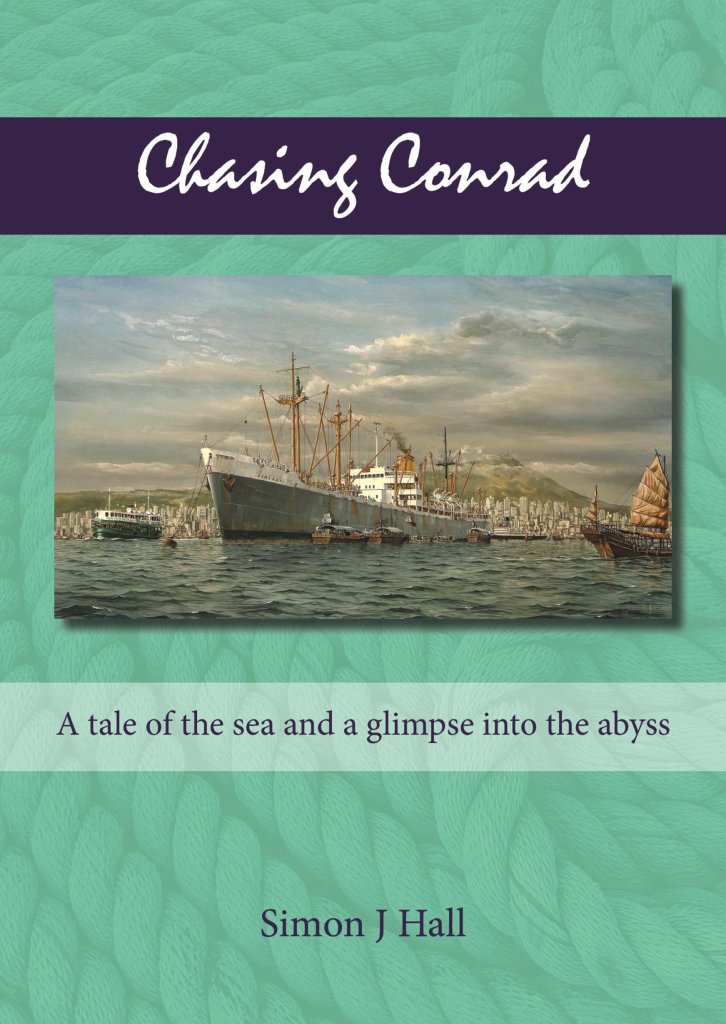 In his Acknowledgements Page Hall gives thanks to, among other things, Doom Bar beer (one of my own favourite real ales!), Admiralty charts 1263 and 748B, his discharge book, all the letters he wrote home (which his mother kept) and his many seafaring friends. He also acknowledges he has been brutal in his descriptions of some of the British ports in the 1970s – and this lack of embroidery of the truth gives the book a gritty reality and memorable narrative.
His prose can also be tactile and atmospheric. He describes a night watch in the Indian Ocean:
- ‘Alone on the bridge wing in the warm tropical night, I heard the wind sing through the stays as an Aeolian harp and I felt anointed by my good fortune.’
On loading rubber and timber in Sarawak he writes:
- ‘The whole pace of life slowed, it felt as torpid as the idle Rajang river itself and we all slowed with it. Everything was so still, so unmoving, as if the whole world had lain down and gone to sleep.’
I enjoyed his descriptions of jaunts to various parts of the world, some of which overlap with my own sea travels in the Navy. His passages on stepping ashore in Hong Kong certainly brought back memories…
- ‘We slid in through the West Lamma Channel and anchored in Victoria Harbour, before being taken to our mooring buoy. There was a buzz in Hong Kong like nowhere else. The harbour was alive with all manner of vessels: a mass of deep sea ships, small coasters, Chinese junks, small inshore boats, bumboats running supplies to all the ships. The green and white Star Ferries ran constantly between Hong Kong Island and the mainland…
We stayed in Hong Kong for one week…I ordered some clothing from Goh Kwok, the company recommended tailor. He measured me up for six shirts. The cost was about the same as a price of one shirt from Marks & Spencer in England. The shirts were ready the next day; a runner brought them out to the ship on a morning bumboat, handing me a package neatly wrapped in brown paper tied with string…
One afternoon I explored the Walled City of Kowloon, the notorious crime district controlled by the 14K Triads. Humanity was packed close in the Walled City, the building was unregulated and blocks leant dangerously close together, sometimes it was hard to see the sky. I never felt menaced although I made sure I was out before the sun went down.’
Hall’s recounting of his struggle against alcohol abuse is a particularly poignant aspect of the book:
- ‘I ordered another cold beer and lit another cigarette, then sat with the ghost of my past dreams while the afternoon died around us and we surveyed the wreckage of all my hopes.’
This, along with his first volume, is an important work that captures the spirit of an era of our maritime heritage now vanished but bridged for us by works such as this.
Under A Yellow Sky review
Simon J Hall Chasing Conrad
Published by Whittles Publishing. ISBN 978 1 84995 155 5
On this day: The Battle of the Nile
Posted on August 1, 2015 1 Comment
On this day in 1798 began the Battle of the Nile, a major naval engagement between the Royal Navy and the Navy of the French Republic. The battle was the climax of a naval campaign that had ranged across the Mediterranean during the previous three months, as a large French convoy sailed from Toulon to Alexandria carrying an expeditionary force under the then General Napoleon Bonaparte. In the engagement the British fleet, led by Rear-Admiral Sir Horatio Nelson, decisively defeated the French in a near-apocalyptic battle of annihilation.
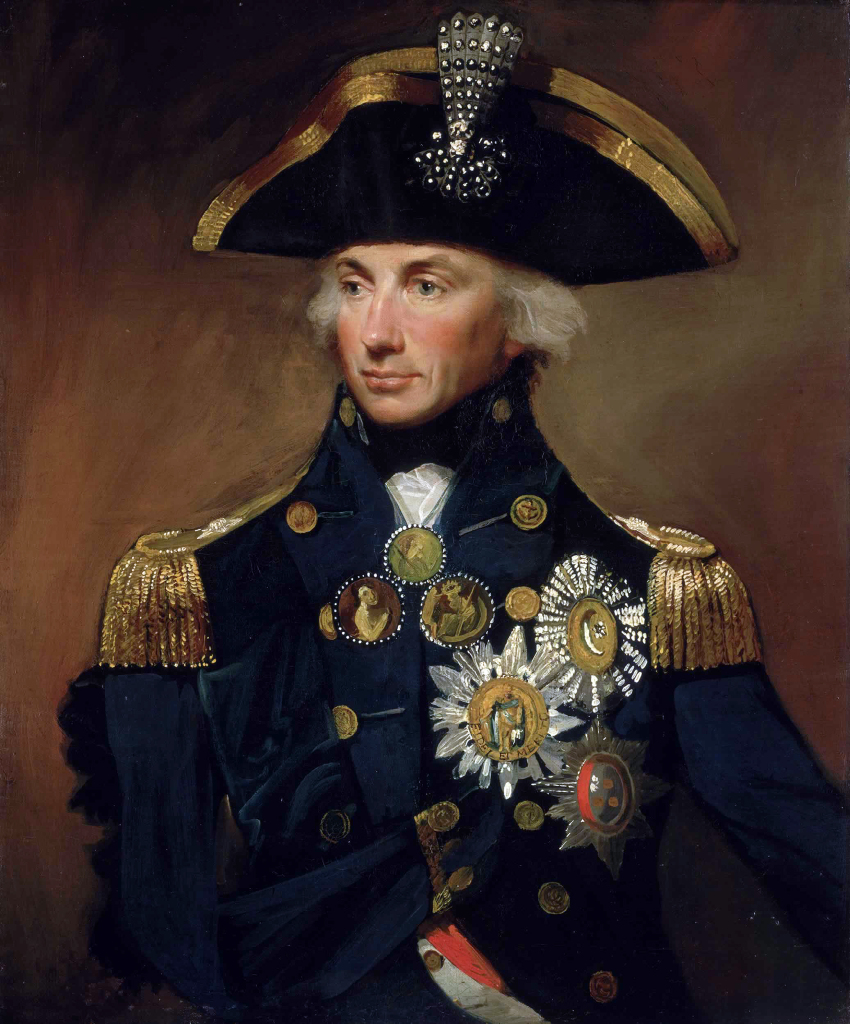
Nelson. On his cocked hat is the aigrette presented by the Ottoman sultan after Nelson’s victory
Nelson’s achievement at the Battle of the Nile is all the more amazing as only the year before much of the British fleet was in a state of mutiny. Yet Nelson took on an enemy of superior numbers and utterly exterminated them, with loss of life on the French side eight times that of the British!
In the course of the extensive research I did for Tenacious I was intrigued to find a number of Devon connections, the English county in which I now live:
More officers and men who defended their country in the Battle of the Nile came from Devon than any other county.

Tenacious
The only captain killed at the Battle of the Nile was Devon man George Westcott, commander of the 74‑gun ship-of-the-line Majestic. When Nelson located the French fleet at anchor at Aboukir Bay, he quickly ordered the British into the attack. Majestic was towards the rear of the British line, and did not come into action until late in the battle. In the darkness and smoke she collided with Heureux and became entangled in her rigging. Trapped for several minutes, Majestic suffered heavy casualties. Westcott was hit by a musket ball in the throat and killed. He was buried at sea. Despite humble origins, like Tom Kydd he had risen to become one of Nelson’s celebrated ‘band of brothers’ and a monument to his memory was erected in St Paul’s, and also in his home town. In January 1801, Nelson, passing through Honiton, on his way to take up a new command at Plymouth, presented Mrs. Westcott with his own Nile medal, saying, ‘You will not value it less because Nelson has worn it.’
After his victory at the Nile, Nelson was given the Freedom of the City of Exeter and a sword was presented to him at the Guildhall. It passed through various hands after his death and was eventually returned to the city in 1934. The scabbard bears the City Arms with the inscription ‘Horatio Nelson (Vice Admiral of the Blue) enrolled as a Freeman of the City of Exeter, 21st January 1801. Thomas Floud Mayor.’
The loss of the French flagship L’Orient during the Battle of the Nile has gone down as ‘the mother of all ship explosions’ in the Great Age of Fighting Sail. When the conflagration aboard the ship reached the magazine L’Orient exploded in an incredible spectacle, with blazing parts of the ship hurled hundreds of yards into the air. After the explosion both sides fell into a stunned silence for about ten minutes and an eerie light pervaded the scene. Mangled, wounded and scorched bodies were strewn all over Aboukir Bay.
The poem Casabianca by Felilcia Hemans was written in commemoration of the death of the son of the captain of the L’Orient:
- The boy stood on the burning deck
Whence all but he had fled
The flame that lit the battle’s wreck
Shone round him o’er the dead
One of the most unusual battle trophies must be the coffin made from the wreckage of L’Orient. After the battle Swiftsure recovered a section of L’Orient’s mainmast. The ship’s carpenter made it into a coffin which Captain Hallowell presented to Nelson. While his officers were appalled, Nelson was amused and for a time kept the coffin standing in his cabin.
L’Orient had reportedly been carrying the treasure of the Knights of St John, looted by Napoleon at his capture of Malta. An underwater archaeological study of L’Orient‘s wreck-site has recovered some artefacts including small-arms, coins and personal possessions of crew-members – but whether Napoleon’s hoard was landed before the battle or lies buried somewhere within Neptune’s Realm may remain a mystery forever…
I have two paperbacks of Tenacious up for grabs! Just email julian@julianstockwin.com with the name of the French commander at the Battle of the Nile. Please include your full postal address. Deadline: August 10
Copyright notices
Lemuel Francis Abbott [Public domain] via Wikimedia Common
Every effort is made to honour copyright but if we have inadvertently published an image with missing or incorrect attribution, on being informed of this, we undertake to delete the image or add a correct credit notice
An Emperor Aboard!
Posted on July 24, 2015 3 Comments
 On this day in 1815 HMS Bellerophon carrying a very special passenger, Napoleon Bonaparte, dropped anchor at Torbay; then shortly after sailed on to Plymouth Sound.

A fascinating exhibition at the Plymouth City Museum and Art Gallery explores the mystique that grew up around the man – monster to some, folk-hero to others. Centred around a painting by Jules Giradet, which shows thousands of people in small boats in Plymouth Sound flocking to catch a glimpse of him, the exhibition runs until September 26.
Just how did the most famous man in the world at that time happen to be making this journey?
After the Battle of Waterloo Napoleon Bonaparte surrendered – not to the Duke of Wellington but to the captain of the ship that had dogged his steps for more than 20 years, HMS Bellerophon – ‘Billy Ruffian’ to her crew. The ship sailed for England and anchored at Torbay on 24 July 1815. Every effort was made to keep the famous man’s presence a secret, and no-one was allowed to come on board. However, a sailor dropped a black glass bottle into the water which was retrieved by some young boys in a small boat nearby. Inside the bottle was a rolled piece of paper with the electrifying message, ‘We have Bonaparte on board!’

Emperor Napoleon’s coronation
Needless to say people thronged there; at the height of the madness it was said that around 10,000 people boarded 1,000 boats in an attempt to get a view of the most famous man in the world.
The crew of Bellerophon hung notices over the ship’s side as to their famous guest’s movements: ‘In cabin with Captain Maitland’, ‘Writing with his officers’…
Among the crowds were large numbers of pretty young women, naval officers, fashionably dressed ladies, red-coated army officers and smartly attired gentlemen. The men took off their hats respectfully when Napoleon showed himself, as he did every evening around 6 p.m. He commented on the beauty of the young ladies and appeared astonished by the size of the crowds.
On 7 August Napoleon was transferred to HMS Northumberland for exile in St Helena, where he died in 1821.
This account (and many other wonders from the Golden Age of Sail) is from Stockwin’s Maritime Miscellany. There’s a copy of the book up for grabs – just email me with the year Napoleon crowned himself Emperor Napoleon I. First out of the hat on July 31 will be the winner! Please include your full postal address.
Deadline: July 31
Copyright notices
Coronation: Jacques-Louis David [Public domain], via Wikimedia Commons
Every effort is made to honour copyright but if we have inadvertently published an image with missing or incorrect attribution, on being informed of this, we undertake to delete the image or add a correct credit notice
Bonjour, Barfleur!
Posted on July 14, 2015 2 Comments
During a recent location research visit to Normandy Kathy and I visited the lovely little coastal village of Barfleur in northwestern France. It’s not far from Cherbourg and well worth a side trip! And as well as one thousand years and more of history there are some wonderful eateries featuring its famous mussels, Blonde de Barfleur, which connoisseurs rate very highly.

The port of Barfleur today
In the ninth century the Viking invaders from Scandinavia made Barfleur one of the bases. In time it became the largest port in Normandy and bore witness to a number of important historical events.

Cannon from the 1692 battle of Barfleur
Barfleur became the port of embarkation for royal crossings, the royal ship Esneca Regis usually making the crossing to Southampton in a night.
In 1120 Henry I, the Duke of Normandy, was returning to England with his two sons. The crossing had been delayed by a strong north wind and to pass the time much wine was imbibed ashore. The ship Blanche Nef founded on the rock Quillebeuf and all bar Berold, a butcher from Rouen perished. (This incident is described by Renzi in Invasion.)
It is said that Henry I was never seen to smile gain.

Barfleur has a huge tide range; the harbour at low water
Henry II married Eleanor of Aquitaine and passed through Barfleur many times, among them on his way to petition the Pope to lift the excommunication after the murder of Thomas Becket.
In 1190 Richard the Lionheart, oldest surving son of Henri II embarked at Barfleur on his way to his coronation as King of England.
Edward II sacked Barfleur in 1346. The population was reduced to some 800 and was under English rule until 1450.

Kathy enjoying Barfleur’s famous moules
Barfleur was occupied by the Germans during World War II and liberated 15 days after D-Day. The port was used by the Allies – as it had been by William the Conqueror and Richard the Lionheart – to ship war supplies.
Copyright notices
photo credit harbour photo: by Matthieu Tétard at fr.wikipedia [CC BY-SA 2.5 (http://creativecommons.org/licenses/by-sa/2.5)%5D, from Wikimedia Commons
Every effort is made to honour copyright but if we have inadvertently published an image with missing or incorrect attribution, on being informed of this, we undertake to delete the image or add a correct credit notice
Blogging away, blogging away – more thoughts…
Posted on July 2, 2015 7 Comments
 First, I must thank you again for all the feedback and comments on my blogs.

Being an author can be a pretty isolated life so it’s always great to hear from readers! And while I thoroughly enjoy writing the Tom Kydd series – and my other historical fiction – it’s a pleasant diversion to put pen to paper (metaphorically) outside the confines of the structure of a novel.
As well as regular blogs via BigJules for the past two years, I’ve been honoured to be invited to write guest blogs a number of times.
Here’s some you may have missed —
English Historical Authors site
The literary magazine Upcoming4.me
Related Blogs
Do send me any suggestions you might have for future blogs, either in the form of a question for ‘Ask BigJules’ or a general topic you’d like to see covered. I’ll pop a special thank-you gift in the post to any that I take up.
Good thing Kathy’s a hard taskmaster about the number of words I write each day, or I might just get a bit carried away with blogs…
I’m also on Facebook, Twitter and Pinterest and I welcome new Friends and Followers. But now, I really must get back to the work in progress…
And you can keep up to date with all the latest reviews and interviews via the News Page of my website.
BookPick: Rigging Period Fore-and-Aft Craft
Posted on June 30, 2015 2 Comments
Employing clear draughtsmanship this book explores the rigging of typical period fore-and-aft vessels, those like Seaflower, the tops’l cutter in which Kydd sailed around the Caribbean.
 Author Lennarth Petersson deploys three typical eighteenth-century types – an English cutter, a three-masted French lugger and an American schooner – to represent variations. Illustrations for these ships include full profile and deck plan, belaying plan, topmast shrouds and jib in a complete working examination of these craft.
The American schooner section has the most illustrations, reflecting the complexity of this vessel.
The author is a professional illustrator and amateur model maker. His first book, Rigging Period Ship Models concentrated on the three masted square sail ship rig and it seems fitting to follow this with fore-and-afters.
Joseph Conrad wrote, in The Mirror of the Sea, of their special beauty:
- ‘A fleet of fore-and-afters at anchor has its own slender graciousness. The setting of their sails resembles more than anything else the unfolding of a bird’s wings; the facility of their evolutions is a pleasure to the eye. They are birds of the sea, whose swimming is like flying…’
Rigging Period Fore-and-Aft Craft features some 200 diagrams showing where each item of standing and running rigging is fitted, led and belayed.
The book brings a visual clarity to the complexities of period rigging and will delight anyone with an interest in the rigging of traditional fore-and-aft craft. It’s not just for modellers but a boon to traditional seafarers and readers of historical fiction also. I know I’ve consulted Petersson’s earlier title many times, and this one will as well take its respected place on my reference shelves.
Lennarth Petersson Rigging Period Fore-and-Aft Craft
Published by Seaforth Publishing. ISBN 978 1 84832 218 9
Contests: A Trio of Goodies!
Posted on June 23, 2015 2 Comments
We all love a chance to win and I hope there’s something to tempt everyone here with not one but three prizes on offer! The contests close on July 20 and you may enter all for which you’re eligible. (The Silk Tree contest is restricted to UK residents; the other contests are open worldwide.) Best of luck!
The Silk Tree
 Last week the paperback of The Silk Tree was officially launched in the UK. The influential book recommendation site Lovereading says of this novel:
My publisher Allison & Busby has launched a competition to win a stunning unique leather notebook (with the map of the heroes’ route as the cover) plus a copy of the book. Enter the contest here.
Advance Reading Copies of Tyger
 Tyger is the next book in the Kydd series, out in the UK and US in October. Twelve Advance Reading Copies are up for grabs!
The greatest naval trial in the Georgian period is underway at Portsmouth with the court martial of Sir Home Popham, Captain Sir Thomas Kydd’s commanding officer in the doomed occupation of Buenos Aires. Kydd has some sympathy for Popham’s unauthorised action but his support for his former commander leaves him athwart some very influential people in the Admiralty.
With his frigate L’Aurore unfit for sea, Kydd is given a commission that some hope will destroy his career. Tyger has recently mutinied but instead of having her company dispersed around the fleet as is customary, the ship is pressed into immediate service in the North Sea. Kydd faces a crew still under some malign influence. Enemies aboard and on the high seas are just the start of the problem…
If you would like the chance to secure an Early Reading Copy of Tyger, several months before it is officially published, email admin@julianstockwin.com with ‘Advance Reader’ in the subject line and your full postal address in the body of the email.
Stockwin’s Maritime Miscellany
 A Ditty Bag of Wonders From the Golden Age of Sail
– Firetrench Reviews
Would you like the opportunity to win a copy? Email admin@julianstockwin.com with ‘Miscellany’ in the subject line and your full postal address in the body of the email.
BookPick: Britain’s Heritage Coast Exmouth to Plymouth
Posted on May 26, 2015 4 Comments
Kathy and I moved to Devon a dozen years ago and we know we’re privileged to live in one of the nation’s loveliest regions, with superb coastal and maritime vistas at almost every turn. The regular tweeted photographs from @GaryHolpin rarely fail to brighten my day, especially those with a salty bent. Says Gary: ‘I’m an amateur photographer who loves the South West of England and is more than a little addicted to walking its coastline with my camera.’ Gary has written a delightful little volume about the history, folklore and outstanding beauty of the South Devon coast. It’s superbly illustrated with a selection of his photographs as well as historic images – and because it’s a compact little volume it’s ideal to bring along on your seaside holiday…
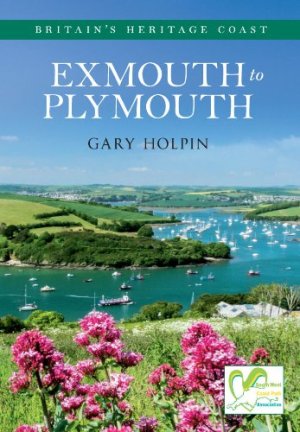 The book’s first two chapters give the reader a useful overview of the region’s varied geology and human settlement. The sea was at the centre of its history for centuries. Superb natural anchorages and sheltered estuaries put South Devon’s ports to the forefront in defending the nation and enabling the growth of global trade. And of course famous explorers, such as Sir Francis Drake and Sir Walter Raleigh were true sons of Devon!
The rest of the book takes the armchair reader on a journey along the South Devon heritage coast, beginning at Exmouth. The oldest seaside town in Devon, Exmouth sits at the mouth of the River Exe and is the gateway to the Jurassic Coast.

Sunset at the mouth of the River Erme
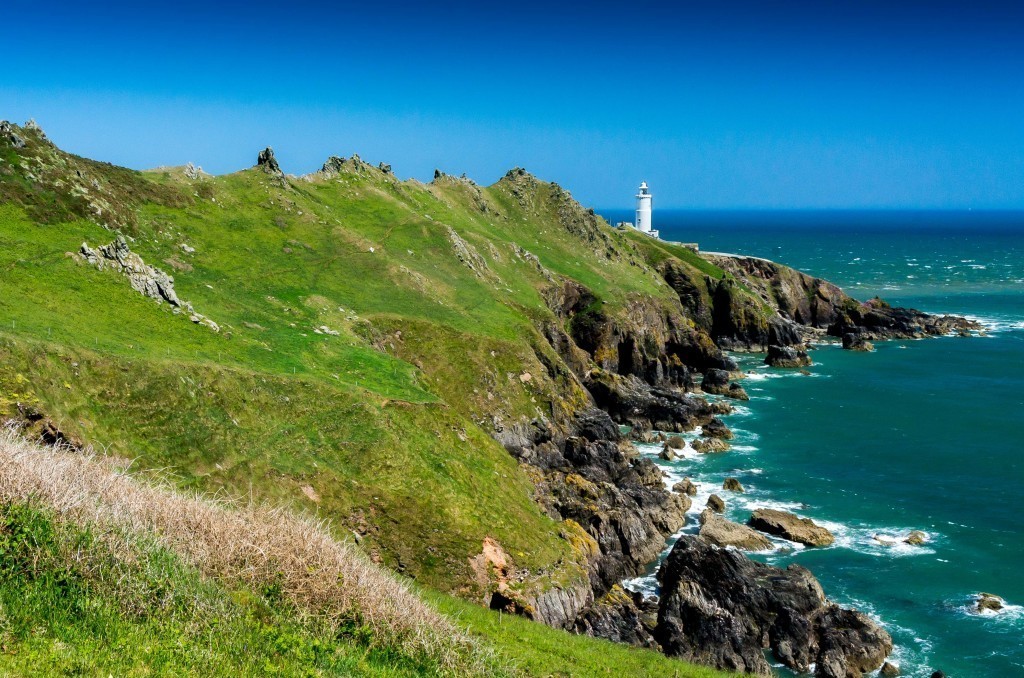
The dramatic headland of Start Point
The spectacular scenery of the South Devon coast can be enjoyed on foot along the South West Coast Path †, part of which Kathy and I have walked. It is a wonderful way to explore the beauty and history of the region. I also had the privilege of spending time in many of the little coastal settlements during research for my Kydd book The Admiral’s Daughter.
Among the references at the back of Exmouth to Plymouth are details of some 80 websites for readers wishing to go further into some aspect covered in the text.
Gary’s book is a must-read for anyone visiting Devon and serves as a reminder of Neptune’s bounty on our doorstep for those of us lucky enough to live in the region.
† The South West Coast Path with a length of 630 miles, follows the entire coastline of England’s South West Peninsula.
Gary Holpin Exmouth to Plymouth
Published by Amberley Publishing ISBN 978 1 4456 2151 7
Copyright notices
Photographs © Gary Holpin, used with his kind permission
Every effort is made to honour copyright but if we have inadvertently published an image with missing or incorrect attribution, on being informed of this, we undertake to delete the image or add a correct credit notice
BookPick: Support for the Fleet
Posted on May 19, 2015 1 Comment
The author of this monumental work is Jonathan Coad, a former Inspector of Ancient Monuments. He is a Vice-President of the Society for Nautical Research and a former President of the Royal Archaeological Institute of Great Britain and Ireland. Support for the Fleet traces the architectural and engineering works in the Royal Navy’s shore bases at home and overseas and the political imperatives and technologies that helped shape them up to the First World War.
 Based on 45 years’ detailed research, the book concentrates on the remarkable legacy of surviving structures. These bring to vivid life the varied requirements of the sailing navy and its steam-driven successor, and are reflected in successive dockyard remodellings and expansions throughout the world, a remarkable number of which survive to this day to be discovered by the interested reader. Revealed as well are the close links that developed with a rapidly industrialising Britain at the end of the eighteenth century, showing contributions of figures such as Samuel Bentham, Thomas Telford and James Watt.
The influence of the Royal Engineers is traced from early beginnings in the 1700s to their major role in the dockyard expansions from the late 1830s into the twentieth century. The architectural development of victualling and ordnance yards, naval hospitals, schools and coaling stations are all described, together with their key contributions to Great Britain’s long naval supremacy.
To give an idea of the extent of the coverage in this splendid volume, for the prospective reader I’m going to list the chapter headings –
- 1 The Royal Dockyards in Great Britain, 1700-1835
2 The Royal Dockyards in Great Britain, 1835-1914
3 Planning and Building the Royal Dockyards to 1795
4 Planning and Building the Royal Dockyards, 1795-1914
5 Engineering Works of the Sailing Navy, 1700-1835
6 Buildings of the Sailing Navy
7 Dockyard Housing, Offices and Chapels
8 Buildings and Engineering Works of the Steam Navy, 1835-1914
9 Growth of Empire: The Overseas Bases of the Sailing Navy, 1700-1835
10 Heyday of Empire: The Overseas Bases, 1835-1914
11 The Mediterranean Bases: Buildings and Engineering Works, 1700-1914
12 The West Indies and North American Bases: Buildings and Engineering Works, 1700-1914
13 South Atlantic and Australian Bases: Buildings and Engineering Works, 1700-1914
14 Feeding the Fleet: The Royal Victualling Yards
15 Naval Ordnance Yards
16 Care of the Sick and Wounded: Naval Hospitals
17 Barracks and Training Establishments
Support for the Fleet is copiously illustrated with maps, plans and photographs. Although an expensive volume, this lively and informative work to my mind stands to the forefront as the definitive guide to the importance and workings of the Royal Navy bases and has to be the ‘go to’ source for this other half of naval life for many years to come. It is highly recommended.
Jonathan Coad Support for the Fleet
Published by English Heritage. ISBN 978-1-84802-055-9
Copyright notices
Every effort is made to honour copyright but if we have inadvertently published an image with missing or incorrect attribution, on being informed of this, we undertake to delete the image or add a correct credit notice
HMS Victory – 250 this month!
Posted on May 12, 2015 6 Comments
There’ve been many famous ships in Britain’s proud maritime history – Mary Rose, Golden Hinde, Cutty Sark, to name but three… but one ship stands head and shoulders above the rest – HMS Victory, now currently undergoing major restoration in Portsmouth Historic Dockyard to ensure her preservation for future generations
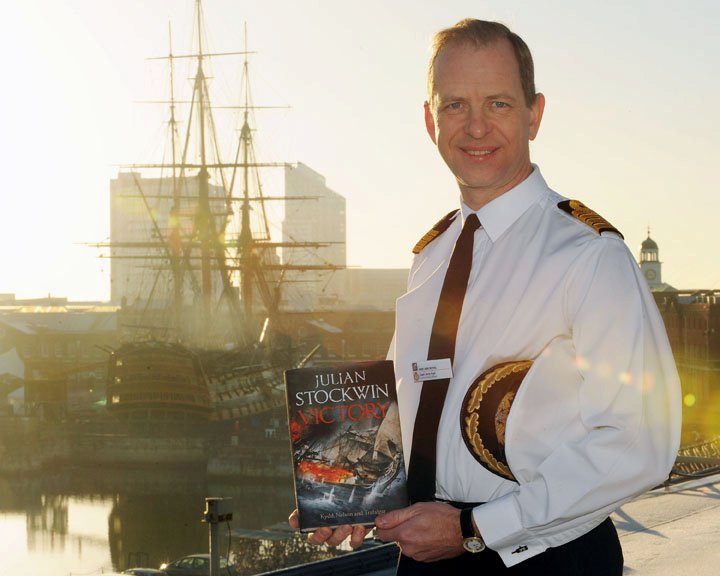
Captain Kyd, former CO of HMS Ark Royal with Victory in front of Victory
Once in the water the task of fitting out could begin, transforming a hollow planked frame into a living, breathing fighting ship. From her steering gear to masts, hatches to capstans, pumps to officers cabins. And of course her guns – 104 of them on three gun-decks, from 12 pdrs to massive 42 pdrs.
This iconic ship already had a quite a number of years’ service before her most famous role as Nelson’s flagship at the Battle of Trafalgar, October 21, 1805.
In 1797 she returned to England, 32 years old, scarred and battle-weary. Late in that year, considered unfit for service, it was ordered she be converted into a hospital ship and eventual disposal. But fate intervened – as it would several times in her career – and when the first rate Impregnable was lost in Chichester Harbour there was an urgent need for another three- decker for the Channel Fleet. Victory was to be given a new lease of life! Refitting commenced at Chatham Dockyard in late 1800.
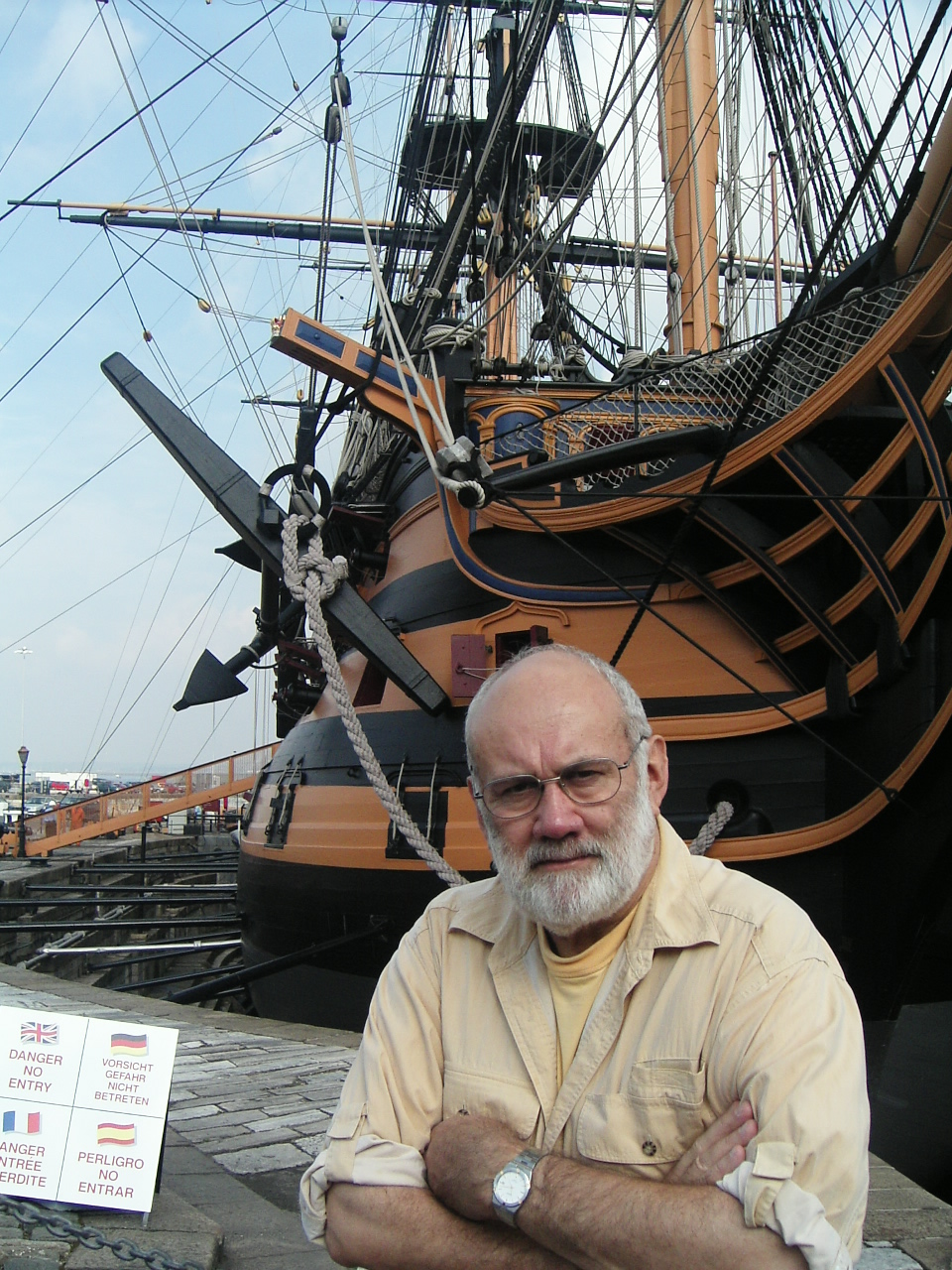
One of my many visits to Victory
A ship of the line like Victory required a great deal of timber for her construction; around 6000 trees were felled, mainly oak from the Wealden forests of Kent and Sussex. Her statistics are impressive: the vast amount of canvas that could be set meant a sail area a third larger than a football pitch; if laid end for end, cordage used for her rigging would stretch 26 miles.
Despite her age, she once stayed at sea for two years and three months without once entering port.

Victory’s figurehead
When I began writing the Kydd Series I came across some incredible statistics. In the bitter French wars at the end of the 18th century, there were, out of the six hundred thousand or so seamen in the Navy over that time, only about 120, who, by their own courage, resolution and let’s face it, brute tenacity, made the awe inspiring journey from the fo’c’sle as common seaman to King’s officer on the quarterdeck. This meant they changed from common folk; they became gentlemen. And that was no mean feat in the eighteenth century. Of those 120, just over 20 became captains of their own ship – and a miraculous 3 became admirals! After Nelson and Hardy, the two most important men aboard Victory at Trafalgar were cut from this cloth, both originally common seamen – John Quilliam, first lieutenant and John Pascoe, the signal lieutenant.

Victory and one of the ship’s upper deck guns
In 1831 Victory was listed for disposal but when the First Sea Lord Thomas Hardy told his wife that he had just signed an order for this, Lady Hardy is said to have burst into tears and sent him straight back to the Admiralty to rescind the order. Curiously, the page of the duty log containing the orders for that day is missing.
Victory was permanently saved for posterity in the 1920s by a national appeal led by the Society of National Research.
To this day Victory is manned by officers and ratings of the Royal Navy and now proudly fulfils a dual role as flagship of the First Sea Lord and a living museum of the Georgian navy.
It was my great privilege to have been given virtually unlimited access to the ship when I wrote my book Victory. Of course this was by no means my first visit, I must have made pilgrimage at least a dozen times before!
The official website
( A longer version of this article appears in the latest issue of Quarterdeck magazine A .pdf of that article is available on request to admin@julianstockwin.com )
Copyright notice
Every effort is made to honour copyright but if we have inadvertently published an image with missing or incorrect attribution, on being informed of this, we undertake to delete the image or add a correct credit notice
 Julian Stockwin