
INVASION: glory and adventure
Posted on July 31, 2014 6 Comments
A regular feature looking back on each of the Kydd titles – with story background, research highlights, writing challenges and more.
Thank you for all your kind comments on the post about my ninth book, TREACHERY.
The tenth book in the Kydd series is INVASION. Kydd finds himself centrally involved in the activities to counter the fearsome invason plans of Napoleon Bonaparte. This book was somewhat of a milestone in my literary career: my 10th book in print – one million unique words out there!
Real-life characters
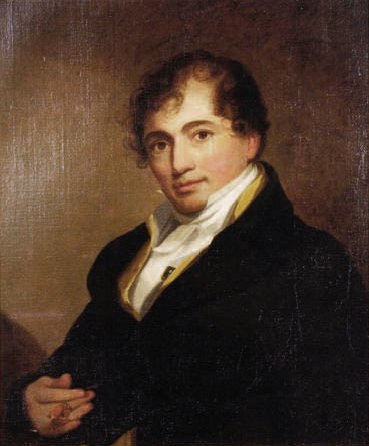
Robert Fulton
Fulton’s nickname of ‘Toot’ was widely used but I can find no definitive reason for it. Some have suggested it derives from the whistle of the steamboat for which he’s known, but his nickname was certainly used before this time. Fulton was very gifted but difficult to penetrate as a person, naïve but intense. A Maryland farm boy, he came to England by invitation, and for a time lived as a portrait painter in Devon.

Plans for Fulton’s working submarine
Fulton’s proposed machines were the first weapons of mass destruction – deliberately designed to blow up humans without warning or a chance to fight back and caused as much stir then as WMD does today.
Other characters in this book may seem at first reading to be the product of a vivid imagination but there really was a mysterious ‘Mr Smith’ who detached Fulton from Napoleon to transfer his allegiance to England. There is very little known on this episode so I took what I felt was likely to have occurred, and put Renzi in Smith’s place. Likewise, the famed Parisian savant, LaPlace, was indeed a friend of Fulton’s…
I enjoy Jane Austen’s works and it was on a literary whim that I decided to mention her in INVASION, via her brother who actually was in post there at the time. She had two sailor brothers; Francis, who Kydd meets in the course of his acquaintance with the Fencibles, and Charles. Both later advanced to become admirals and Jane no doubt consulted them when she created William Price in Mansfield Park and Captain Wentworth in Persuasion.
Location Research
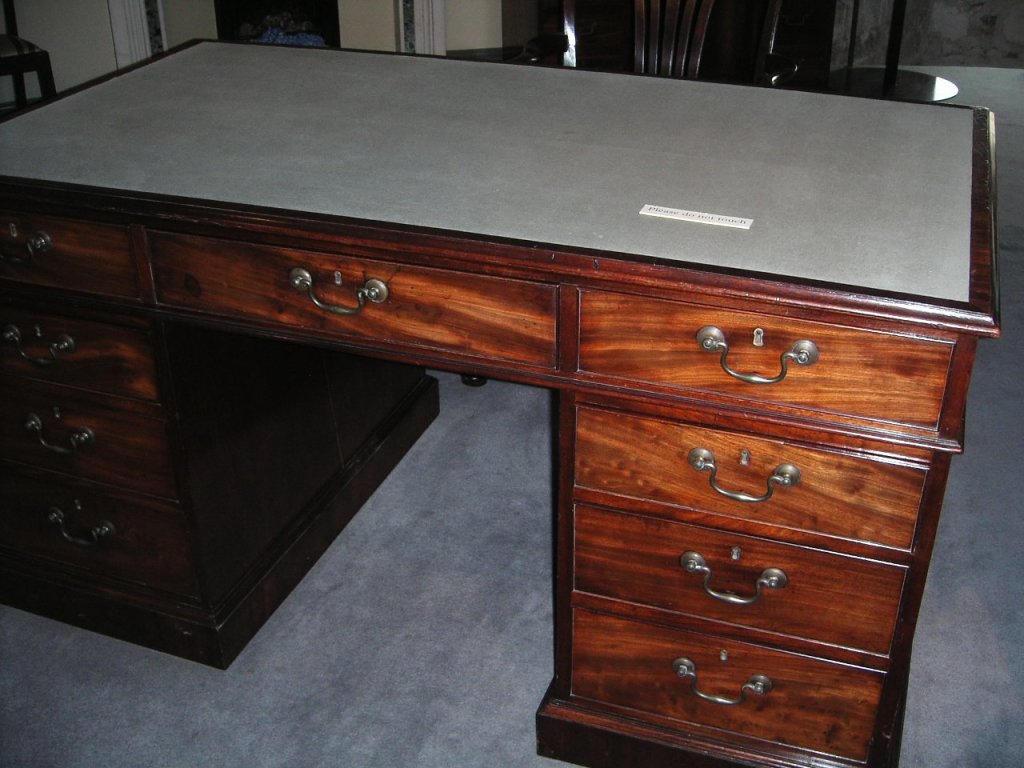
The actual desk Prime Minister Pitt used when working at Walmer Castle on secret missions
The book’s publishing journey
December 1, 2008
I pressed the Send Email button then sat down with Kathy for our traditional glass-raising ceremony to toast completion of a book… Within milliseconds the file arrived at my editor Anne Clarke’s computer via a high-speed broadband connection between Ivybridge, Devon and London.
Anne had recently become my new editor at Hodder: ‘When I took over as Julian Stockwin’s editor I felt honoured and not a little nervous about working on such a highly regarded and well-loved series. I needn’t have worried – when I read the manuscript for INVASION I was delighted to find I could almost send it straight to the printers, as it was pacy, compelling, extremely well structured, and full of as much adventure as I could wish; there was really very little editing for me to do! INVASION is a wonderful historical novel and in reading it you get swept away into the lives of Kydd and Renzi and the excitement and drama of fighting Napoleon on the high seas. I loved the direction Kydd was taking, and looked forward to many more adventures to come.’
February 12, 2009
Anne sent minor editorial queries to me. I responded to her questions, making changes to the manuscript.
March 1, 2009
The next person in the publishing chain was freelance copy editor Hazel Orme: ‘I’ve had the good fortune to work on all of Julian’s Kydd series – every one a winner – and look forward as soon as I’ve finished one to meeting up again with Kydd and Renzi in the next. They’re old friends now. With each novel I’ve noticed there’s less and less for me to do – I iron out the odd awkwardness, question the occasional inconsistency, spot-check Julian’s impeccable research and adjust punctuation, but principally I sit back and enjoy what is always a ripping yarn. Julian wears his scholarship lightly – but with each novel I learn something new. What did I think of INVASION – suspenseful, gripping – another great yarn from an author whose understanding of the world’s oceans and shipping shines through all of his work. More!’
March 20
The manuscript with Hazel’s queries was sent back to me.
April 4
I returned the corrected manuscript to Anne Clarke.
April 15
The manuscript continued its journey and passed to Palimpsest. Located in Grangemouth, Scotland, Palimpsest is the largest supplier of typesetting in the UK.
Palimpsest’s Craig Morrison: ‘Having booked in the title noting the production schedule dates, the first part of the process was to create a clean electronic text. The design specification was as per TREACHERY, the previous book in the Kydd series, and this was used as a reference for styling and tagging. The clean, tagged Word file was then ready for typesetting.
Once the systems operator was happy with the layout and the publisher had approved the page count, a full proof of the text was produced for our in-house proofreader to check. Then hard copy printouts and a digital proof was sent back to Hodder for forwarding to the author and Hodder’s proofreader.’
Upon receipt of a marked proof incorporating editor, author and proofreader corrections the text was amended by Palimpsest and a revised proof sent for approval. Upon signoff from the publisher a final press-ready digital file was created for the printer.
April 22
Anne Clarke met with Hodder’s inhouse designer to discuss the jacket design. Hodder had decided to take the covers in a new direction after researching the market and concluding that the books would appeal to a wider readership if they changed the jackets to reflect modern taste. Freelance designer Larry Rostant was commissioned to produce the visual and then Hodder’s designer added the title, blurb etc. in-house.
June 4
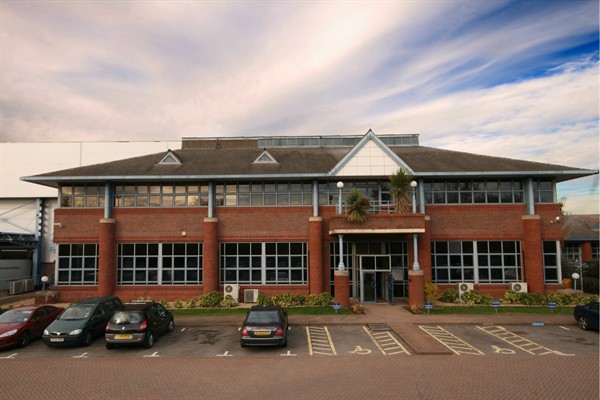
Bookpoint, distribution centre for my books
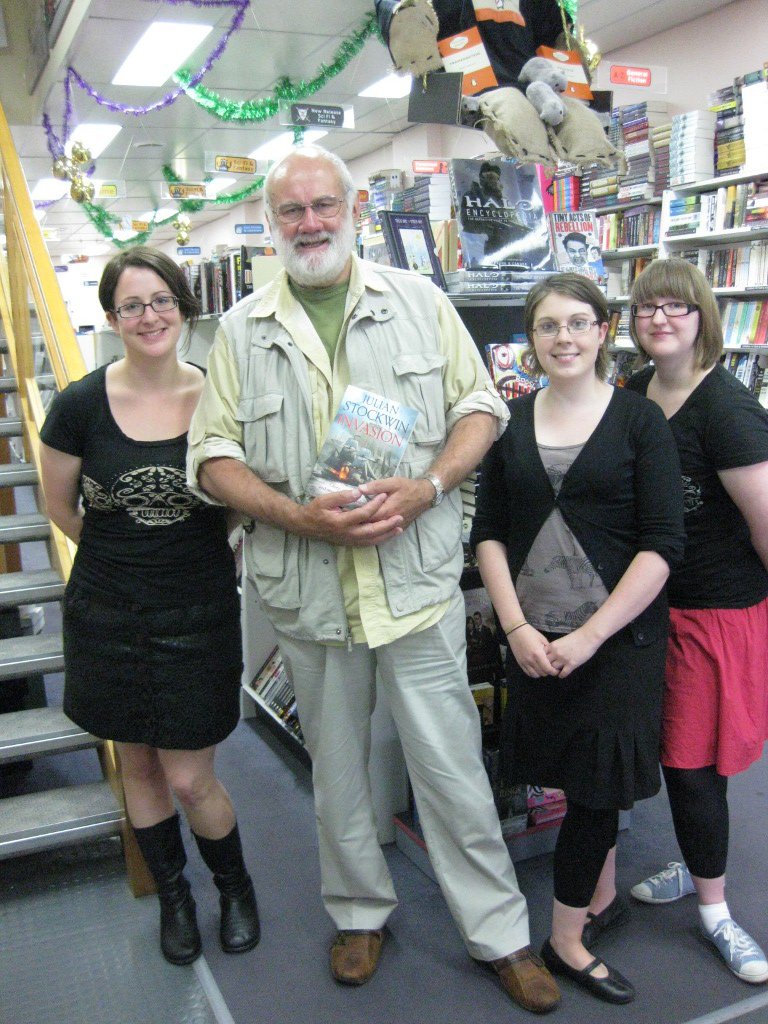
Warmly welcomed by the staff of Ellison and Hawker, Hobart, Tasmania
Trucks arrived to pick up the first pallet loads of INVASION for delivery to Hodder’s distribution unit, Bookpoint, 181 miles away. There, the books were loaded into computer-controlled storage areas for ‘picking’ when the orders from bookstores rolled in.
15 September
The INVASION publicity campaign ramped up. Press releases and early review copies of the book were sent out.
15 October
INVASION arrived at the booksellers, its long journey from my little study in Ivybridge to bound book in the shops complete!
Copyright notices
Fulton image: By Circle of Thomas Sully (American, 1783-1872) (Christie’s) [Public domain], via Wikimedia Commons; diagram: Public Domain via Wikimedia Commons
Every effort is made to honour copyright but if we have inadvertently published an image with missing or incorrect attribution, on being informed of this, we undertake to delete the image or add a correct credit notice
She speaks…
Posted on July 28, 2014 21 Comments
[To leave a comment or reply go to box at the end of the page]
I was recently chatting to a reader who told me he enjoyed my blogs and mentioned that he’d like to see a Guest Blog from Kathy as she is so intimately connected with my work. She was up for it but I did wonder whether I’d done the right thing in inviting her to write whatever she liked, along with her choice of photographs. As any who know her are aware, she can be pretty straight talking.
Without any further ado, over to Kathy…

Partying in Hong Kong. The world of Tom Kydd had yet to open up…
But let us begin at the beginning, when we first met.
I was a brand new educational psychologist rolling up for my first job, at a special centre for disturbed youngsters. I had an appointment with the head of the centre but as it happened he’d been urgently called away and I was told to wait in the staff room. I was a bit flustered as I’d driven over 200 miles from my home town, and had only recently passed my driving test (from a family, I hasten to add, where no-one drove a car…) In the staff room a dark-haired young man came up to me and asked if he could point me to the right room. I apparently curtly told him I knew exactly where I was supposed to be! Later I learned his name, Julian Stockwin; he was also a psychologist and had thought I was one of the hard-case female problem teenagers!
Not a good start. But over the coming months I began to think I had been a little too harsh in my dismissal… He obviously had a huge intellect, and wasn’t all that bad looking, either. And his wicked sense of humour was a plus as well.

Cutting our wedding cake
In the UK I had a number of interesting roles – running a customer service department, executive headhunting, and work in the retail sector. Julian, meanwhile, was developing specialist systems that would go on to be adopted by NATO.
However it was a very stressful environment for him and after the project was successfully completed I knew it was time to take stock. To this day I’m not quite sure why I suggested he try his hand at writing a book. The only ‘writing’ he’d done was business reports. Female intuition? Or perhaps my days as an editor had given me a sense of innate writing ability. Anyway, after initial resistance, we decided on a plan. He’d give up the computer systems design and take a half-time job lecturing while he applied himself to learning the craft of writing a book.
The topic came fairly quickly – for someone with salt coursing through his veins what else but the sea? And the great age of fighting sail had always been a draw for him. But where was the focus, the story? That was the challenge.

Travelling the world for Tom Kydd
I was still working full-time at this stage as we were under no illusions that Julian becoming a published writer could take a very long time.
When the manuscript of the first book, Kydd, was completed to our satisfaction we made a list of the top agents in the UK and decided we would work our way down, prepared for many rejections. However the god of debut authors was smiling on us and the agent Carole Blake (the very first agent we contacted) replied saying she was interested in possibly representing Julian.
But before that happened we had to visit Carole in her office to pass scrutiny. Carole takes on very few new clients and while she is warm and charming she is a very formidable presence. However something clicked. Carole soon had auctions going on both sides of the Atlantic, and was negotiating foreign language rights, audiobook rights etc.
It was a dizzy first year when Kydd came out and we travelled all over the UK for author talks, book signings, media events.
Julian resigned from his part-time teaching post and we decided to take the big gamble of my giving up the day job so that both of us could work full time on the Kydd Series.
My role encompasses editing, being a sounding board, administration, marketing and publicity initiatives, some research – in fact almost everything except the actual writing of the books. Julian calls me his ‘reality manager’ – the interface between his eighteenth century and the world outside.
We’ve travelled the globe with Tom Kydd and it’s also been great fun putting together Stockwin’s Maritime Miscellany with him and latterly an exciting new project, a stand-alone historical, The Silk Tree (which comes out in November). The Kydd series will continue, with a new book each year, but I’m delighted to see Julian’s maturing as a writer in tackling these other projects.
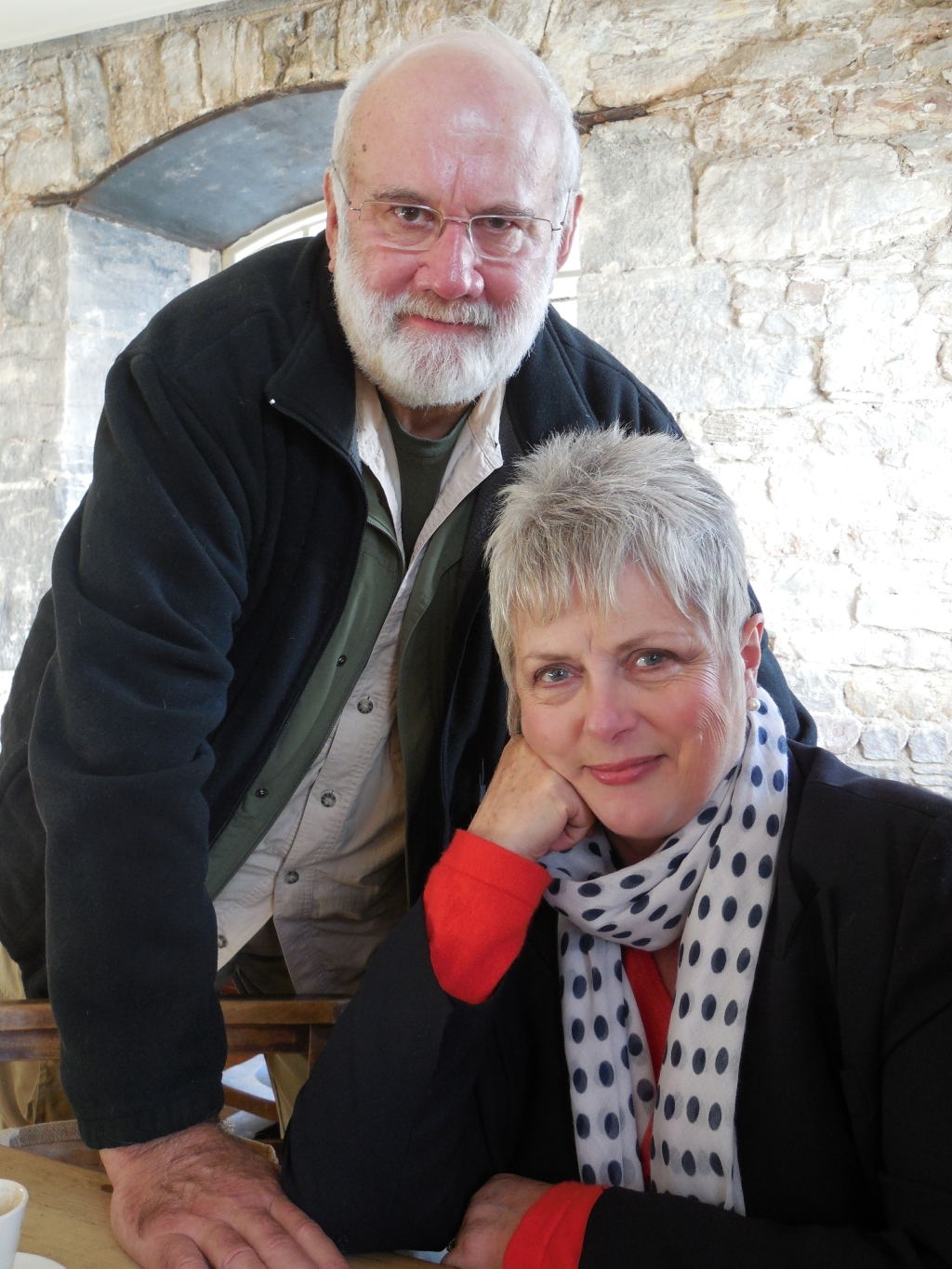
Team Stockwin!
As I look back on our life so far I celebrate what we have experienced together and look forward enthusiastically to whatever the future may bring.
Napoleon comes to Plymouth…
Posted on July 26, 2014 2 Comments
[To leave a comment or reply go to box at the end of the page]
I have the great good fortune to live not far from Plymouth, Devon. Ever since the days of Sir Francis Drake and the Spanish Armada, Plymouth has played a key role in Britain’s maritime history. But it was on this day in 1815 that perhaps the most amazing sight was ever seen on the harbour…
This description of the scene is taken my from little non-fiction volume, Stockwin’s Maritime Miscellany
Shortly after the Battle of Waterloo Napoleon Bonaparte surrendered – not to Wellington but to the captain of the ship that had dogged his steps for more than 20 years, Bellerophon – ‘Billy Ruffian’ to her crew. The ship sailed for England and the ship anchored at Torbay. Every effort was made to keep the famous man’s presence a secret and no-one was allowed to come on board. However a sailor dropped a black glass bottle into the water which was retrieved by some young boys in a small boat nearby. Inside the bottle was a rolled piece of paper with the electrifying message, ‘We’ve got Bonaparte on board.’
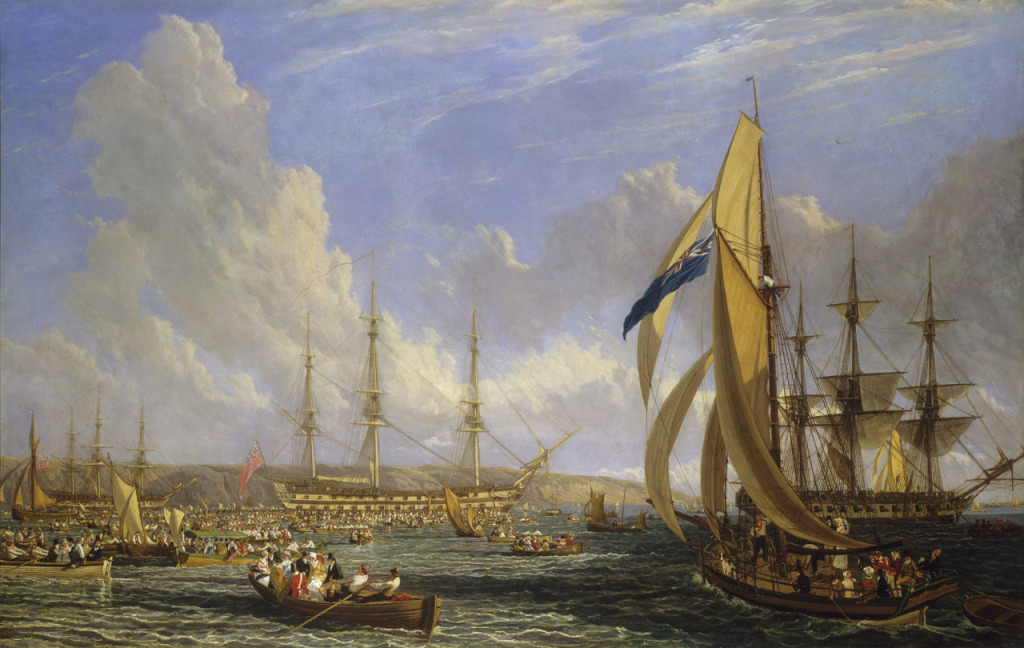
In 1816 British artist John James Chalon recreated the scene when Napoleon came to Plymouth
Once the word got out the vessel was quickly surrounded by sightseers in everything that could float. Bonaparte even appeared on deck to greet the crowds. The British government were worried that the emperor might escape before they could work out what to do with him so Bellerophon was hastily ordered to weigh anchor and sail to Plymouth, with its more secure harbour.
Needless to say people thronged there; at the height of the madness 10,000 people boarded 1000 boats in an attempt to get a view of the most famous man in the world. Several even drowned in the frenzy.
The crew of Bellerophon hung notices over the ship’s side as to their famous guest’s movements: ‘In cabin with Captain Maitland’, ‘Writing with his officers’…
Among the crowds were large numbers of pretty young women and fashionably dressed ladies, naval officers, red-coated army officers, smartly-attired gentlemen. The men took off their hats respectfully when Napoleon showed himself as he did every evening around 6 p.m. He commented on the beauty of the young ladies and appeared astonished by size of the crowds.
On August 7 Napoleon was transferred to Northumberland for exile in St Helena, where he remained until his death in 1821.
Stockwin’s Maritime Miscellany is published by Ebury Press. It is available in hardback and ebook format worldwide.
Copyright notices
Image: John James Chalon [Public domain], via Wikimedia Commons
Every effort is made to honour copyright but if we have inadvertently published an image with missing or incorrect attribution, on being informed of this, we undertake to delete the image or add a correct credit notice
TREACHERY: prey and prizes
Posted on July 20, 2014 3 Comments
A regular feature looking back on each of the Kydd titles – with story background, research highlights, writing challenges and more.
And thank you for all your kind comments on the post about my eighth book, THE ADMIRAL’S DAUGHTER.
The ninth book in the series is TREACHERY, published in the US as THE PRIVATEER’S REVENGE). Facing a grim future Kydd has been framed and unfairly dismissed his ship. He struggles to survive – and clear his name.
Praise for the book
‘Julian Stockwin is the superstar of naval fiction set during the Age of Sail . . . another great seafaring adventure.’ – Warships
‘Once again Kydd triumphs when all seems lost.’ – Maritime Book Reviews
‘Stockwin is a born storyteller and, with his series of intriguing sub-plots, a man with a vivid imagination. Importantly, his research is accurate and first class. TREACHERY is highly recommended.’ – Flagship
Location research

France is clearly visible from Mt Orgueil
During the period of the French Wars, the Channel Islands held a special significance for England because of their proximity to the enemy coast. And during much of World War II they were actually occupied by Nazi Germany.
The rock-strewn waters around the Channel Islands are among the most treacherous in the world and presented Kydd and his ship with horrific hazards. Over the centuries uncountable vessels were claimed by the sea and lie forever in Davy Jones’ Locker.
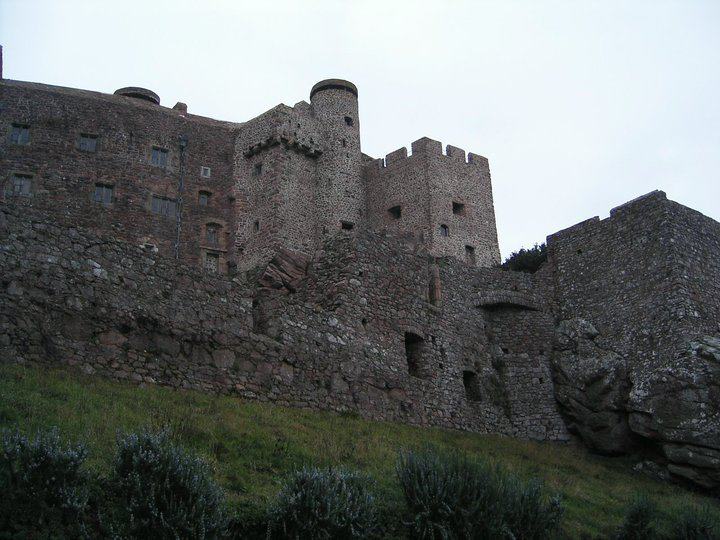
The ancient castle of Mont Orgueil at the head of Gorey Bay in Jersey; where Renzi worked with Philippe d’Auvergne
Local experts
As usual, we spent quite a deal of time delving into historical records and talking to various experts. Guernsey has a wonderful local studies centre, the Priaulx, and an excellent library, the Guille Alle. As well, we were given special permission to access eighteenth century documents in the Greffe, the official archives.
Dr Gregory Stevens Cox, a world-renowned historian, provided much useful information on the early nineteenth century and I also spent a fascinating morning with the harbour master, Captain Gill, from whom I learned of the extraordinary tidal and other phenomena that make the Channel Islands so unique.
A trip highlight

A magnificent portrait of Admiral Saumarez
He was one of the most illustrious officers to serve in the Royal Navy, but the achievements of his long naval career were often overshadowed by Horatio Nelson.
Kathy and I also managed to fit in a trip to the neighbouring island of Jersey, to tour over the impressive Mount Orgueil castle, from where the covert operations against the French that I describe in the book were actually carried out. Very atmospheric – I recommend a visit!
Homeward bound
I must say it was with some reluctance that we returned to Devon. With its abundance of fresh produce, and the range of superb French wines, the Channel Islands’ reputation as a foodie paradise is well deserved!
But fine dining aside, my abiding memory of this visit was standing braced on the hills above St Peter Port on a cold wet morning looking out into the storm-tossed seas – and transporting myself back to Kydd’s time to once again marvel at the skill of seamen in wooden ships who pitted themselves against the forces of wind, tide and sea.
‘The big trick is not to miss my stop!’
Posted on July 16, 2014 3 Comments
[To leave a comment or reply go to box at the end of the page]
I love meeting readers and am often humbled by their range of interests and accomplishments. Although I would love to be able to paint and draw, I do not have any real talent in this area – but I have a great admiration for gifted artists. Recently, Kathy and I met painter/musician – and New Yorker – Joe Ongie at a book-signing in Cornwall and he painted a charming little portrait of the two of us on the spot.
I am delighted to feature Joe as July’s reader of the month as he shares some of his thoughts on my books, art – and life in the Big Apple.
How did you discover the Kydd series?
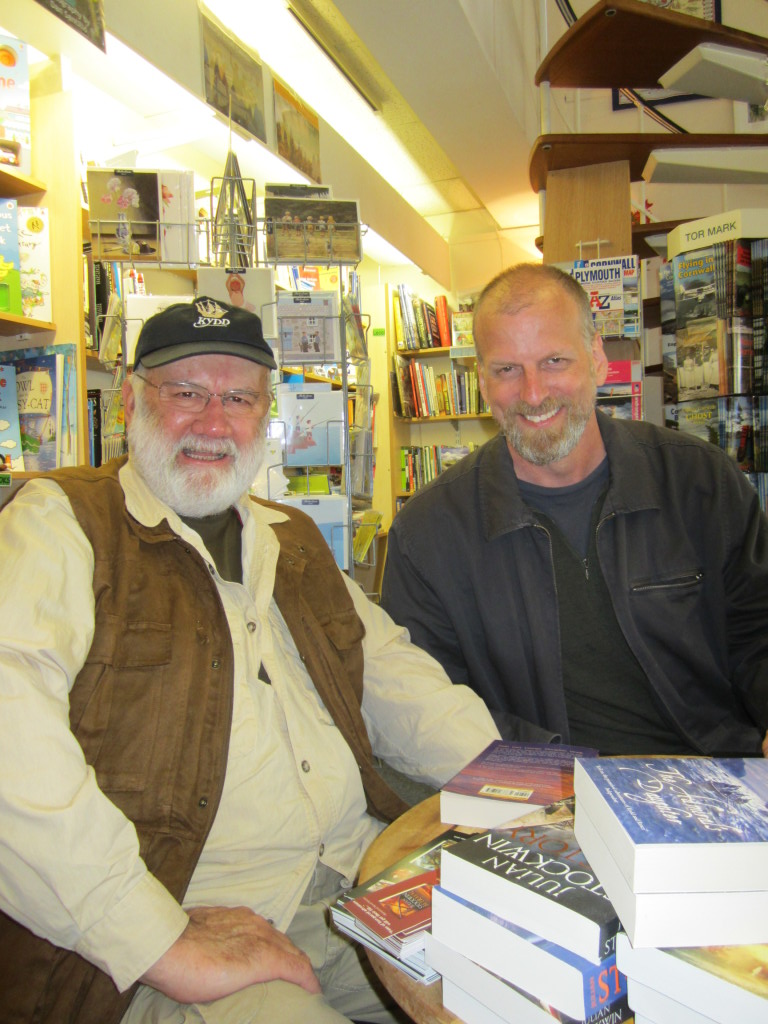
Joe and me
Was your recent visit to the UK your first time here and what was the purpose of the visit?
I have visited the UK many times and in fact, lived in London for a year in the late 1980s. I dearly love it there, and have always been a bit of an Anglophile. My favorite painters are mostly English (or based in England) and as a musician, I’ve been most influenced by the British Invasion. And, of course, the writers… The purpose of this recent visit was initially motivated by a desire to see the Dame Laura Knight exhibition in Plymouth and to explore Cornwall a bit, and of course do some painting.
If you were going to paint Tom Kydd what features would attract you as an artist?

Joe’s impromptu watercolour sketch of the Stockwins
Do you have a favourite title? Favourite character?
If I had to choose a favorite, I think it would be THE PRIVATEER’S REVENGE/TREACHERY. From the poignant beginning, through to the intrigue and final triumph, and the setting in the Channel Islands, I found this book to be very satisfying… but then they all are. As to a favorite character, it would have to be our heroes, although it’s really the beautifully portrayed relationship between them (and with all the wonderful secondary characters). I truly believe it is these relationships that make for great books, not the plot or or setting.
You live in New York and are very much involved in the vibrant modern life there – so what attracts you to my historical novels set in the Georgian era 200 years ago?

Woman in a Red Beret
by Joe Ongie
What are you working on at the moment?
My days are spent painting and my nights are spent making music, with all the pleasures of this great town sprinkled in between. I recently finished a portrait of a fellow artist and a large charcoal of Senegalese girl. I am planning on yearly trips to the UK to do more extended and serious painting.
More on Joe and his work
Would you like to be a candidate for Reader of the Month? Just get in touch with a few sentences about your background and why you enjoy the Kydd series!
Audiobooks to Go!
Posted on July 1, 2014 7 Comments
[To leave a comment or reply go to box at the end of the page]
I know there are quite a number of Kydd fans who find the audiobooks a boon, especially on long commutes. But you have to have a good narrator! I’m fortunate to have someone of the calibre of Christian Rodska in that role. He really is incredible – such a range of voices and an emotional expression that just pulls you in!

Christian Rodska
Rodska is a professional actor with a distinguished career. Among his television and stage credits are Macbeth, Driving Miss Daisy, Spooks, Doc Martin and Sharpe. His voice can also be heard on Ice Road Truckers and Megastructures on Channel Five in the UK.
Kathy and I are currently re-listening to the entire Kydd series on audiobooks. But we have to limit ourselves to just half an hour or so a day – or the next book would not be written! At the moment we’re mid-way through MUTINY, so plenty more to enjoy… I calculated that from KYDD up to and including CARIBBEE there’s over 150 hours!
Spoken word recordings first became possible with the invention of the phonograph by Thomas Edison in 1877. However it was to be some time before recordings of full length books became practical – this wasn’t really until the 1930s. The term audiobook came into usage in the 1970s when audiocassettes began to replace records. With the advent of the internet, broadband technologies, new compressed audio formats and portable media players, the popularity of audiobooks grew significantly during the late 1990s and 2000s. And this trend continues as people discover the pleasures and convenience of the spoken word.

Less than a year after the invention of the phonograph this drawing offered a vision of the future – but novels would remain impractical for phonographs for 50 years
When W H Howes was set up in the UK it was named after one of Trentman’s distant relatives; a man called William Frank Howes. Howes was a well-known captain of clipper ships during the 1830s. And I was chuffed to find that the salty links do not end there. Christian Rodska is the son of a Danish sailor, who was at one time captained the royal yacht of King Faisal.
Whole Story Audiobooks, the retail arm of WH Howes, is releasing the Kydd Series today under its new Lamplight imprint. To celebrate this, there’s a special discount of 20% on Kydd titles until September. The code is KYDD. Additionally, CARIBBEE is on offer at £14.39 until 11 July. (This site is for customers in the UK and Europe.)
As always, I welcome comments. I’d love to hear if you have a favourite Kydd audiobook or passage in one of the books?
Ninety-six years’ naval service!
Posted on June 24, 2014 7 Comments
I would have loved to have met Provo Wallis!
Throughout maritime history many seamen gave a huge part of their lives to King and Country. In the course of his service at sea, John Balchen saw action in numerous battles against the French and Spanish navies across 60 years and three separate wars. Earl St.Vincent served throughout the latter half of the 18th century and into the 19th, and was an active commander during the Seven Years’ War, American War of Independence, French Revolutionary War and the Napoleonic Wars. He chalked up 73 years’ service. But Provo William Parry Wallis beats them all, 96 years in the Royal Navy. Yes, 96 years!

A young officer, Provo Wallis in 1813
It was in the War of 1812, during the now-famous Shannon and Chesapeake incident, 201 years ago this month, that Provo showed his real mettle. HMS Shannon captured USS Chesapeake near Boston on 1 June 1813. Shannon‘s captain, Philip Bowes Vere Broke, was badly wounded during the action and her first lieutenant was killed.
Talk about being thrown in at the deep end! Second Lieutenant Wallis found himself in command of not one but two ships crowded with dead and wounded – as well as prisoners – and close to the enemy coast. In deference to Captain Broke, lying near death in his cabin, Wallis ordered a silent ship. He then sorted out the most pressing concerns, including organising essential repairs, and set course for Halifax. Such was the burden of this command that he did not change his clothes during the six-day voyage and scarcely slept.
Provo went on to serve in various theatres and eventually became admiral of the fleet in 1877.

Provo Wallis in later years
Provo became a much-revered figure in Portsmouth, often being visited by young officers keen to pay their respects to a man who had once set eyes on the great Nelson himself.
Provo liked to row his wife in a little boat around the pond at the back of his house. At the age of 98 he was a special guest on board HMS Monarch during the great naval review to honour the recently crowned Kaiser Wilhelm II.
He’d fought at sea under sail and continued to serve well into an era of steel battleships, torpedoes, submarines and electric power. What he thought of it all has regrettably gone unrecorded…
Provo Wallis died just before his 101st birthday – and at his request was laid to rest as a sailor in a plain wooden casket with a ship’s blanket for a shroud.
Copyright notices
Portrait of a young Wallis: By Robert Field (McCord Museum/ McGill) [Public domain], via Wikimedia Commons; Portrait of older Wallis: Public Domain via Wikipedia
Every effort is made to honour copyright but if we have inadvertently published an image with missing or incorrect attribution, on being informed of this, we undertake to delete the image or add a correct credit notice
BookPick: Arthur Phillip
Posted on June 21, 2014 Leave a Comment
[To leave a comment or reply go to box at the end of the page]
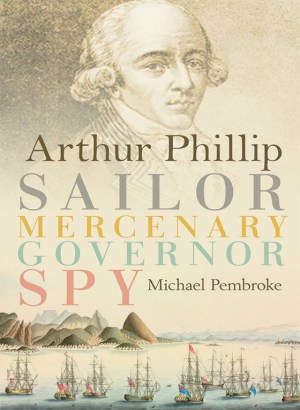
Arthur Philip
And this biography by Australian Michael Pembroke didn’t disappoint.
Phillip was the first governor of the colony of New South Wales. A somewhat mercurial man, I discovered to my surprise he had many other careers – soldier, mercenary, spy for the British Empire – long before he captained the First Fleet and founded Sydney.
Pembroke’s absorbing tale of Phillip’s life takes us through wars with Spain and France, battles, court martials, and the taking of Havana from the Spanish. In his 20s he married a wealthy widow and briefly became a gentleman farmer. The marriage ended in divorce, before such a thing existed in England, but Phillip then became a successful merchant in France and likely spy for England. In 1774 he became a paid mercenary for the Portuguese navy at the behest of the Admiralty – his enemy again was Spain but now in South America. Upon his return to London some years later, the revolution in the American colonies triggered another war with France and then Spain as well. England faced the possibility of its first invasion since 1588 and Phillip became the captain of a 74 gun ship with a crew of 600 men defending the channel. Phillip is here revealed to have undertaken secret missions for the Admiralty throughout his career and perhaps was among the first to be a part of the Secret Service.
For those wishing to explore the subject matter of this book further, the author provides extensive notes and references to his sources.
Arthur Phillip: Sailor, Mercenary, Governor, Spy by Michael Pembroke RRP £20.00
Published by Hardie Grant. ISBN 978-1742708058
THE ADMIRAL’S DAUGHTER: dangerous waters!
Posted on June 17, 2014 9 Comments
A regular feature looking back on each of the Kydd titles – with story background, research highlights, writing challenges and more.
The eighth book in the Kydd series is THE ADMIRAL’S DAUGHTER. Kydd is back in command of his beloved Teazer but he finds as many challenges ashore as at sea in pursuit of the enemy.
Home Waters
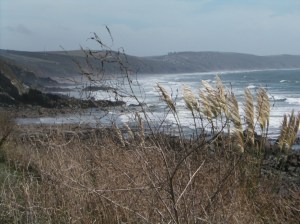
The treacherous Whitsand Bay from Portwrinkle to Rame Head
This was the first Kydd book set in home waters – and I found it to be as wild and exotic a location as any, with spectacles such as the incredible complex of the Plymouth naval base and dockyard. In those pre-factory times it was the wonder of the age, employing thousands of men, when most industries counted their workers in tens at most.
No one in England lives far from the sea and a strong and abiding relationship with Neptune’s kingdom is a national characteristic, but it’s perhaps in the West Country where the maritime heritage is strongest. Since time immemorial, the sea has provided food and transport links between isolated communities, and with hundreds of miles of rocky coastline, and winter storms equal to any it’s also been the graveyard of so many fine ships.
I spent many hours exploring the iron-bound coast and shoreline. I chose Whitsand Bay, the scene of many all-too-familiar wrecks on the Cornish coast for a dramatic incident in the book. Kydd’s ship Teazer is making heavy weather of it back to the safety of Plymouth Sound and sights another vessel perilously close inshore. But despite heroic efforts by Kydd and his crew the other ship breaks up and the sailors perish, their strength spent in exhaustion and cold.
The book’s dedication
Given incidents like the one in Whitsand Bay it seemed appropriate to use this verse Martyn Parker wrote, some 200 years ago
- Ye gentlemen of England that live at home at ease
Ah! Little do you think upon the dangers of the seas!
His words still have resonance today.
Research
In the course of location research, as well as taking in the general area of the West Country, I spent some time in the picturesque fishing village of Polperro in Cornwall. Kathy and I stayed in a smugglers cottage dating back to even before Kydd’s day.

The Polperro smugglers’ cottage we stayed in
When doing location research finding local inhabitants with knowledge and expertise is always invaluable. For THE ADMIRAL’S DAUGHTER there were many I had to thank, including former harbour master Tony White and historian Jeremy Johns – but a special debt is owed to ex-fisherman Bill Cowan who schooled me in the lore and practice of the Cornish fishery, and shipwright Ron Butters, whose wonderfully crafted models of fishing vessels under sail told me all I need to know about these hardy craft.
If you’re ever in Polperro it’s worth visiting the Polperro Heritage Museum of Smuggling and Fishing which houses a fascinating collection of exhibits. It’s open March to October.
In Plymouth, which is actually not far from my home in Devon, I was privileged to be given a special private tour of Stonehouse Royal Marine Barracks. The Long Room, where Kydd attended the ball, still stands tall within the complex. As well, Kathy and I put in considerable footwork in Old Plymouth pacing out the very streets that Kydd comes to know in the book.
An ancestral link!
Deep into document-based research I discovered that my wife Kathy is related to one of the real-life characters in the story! Did she, I casually asked one day, poring over some arcane document or other, by any chance have an English ancestor by the name of John Stackhouse? Unsure, Kathy emailed her parents in Tasmania, Keith and Cressey Stackhouse, and was amazed to learn that indeed she was related to him. John Stackhouse was born in Cornwall in 1742. After completing his education at Oxford, he spent several years studying marine biology around the Mediterranean; his particular interest was seaweed. He married a Susanna Acton and built Acton Castle above what is now known as Stackhouse Cove. Kathy is a descendant of Alfred Stackhouse who settled in Van Diemen’s Land in the nineteenth century and whose grandfather was John Stackhouse’s brother!
Now why can’t I have some illustrious ancestry…
Writing challenges
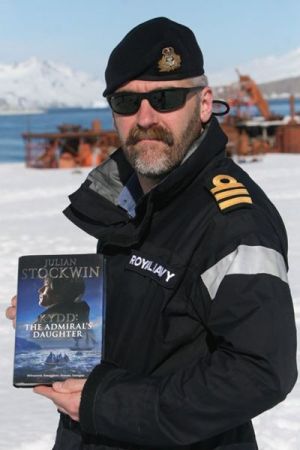
THE ADMIRAL’S DAUGHTER made it to the cold wastes of Patagonia aboard HMS Southampton
Perhaps the greatest challenge I encountered when writing this book was how to deal with the two loves in Kydd’s life, Persephone and Rosalynd. I think in some ways I fell in love with both of them, too…
Of all the aspects of Kydd’s life I have written about this is the one that has generated the most comment from readers. Some have told me they thought Kydd mad to give up Persephone and all she would have meant for his career. Others stood firmly with Kydd in his decision to follow his heart and marry sweet Rosalynd. The debate will continue, no doubt!
My thanks to Kydd
Becoming an author has meant that I‘ve met people from many walks of life all over the world – certainly in my previous profession as a computer systems designer it would have been unlikely for our paths to have crossed. There are far too many new friends and acquaintances directly attributable to Thomas Kydd to acknowledge them all, but I know I’m enriched by every one of them. To be able to write for one’s living is a great privilege; I know I’m very fortunate.
News: THE SILK TREE to be published in November!
Posted on June 12, 2014 33 Comments
[To leave a comment or reply go to box at the end of the page]
Exciting news! This year, as well as the next book in the ongoing Kydd series, PASHA (coming out in October), I’m bringing out another historical action-adventure novel, THE SILK TREE.
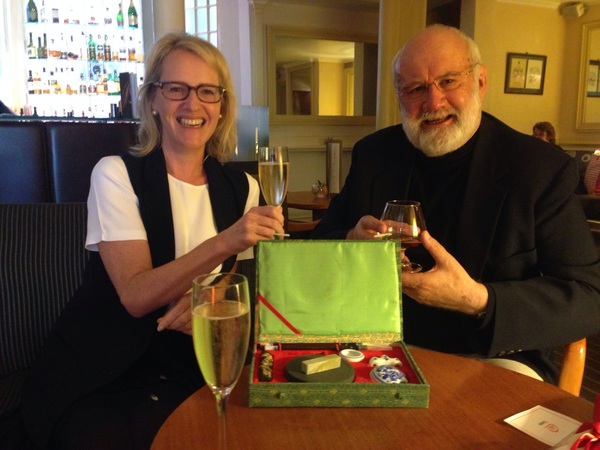
Toasting the upcoming launch in November of THE SILK TREE with Allison & Busby’s Publishing Director Susie Dunlop
Rooted in the historical record, this is an epic quest across an immense and hostile geographical canvas. It is also a tale of friendship and courage; myth and love.
So how did this book come about? On location research in Istanbul Kathy discovered a rather lovely silk scarf in the Grand Bazaar. While she was chatting to the merchant I idly wondered just how it was that silk was brought from China to the West. Intrigued, I did some research and the creative juices started flowing – I knew I had another story I had to tell …
It’s been hard work balancing two writing schedules but I’m thrilled that the British publisher Allison & Busby shares my enthusiasm for the story and are bringing out THE SILK TREE in November in hardback and ebook.
More on THE SILK TREE in upcoming blogs…
 Julian Stockwin