
BookPick: The Great War at Sea
Posted on August 23, 2014 5 Comments
 Lawrence Sondhaus brings impressive credentials to this work; he is Director of the Institute for the Study of War and Diplomacy at the University of Indianapolis.
In his Introduction, Sondhaus makes the point that while the Great War was a conflict distinctive for its unprecedented bloodshed, less than 1 percent of the 8.5 million combatant deaths were naval personnel lost at sea – but this disproportionate distribution of human sacrifice did not mean that the war at sea had a peripheral significance to the final outcome. Far from it.
In this major new naval history of the First World War Sondhaus reveals the decisive contribution of the war at sea to Allied victory. In a truly global account, he traces the course of the campaigns in the North Sea, Atlantic, Adriatic, Baltic and Mediterranean and examines the role of critical innovations in the design and performance of ships, wireless communication and firepower. He charts how Allied supremacy led the Central Powers to attempt to revolutionize naval warfare by pursuing unrestricted submarine warfare, ultimately prompting the United States to enter the war. His treatment of this novel and entirely game-changing mode of warfare is particularly engaging, making full use of modern scholarship discoveries in uncovering its development from a German perspective. Victory against the submarine challenge, following their earlier success in sweeping the seas of German cruisers and other surface raiders, left the Allies free to use the world’s sea lanes to transport supplies and troops to Europe from overseas territories, and eventually from the United States, which proved a decisive factor in their ultimate victory.
Compellingly written and well documented, with maps, photographs and an extensive bibliography, this work will appeal to all serious scholars of war and the general reader with a particular interest in The War to End All Wars.
The Great War at Sea by Lawrence Sondaus, Published by Cambridge University Press. ISBN ISBN 978 1 107 03690
Falmouth, Ahoy!
Posted on August 19, 2014 6 Comments
In under two weeks the Cornish town of Falmouth will witness a truly spectacular sight – white sail cresting the horizon and then coming to anchor in the third deepest natural harbour in the world. Forty-six Sail Training vessels from around the world, including eleven magnificent square sail Tall Ships, will arrive for four days of events from 28 to 31 August.
Proud history

The American artist Henry Scott Tuke lived in Falmouth in the early twentieth century and painted this charming watercolour of two French barques in Carrick Roads
Falmouth has a long history and proud history. It was the site where Henry VIII built Pendennis Castle to defend Carrick Roads (as the deep channel of the harbour is known) in 1540. (The main town of the district was then at Penryn.)
In the late 16th century, under threat from the Spanish Armada, the defences at Pendennis were strengthened by the building of angled ramparts. During the Civil War, Pendennis Castle was the second to last fort to surrender to the Parliamentary Army.
Sir John Killigrew created the town of Falmouth in the early seventeenth century.
The famous Falmouth Packet Service operated for over 160 years between 1689 and 1851 carrying mail to and from Britain’s growing empire.
In 1805 news of Britain’s victory and Admiral Nelson’s death at Trafalgar was landed here from the schooner Pickle and taken to London by Lieutenant John Lapenotiere in an epic 36-hour journey that took 21 changes of horses and carriages.
On 2 October 1836 HMS Beagle with Charles Darwin aboard anchored at Falmouth at the end of its famous survey voyage around the world.
Contest
Kydd and Renzi visited Falmouth in one of the Kydd titles. Email julian@julianstockwin.com with the name of the book and you’ll go into the hat for a chance to win a Navy Blue Kydd Cap plus a signed paperback of that title…
Falmouth signing
I’ll be at Falmouth Booksellers signing copies of my books on Friday 29, noon. Drop by if you’re passing! I’ll be giving away postcards and bookmarks while stocks last.
Copyright notices
Henry Scott Tuke [Public domain or Public domain], via Wikimedia Commons
Every effort is made to honour copyright but if we have inadvertently published an image with missing or incorrect attribution, on being informed of this, we undertake to delete the image or add a correct credit notice
A Peek at PASHA
Posted on August 15, 2014 3 Comments

Here’s what three advance reviewers of Pasha have said:
- What a read! This is a very mature novel, with various storylines woven expertly into the history.
- All I can say is WOW!! So many twists and turns. So many questions answered. So many things set to rights, and then it’s all a whole new set up!! Totally unexpected and totally enjoyable.
- I have enjoyed the Kydd series immensely, but Pasha is my favourite. I love the new developments in Renzi’s life. I will say no more!
Click here to read an excerpt
Pasha is published in hardback and ebook in the UK by Hodder & Stoughton on October 9, and in the US by McBooks Press on November 1
BookPick: Mary Rose and Billy Ruffian
Posted on August 13, 2014 1 Comment
[To leave a comment or reply go to box at the end of the page]
Some ships capture our hearts and minds. Mary Rose and HMS Bellerophon are two such celebrated in this double helping of Book Pick. One ship has been saved for the nation, the other sadly not, but both are deservedly especially honoured, part of Britain’s rich seafaring heritage.
 The raising of Mary Rose in 1982, 450 years since she sank, made headlines around the world. The ship served Henry VIII’s Navy Royal for thirty-six years, many of which she spent as the flagship on active service. She took part in three wars against the French and one against the Scottish.
This new paperback edition brings the history of this famous warship up to date with new chapters on the stunning presentation of the hull and the 19,000 salvaged artefacts in the new museum in Portsmouth. The book also tells the story of her eventful career, placing it firmly within the colourful context of Tudor politics, court life and the developing administration of a permanent navy. Beautifully illustrated.
The Warship Mary Rose by David Childs, Published by Seaforth. ISBN 978 1 84832 211 0
 Known as ‘Billy Ruffian’ to Jack Tar, Bellerophon’s story spans the dramatic years of the Napoleonic wars, 1793 – 1815. She took part in the first great fleet action of the War and was involved in the last moments of the struggle with the surrender of Napoleon. Bellerophon was one of the most distinguished of the 74-gun ships. Having fought at The Glorious First of June, the Battle of the Nile and Trafalgar she saw more than her share of fierce ship-to-ship encounters. In between there were the varying duties of blockade and escort carried out with service in the Channel, the Mediterranean, the North Sea, the Baltic and the West Indies. Author Pengelly covers the many and various aspects of the ship’s life from construction through maintenance and refits, action against the enemy, to her final disposal.
This book was first published in 1966 and reprinted this year.
HMS Bellerophon by Colin Pengelly, Published by Pen and Sword. ISBN 1783 462 40X
VICTORY: Kydd at Trafalgar
Posted on August 9, 2014 10 Comments
A regular feature looking back on each of the Kydd titles – with story background, research highlights, writing challenges and more.
And thank you for all your kind comments on the post about my tenth book, Invasion.
The eleventh book in the Kydd series is Victory, which climaxes in Kydd’s involvement in Trafalgar, one of the grandest battle spectacles in history.
Praise for the book
‘Well-written mixture of high-seas adventure and character-based drama . . . impossible not to enjoy!’ — Booklist
‘Elegantly plotted . . . the writing has the power of a broadside at close range’ — Oxford Times
‘This book is as fresh as the first to be published . . . the characters have matured as the tales unfolded and each story adds a new layer of complexity . . . a fictional tale that takes forward the careers of his two heroes in such a natural way that they feel to be a genuine part of history, interacting with the real story of Nelson, Trafalgar and Victory’ — Firetrench
Location research
The main focus for research for this book was Portsmouth in the county of Hampshire. I was privileged to have been given virtually unlimited access to the HMS Victory. As you can probably imagine I spent many contented hours aboard…
Although I know Portsmouth very well, having been quartered in the city during my time in the Navy, and also having visited on location research for earlier Kydd books, I never seem to tire of ‘Pompey’ and its maritime attractions. For Victory I spent quite some time in Old Portsmouth, too, much of which stands just as it did in Kydd’s day.
Another locale for research for this book was London, both the physical city and the river Thames, as well as museums, archives and libraries – and I had spent time in the Mediterranean area on previous location research trips.
Three captains…

Captain Gabriel Catolino
I love being sent photographs of readers with my books but in the case of Victory I was somewhat taken aback to find I had been sent three rather special ones – three ship captains, each holding Victory!
Captain Gabriel Catolino is commander of a destroyer squadron in the Argentinian navy. Captain Catolino enjoys historical maritime fiction and told me he immediately became a Kydd fan after reading Victory.
Captain Paul Wright of Cunard’s Queen Victoria was presented with a copy of Victory by one of my readers, fittingly, as the ship rounded Cape Trafalgar!
Captain (now Commodore) Jerry Kyd, the last Commanding Officer of HMS Ark Royal, graciously posed with Victory with Victory in the background. He was recently appointed the first seagoing Captain of the Royal Navy’s brand new aircraft carrier HMS Queen Elizabeth.
Writing challenges

Captain Jerry Kyd, then commanding officer of HMS Ark Royal
HMS Victory in background
When I first began the series I knew that at one point I’d have to deal with Trafalgar, but as I was only in 1793, at book one, I was able to put my concerns about writing about such a famous event to one side, and get on with the business to hand. However, when I finished Invasion, I had to face the special challenges of Victory. How could I bring something fresh and new to such a well-known story? In the end I decided to do this by having two perspectives on the battle, one of my hero in his ship, and the other from a lowly midshipman aboard Victory herself.
Another problem was that while I have a huge admiration for Nelson (which, if anything, increased as I was writing the book) he is a huge presence on the maritime stage and I didn’t want him to take over the story
Nelson’s prayer
On the morning of October 21, 1805, with the combined fleets of France and Spain in sight, Nelson wrote this prayer, which I still find very moving to read :
- May the Great God, whom I worship, grant to my Country and for the benefit of Europe in general, a great and glorious Victory; and may no misconduct in any one, tarnish it and may humanity after victory be the predominant feature of the British Fleet. For myself individually, I commit my life to Him who made me and may His blessing light upon my endeavours for serving my Country faithfully. To Him I resign myself and the just cause which is entrusted to me to defend. Amen. Amen. Amen.
Milestone in the series

Captain Peter Wright of Queen Victoria
Victory completed the trilogy (which included the previous two titles: Treachery and Invasion) that dealt with the incredible events in the two years leading up to Napoleon’s defeat at Trafalgar in 1805. Victory was a milestone in the Kydd series; it featured the last of the big set-piece naval battles. Trafalgar removed the sceptre of invasion and Great Britain was released to seek conquests and colonies in the furthest reaches of the world. In subsequent books Kydd finds himself at the forefront of this race to wrest empire from the French and Dutch in exotic and little-known corners of the world.
Read more about Victory on earlier blogs
“Renzi is my favourite character”
Posted on August 5, 2014 4 Comments
[To leave a comment or reply go to box at the end of the page]
These days, with the pervasiveness of the internet and ease of world travel for many people, an author describing locations must be very careful to get his facts right, even if he is writing about how an area was in the eighteenth/early nineteenth century. Kathy and I have travelled the world researching the Kydd series and these trips are hard work! Very enjoyable, I hasten to add, but much time is spent in museums, local archives etc. as well as taking multiple photographs and lengthy notes.
It’s always gratifying when readers tell me they have visited places mentioned in my books and that I got the descriptions spot on!

Tom Rogers visiting the Grand Cayman Museum in the Caribbean
Over to Tom…
Your favourite title?
Caribbee was the best so far, in my opinion. I’ve been to many of the Caribbean Islands including Nassau, Eleuthera, The Caymans, Puerto Rico, US Virgin Islands, British Virgin Islands, Montserrat, Antigua, Saint Martin, St Lucia and Aruba. One of my favorite parts in Caribbee is the description of entering and invading Dutch harbour, where I’ve been. One thing I remember about that area was the beauty of the Silver Thatch Palms. Online pics do not do them justice compared to real sunlight. The cliff descriptions in the book made me think this was the entry area to Cayman Brac. There is a great little museum on the island. I have also been to English Harbour (Nelson’s Dockyard) and Shirley Heights, Antigua. An awesome view of the harbour below! And then there is Aruba. The Dutch look is different from any other in the Caribbean. The description of the colorful houses and small buildings was spot on. I really enjoyed Caribbee. What a great story with a few twists along the way. One of the things I especially like in the Kydd series is the way people and events in earlier books are linked to later ones. Like the drunken captain in Caribbee. I’d forgotten about him until he re-appeared!’
First boat?
I grew up in a small coastal town on the Gulf of Mexico. My hometown is Rockport, in south Texas, noted for tourism and commercial fishing (mostly oysters and bay shrimp). Growing up in Rockport, I spent quite a lot of time duck hunting and water skiing. My first boat was a Boston Whaler dinghy. Kind of like a bath-tub with a sail! My summer jobs while in grade school ranged from scraping barnacles off the bottom of boats to deck hand on off shore fishing yachts. I quickly found the topside of a boat was better. I’ve been on the Nina Columbus replica ship that was docked at Corpus Christi Texas. It was a lot smaller than I expected. The only warships I’ve been on are of the modern era – the Battleship Texas and the Aircraft Carrier Lexington.
How were you drawn to the series?
I’ve enjoyed reading nautical historical fiction from many authors including Dudley Pope and Douglas Reeman (Alexander Kent). In my electronic search for similar series, Kydd grabbed my attention; the reviews on the internet looked promising. One book later and I was hooked.
Favourite character?
Renzi is my favorite character. I enjoy his thoughts on the story. He is the most complex in the series. The fact that he is so intellectual yet fails often makes him interesting. I keep hoping good things will happen for him.
Would you like to be a candidate for Reader of the Month? Just get in touch with a few sentences about your background and why you enjoy the Kydd series!
Collectors Sets and Signed First Editions Going Fast!
Posted on August 2, 2014 7 Comments
This year I’m delighted to be offering +two+ Collectors Sets, one for Pasha, the next title in the Kydd series, and one for The Silk Tree, my standalone historical novel (and a departure from my maritime tales) set in the sixth century. Each Set is strictly limited in number and I am happy to write short inscriptions on request.
THE SILK TREE Set
 The Silk Tree Collectors Set is a standalone historical novel and will be published in November. Inspired by a visit to Istanbul, and rooted in the historical record, it tells the story of two adventurers who dare all to steal the secret of silk from China. The Collectors Set comprises a signed and numbered First Edition, which will also be stamped with my own personal vermilion Chinese ‘chop’; and a signed cover postcard. This offer is in very limited numbers, just 150, so don’t delay — first come, first served…
The PASHA Set
 PASHA will be published in October. This book sees Kydd involved in a critical sphere of interest: the Dardanelles, key to the route to India.
The Collectors Set comprises a signed, numbered and embossed UK First Edition and a signed cover postcard. This offer is in very limited numbers, just 500. The Pasha set is already nearly fully subscribed…
Signed First Editions
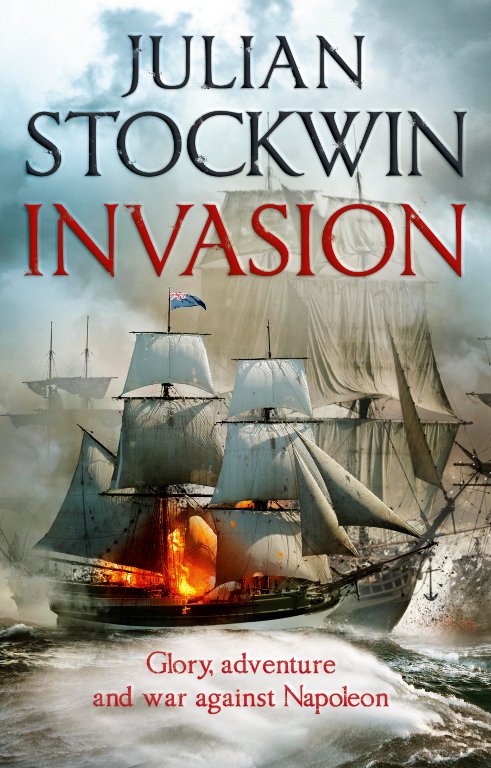 I also have a small number of signed First Editions still available: as well as INVASION, there’s TREACHERY, CONQUEST, COMMAND, QUARTERDECK, BETRAYAL and CARIBBEE. Email me julian@julianstockwin.com for further details, or use the contact form below. All these signed First Editions are £25 each, including postage for UK and Europe; £30 each for rest of world. Payment is via Paypal to admin@julianstockwin.com and a 10% discount is given for purchases of three or more books.
INVASION: glory and adventure
Posted on July 31, 2014 6 Comments
A regular feature looking back on each of the Kydd titles – with story background, research highlights, writing challenges and more.
Thank you for all your kind comments on the post about my ninth book, TREACHERY.
The tenth book in the Kydd series is INVASION. Kydd finds himself centrally involved in the activities to counter the fearsome invason plans of Napoleon Bonaparte. This book was somewhat of a milestone in my literary career: my 10th book in print – one million unique words out there!
Real-life characters
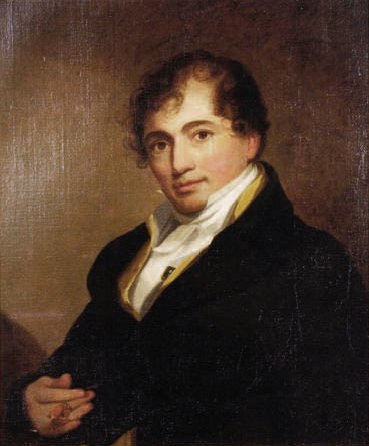
Robert Fulton
Fulton’s nickname of ‘Toot’ was widely used but I can find no definitive reason for it. Some have suggested it derives from the whistle of the steamboat for which he’s known, but his nickname was certainly used before this time. Fulton was very gifted but difficult to penetrate as a person, naïve but intense. A Maryland farm boy, he came to England by invitation, and for a time lived as a portrait painter in Devon.

Plans for Fulton’s working submarine
Fulton’s proposed machines were the first weapons of mass destruction – deliberately designed to blow up humans without warning or a chance to fight back and caused as much stir then as WMD does today.
Other characters in this book may seem at first reading to be the product of a vivid imagination but there really was a mysterious ‘Mr Smith’ who detached Fulton from Napoleon to transfer his allegiance to England. There is very little known on this episode so I took what I felt was likely to have occurred, and put Renzi in Smith’s place. Likewise, the famed Parisian savant, LaPlace, was indeed a friend of Fulton’s…
I enjoy Jane Austen’s works and it was on a literary whim that I decided to mention her in INVASION, via her brother who actually was in post there at the time. She had two sailor brothers; Francis, who Kydd meets in the course of his acquaintance with the Fencibles, and Charles. Both later advanced to become admirals and Jane no doubt consulted them when she created William Price in Mansfield Park and Captain Wentworth in Persuasion.
Location Research
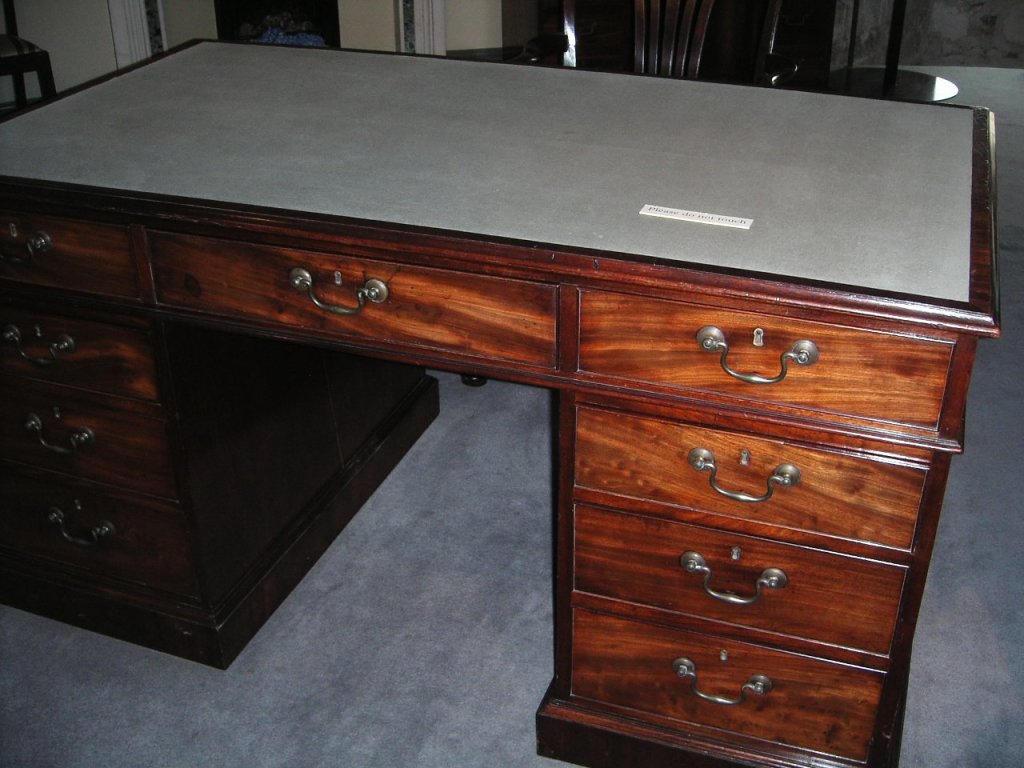
The actual desk Prime Minister Pitt used when working at Walmer Castle on secret missions
The book’s publishing journey
December 1, 2008
I pressed the Send Email button then sat down with Kathy for our traditional glass-raising ceremony to toast completion of a book… Within milliseconds the file arrived at my editor Anne Clarke’s computer via a high-speed broadband connection between Ivybridge, Devon and London.
Anne had recently become my new editor at Hodder: ‘When I took over as Julian Stockwin’s editor I felt honoured and not a little nervous about working on such a highly regarded and well-loved series. I needn’t have worried – when I read the manuscript for INVASION I was delighted to find I could almost send it straight to the printers, as it was pacy, compelling, extremely well structured, and full of as much adventure as I could wish; there was really very little editing for me to do! INVASION is a wonderful historical novel and in reading it you get swept away into the lives of Kydd and Renzi and the excitement and drama of fighting Napoleon on the high seas. I loved the direction Kydd was taking, and looked forward to many more adventures to come.’
February 12, 2009
Anne sent minor editorial queries to me. I responded to her questions, making changes to the manuscript.
March 1, 2009
The next person in the publishing chain was freelance copy editor Hazel Orme: ‘I’ve had the good fortune to work on all of Julian’s Kydd series – every one a winner – and look forward as soon as I’ve finished one to meeting up again with Kydd and Renzi in the next. They’re old friends now. With each novel I’ve noticed there’s less and less for me to do – I iron out the odd awkwardness, question the occasional inconsistency, spot-check Julian’s impeccable research and adjust punctuation, but principally I sit back and enjoy what is always a ripping yarn. Julian wears his scholarship lightly – but with each novel I learn something new. What did I think of INVASION – suspenseful, gripping – another great yarn from an author whose understanding of the world’s oceans and shipping shines through all of his work. More!’
March 20
The manuscript with Hazel’s queries was sent back to me.
April 4
I returned the corrected manuscript to Anne Clarke.
April 15
The manuscript continued its journey and passed to Palimpsest. Located in Grangemouth, Scotland, Palimpsest is the largest supplier of typesetting in the UK.
Palimpsest’s Craig Morrison: ‘Having booked in the title noting the production schedule dates, the first part of the process was to create a clean electronic text. The design specification was as per TREACHERY, the previous book in the Kydd series, and this was used as a reference for styling and tagging. The clean, tagged Word file was then ready for typesetting.
Once the systems operator was happy with the layout and the publisher had approved the page count, a full proof of the text was produced for our in-house proofreader to check. Then hard copy printouts and a digital proof was sent back to Hodder for forwarding to the author and Hodder’s proofreader.’
Upon receipt of a marked proof incorporating editor, author and proofreader corrections the text was amended by Palimpsest and a revised proof sent for approval. Upon signoff from the publisher a final press-ready digital file was created for the printer.
April 22
Anne Clarke met with Hodder’s inhouse designer to discuss the jacket design. Hodder had decided to take the covers in a new direction after researching the market and concluding that the books would appeal to a wider readership if they changed the jackets to reflect modern taste. Freelance designer Larry Rostant was commissioned to produce the visual and then Hodder’s designer added the title, blurb etc. in-house.
June 4
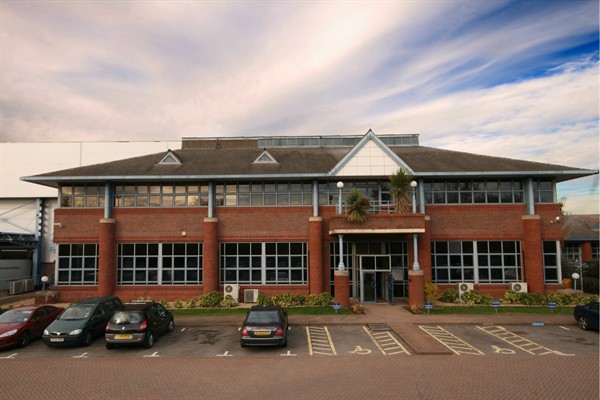
Bookpoint, distribution centre for my books
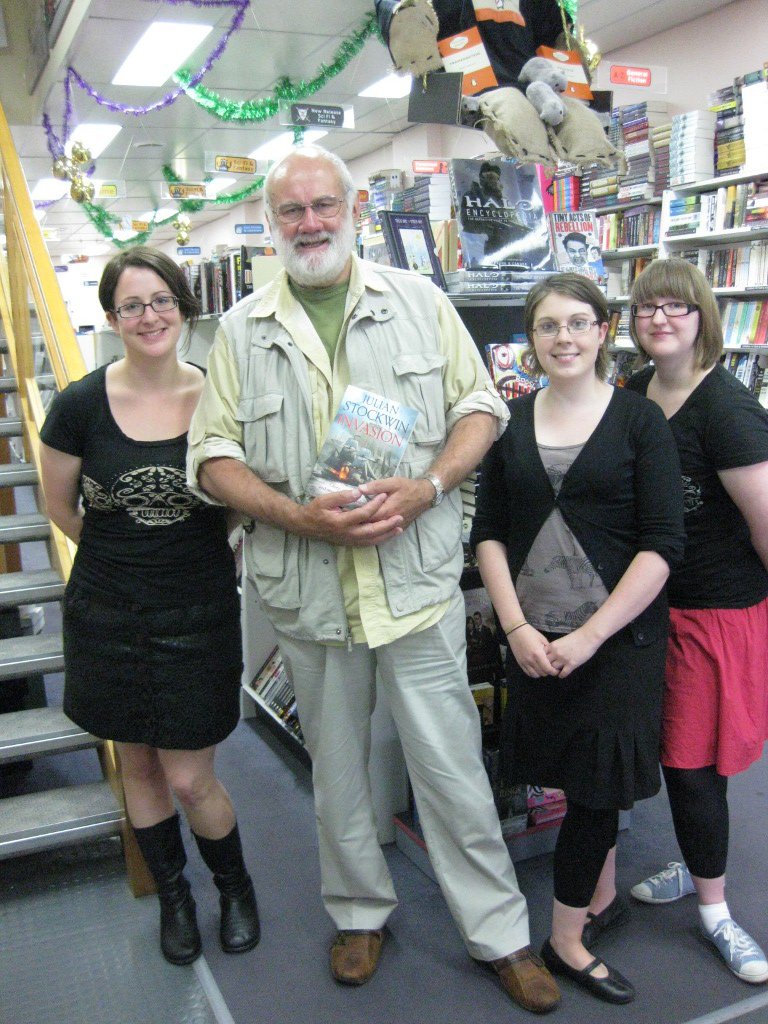
Warmly welcomed by the staff of Ellison and Hawker, Hobart, Tasmania
Trucks arrived to pick up the first pallet loads of INVASION for delivery to Hodder’s distribution unit, Bookpoint, 181 miles away. There, the books were loaded into computer-controlled storage areas for ‘picking’ when the orders from bookstores rolled in.
15 September
The INVASION publicity campaign ramped up. Press releases and early review copies of the book were sent out.
15 October
INVASION arrived at the booksellers, its long journey from my little study in Ivybridge to bound book in the shops complete!
Copyright notices
Fulton image: By Circle of Thomas Sully (American, 1783-1872) (Christie’s) [Public domain], via Wikimedia Commons; diagram: Public Domain via Wikimedia Commons
Every effort is made to honour copyright but if we have inadvertently published an image with missing or incorrect attribution, on being informed of this, we undertake to delete the image or add a correct credit notice
She speaks…
Posted on July 28, 2014 21 Comments
[To leave a comment or reply go to box at the end of the page]
I was recently chatting to a reader who told me he enjoyed my blogs and mentioned that he’d like to see a Guest Blog from Kathy as she is so intimately connected with my work. She was up for it but I did wonder whether I’d done the right thing in inviting her to write whatever she liked, along with her choice of photographs. As any who know her are aware, she can be pretty straight talking.
Without any further ado, over to Kathy…

Partying in Hong Kong. The world of Tom Kydd had yet to open up…
But let us begin at the beginning, when we first met.
I was a brand new educational psychologist rolling up for my first job, at a special centre for disturbed youngsters. I had an appointment with the head of the centre but as it happened he’d been urgently called away and I was told to wait in the staff room. I was a bit flustered as I’d driven over 200 miles from my home town, and had only recently passed my driving test (from a family, I hasten to add, where no-one drove a car…) In the staff room a dark-haired young man came up to me and asked if he could point me to the right room. I apparently curtly told him I knew exactly where I was supposed to be! Later I learned his name, Julian Stockwin; he was also a psychologist and had thought I was one of the hard-case female problem teenagers!
Not a good start. But over the coming months I began to think I had been a little too harsh in my dismissal… He obviously had a huge intellect, and wasn’t all that bad looking, either. And his wicked sense of humour was a plus as well.

Cutting our wedding cake
In the UK I had a number of interesting roles – running a customer service department, executive headhunting, and work in the retail sector. Julian, meanwhile, was developing specialist systems that would go on to be adopted by NATO.
However it was a very stressful environment for him and after the project was successfully completed I knew it was time to take stock. To this day I’m not quite sure why I suggested he try his hand at writing a book. The only ‘writing’ he’d done was business reports. Female intuition? Or perhaps my days as an editor had given me a sense of innate writing ability. Anyway, after initial resistance, we decided on a plan. He’d give up the computer systems design and take a half-time job lecturing while he applied himself to learning the craft of writing a book.
The topic came fairly quickly – for someone with salt coursing through his veins what else but the sea? And the great age of fighting sail had always been a draw for him. But where was the focus, the story? That was the challenge.

Travelling the world for Tom Kydd
I was still working full-time at this stage as we were under no illusions that Julian becoming a published writer could take a very long time.
When the manuscript of the first book, Kydd, was completed to our satisfaction we made a list of the top agents in the UK and decided we would work our way down, prepared for many rejections. However the god of debut authors was smiling on us and the agent Carole Blake (the very first agent we contacted) replied saying she was interested in possibly representing Julian.
But before that happened we had to visit Carole in her office to pass scrutiny. Carole takes on very few new clients and while she is warm and charming she is a very formidable presence. However something clicked. Carole soon had auctions going on both sides of the Atlantic, and was negotiating foreign language rights, audiobook rights etc.
It was a dizzy first year when Kydd came out and we travelled all over the UK for author talks, book signings, media events.
Julian resigned from his part-time teaching post and we decided to take the big gamble of my giving up the day job so that both of us could work full time on the Kydd Series.
My role encompasses editing, being a sounding board, administration, marketing and publicity initiatives, some research – in fact almost everything except the actual writing of the books. Julian calls me his ‘reality manager’ – the interface between his eighteenth century and the world outside.
We’ve travelled the globe with Tom Kydd and it’s also been great fun putting together Stockwin’s Maritime Miscellany with him and latterly an exciting new project, a stand-alone historical, The Silk Tree (which comes out in November). The Kydd series will continue, with a new book each year, but I’m delighted to see Julian’s maturing as a writer in tackling these other projects.
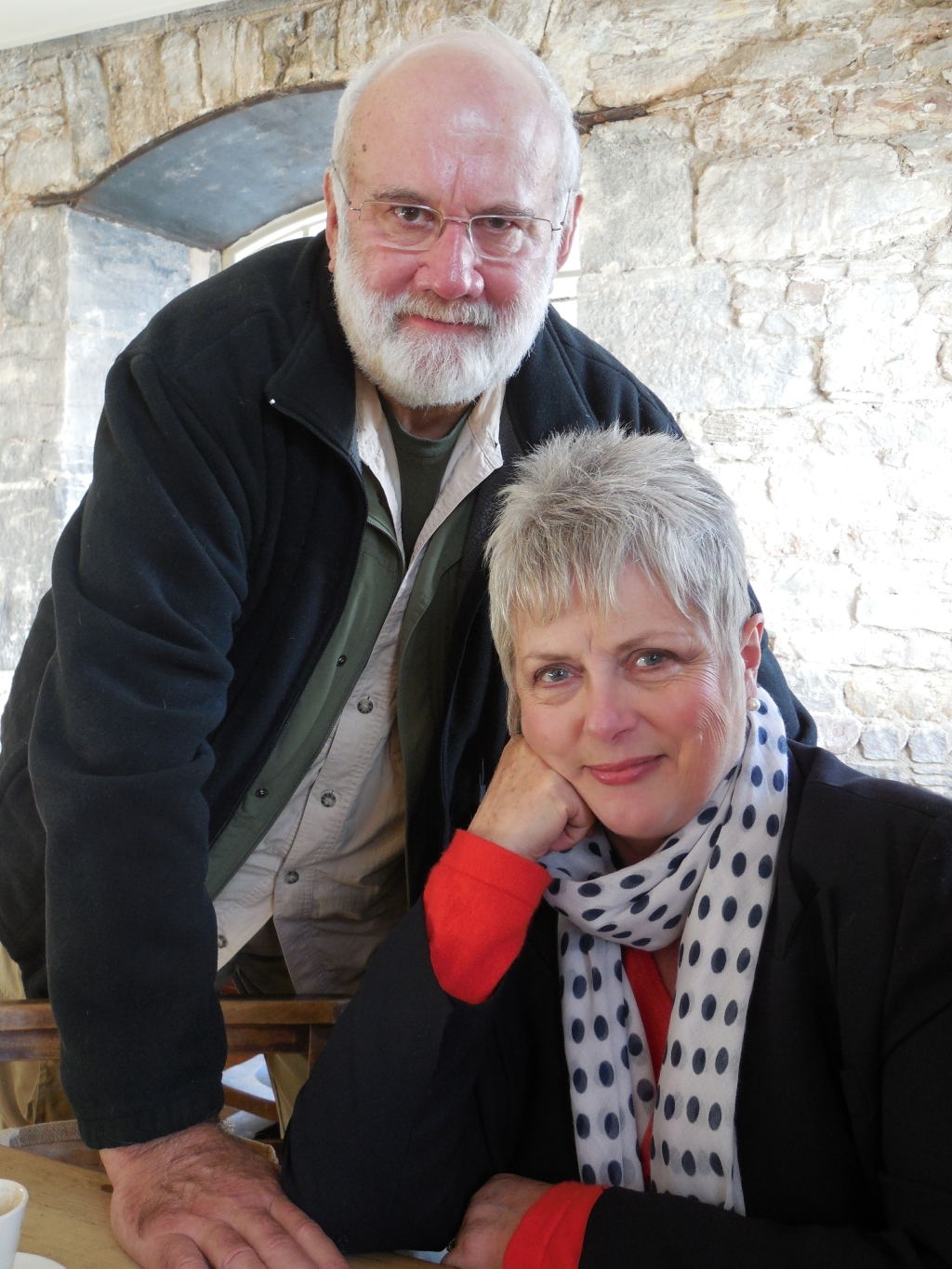
Team Stockwin!
As I look back on our life so far I celebrate what we have experienced together and look forward enthusiastically to whatever the future may bring.
Napoleon comes to Plymouth…
Posted on July 26, 2014 2 Comments
[To leave a comment or reply go to box at the end of the page]
I have the great good fortune to live not far from Plymouth, Devon. Ever since the days of Sir Francis Drake and the Spanish Armada, Plymouth has played a key role in Britain’s maritime history. But it was on this day in 1815 that perhaps the most amazing sight was ever seen on the harbour…
This description of the scene is taken my from little non-fiction volume, Stockwin’s Maritime Miscellany
Shortly after the Battle of Waterloo Napoleon Bonaparte surrendered – not to Wellington but to the captain of the ship that had dogged his steps for more than 20 years, Bellerophon – ‘Billy Ruffian’ to her crew. The ship sailed for England and the ship anchored at Torbay. Every effort was made to keep the famous man’s presence a secret and no-one was allowed to come on board. However a sailor dropped a black glass bottle into the water which was retrieved by some young boys in a small boat nearby. Inside the bottle was a rolled piece of paper with the electrifying message, ‘We’ve got Bonaparte on board.’
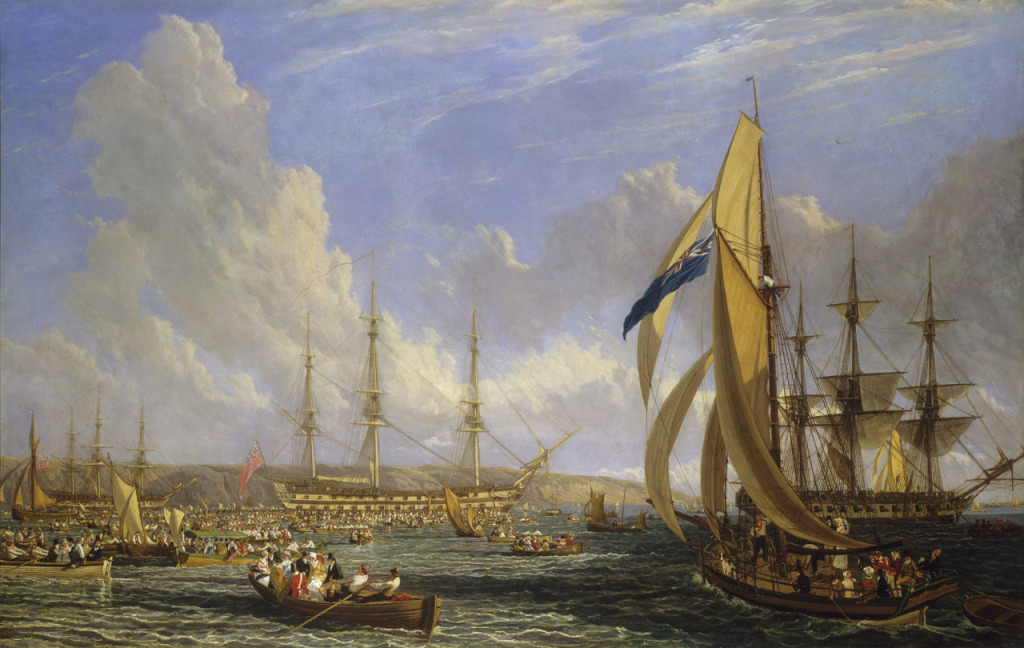
In 1816 British artist John James Chalon recreated the scene when Napoleon came to Plymouth
Once the word got out the vessel was quickly surrounded by sightseers in everything that could float. Bonaparte even appeared on deck to greet the crowds. The British government were worried that the emperor might escape before they could work out what to do with him so Bellerophon was hastily ordered to weigh anchor and sail to Plymouth, with its more secure harbour.
Needless to say people thronged there; at the height of the madness 10,000 people boarded 1000 boats in an attempt to get a view of the most famous man in the world. Several even drowned in the frenzy.
The crew of Bellerophon hung notices over the ship’s side as to their famous guest’s movements: ‘In cabin with Captain Maitland’, ‘Writing with his officers’…
Among the crowds were large numbers of pretty young women and fashionably dressed ladies, naval officers, red-coated army officers, smartly-attired gentlemen. The men took off their hats respectfully when Napoleon showed himself as he did every evening around 6 p.m. He commented on the beauty of the young ladies and appeared astonished by size of the crowds.
On August 7 Napoleon was transferred to Northumberland for exile in St Helena, where he remained until his death in 1821.
Stockwin’s Maritime Miscellany is published by Ebury Press. It is available in hardback and ebook format worldwide.
Copyright notices
Image: John James Chalon [Public domain], via Wikimedia Commons
Every effort is made to honour copyright but if we have inadvertently published an image with missing or incorrect attribution, on being informed of this, we undertake to delete the image or add a correct credit notice
 Julian Stockwin