
TYGER Collector’s Sets
Posted on April 10, 2015 10 Comments
I’ll be offering a Special Collector’s Set of my next book, Tyger. This will comprise a signed, numbered and embossed UK First Edition and a signed cover postcard. The Set is strictly limited to 500. To add your name to the list email admin@julianstockwin.com with your full details, including postal address. The Set, inclusive of p&p, costs £26.99 for delivery to addresses within the UK and Europe; £34.99 for delivery to addresses in the rest of the world.
If you pre-pay, you’ll go into the hat for a full refund of your purchase price! This offer is valid until the end of April. The book is published on October 8 and we’ll get the Collectors Sets out shortly before that date.
To whet your appetite…
With his frigate L’Aurore unfit for sea, Kydd is given a commission that some hope will destroy his career. Tyger has recently mutinied but instead of having her company dispersed around the fleet as is customary, the ship is pressed into immediate service in the North Sea. Kydd faces a crew still under some malign influence.
Enemies aboard and on the high seas are just the start of the problem. Soon he will have to take his untested and untrustworthy crew into the Baltic and there they will get entangled with Napoleon’s invasion of Prussia. The stakes are desperate, the task seemingly impossible and the French implacable. But the only way for Kydd to avoid disgrace is to gamble his reputation and crew on a crazy mission to snatch a Prussian division out of the jaws of Napoleon’s advancing army. Will he return home once more a hero, or himself face a court martial?
Copyright notices
Every effort is made to honour copyright but if we have inadvertently published an image with missing or incorrect attribution, on being informed of this, we undertake to delete the image or add a correct credit notice
BookPick: Nelson’s Victory, 250 Years of War and Peace
Posted on April 7, 2015 5 Comments
The publication of this title, written by Brian Lavery, is very timely as next month sees the anniversary of the launch of HMS Victory from Chatham Dockyard. Sumptuously illustrated, the book tells the story of the ship since she first took to the waters in May 1765. It contains what may be surprises for many readers: that she was almost wrecked on her launch; that diplomacy conducted onboard her played a crucial role in provoking Napoleon’s invasion of Russia in 1812; and that in 1914 Kaiser Wilhelm set the First World War in motion at a desk made from her timbers
 Organised in twelve chronological chapters, the book, not surprisingly, devotes one of these to the young Nelson (promoted to captain at the age of just 20). Nelson was born a few weeks before his most famous ship was ordered, and his career paralleled hers in many ways.
Although it deals with the Battle of Trafalgar in some detail, perhaps the most interesting sections of the book cover the other lives of the ship, which at different times was a flagship, a fighting ship, a prison hospital ship, a training ship for officers and boys, a floating courtroom, a signal school in the early days of radio, tourist attraction and national icon. Lavery shares with the reader how Victory was seen through many eyes, including Queen Victoria, admirals, midshipmen and ordinary seamen – and Beatrix Potter who visited as a girl!
As would be expected from a historian of the calibre of this author, there is a detailed Bibliography and Notes Section included.
Legions of books have been written about Lord Nelson and HMS Victory, many of which I consulted when I wrote my novel Victory. Despite the abundance of titles already published I was impressed with this beautifully produced book and it certainly warrants a place in my personal library.
A special exhibition, which Lavery curated, is running at Chatham until 31 May.
Brian Lavery Nelson’s Victory, 250 Years of War and Peace
Published by Seaforth Publishing. ISBN 978 1 84832 232 5
Copyright notices
Every effort is made to honour copyright but if we have inadvertently published an image with missing or incorrect attribution, on being informed of this, we undertake to delete the image or add a correct credit notice
World’s First Factory Assembly Line
Posted on April 2, 2015 2 Comments
The name of the great Victorian engineer Isambard Kingdom Brunel is widely known for his heroic engineering feats but we should also raise our glasses to his father, Marc Brunel, born this month in 1769 – for it was he who gave us the first factory assembly line ‑ and something that was of great importance to Britain’s continuing naval dominance in Kydd’s day

Marc Brunel
A sailing man‑o’‑war in Kydd’s day typically needed up to 25 miles of rope, much of which was used to raise and lower the sails with the help of wooden pulley blocks. Blocks were also needed to work the great guns and for a variety of other functions throughout the ship – anchors and their associated gear, ship’s boats and storing ship. In total, sometimes 1000 blocks were required for a ship. HMS Victory carried 768 blocks (the largest being 26 inches long, the smallest six inches) for her rigging and 628 for her guns.
At the end of the eighteenth century blocks were all made by hand by a firm called Taylor Walker in Southampton. The Navy ordered more than 100,000 of these a year.
Brunel’s scheme required the services of a highly skilled mechanic and he approached Henry Maudslay. The story goes that Brunel was so impressed with the precision screw that Maudslay had displayed in the window of his premises in Wells Street that he took in a drawing of one of the 26 machines that he had designed to have him make a small prototype. Brunel was anxious to keep his invention secret until he was sure he could trust Maudslay.
A week later when Brunel went back to see his work he showed Maudslay a second drawing who immediately grasped what he had in mind and exclaimed, “Ah! Now I see what you’re thinking of; you want machinery for making blocks.”
Brunel and Maudslay collaborated on building models of the machines, some of which have been preserved in the Maritime Museum in Greenwich. Then they went ahead and built the full‑size machinery and set up the world’s first production line in the block-making house in Portsmouth.

Portsmouth Dockyard Block Mills today
By about 1807, Brunel’s block-making machines met the Royal Navy’s entire requirement and some were still in operation for the D-day landings.
The machines attracted an enormous amount of interest from the time of their installation, ranging from Horatio Nelson to the Princess Victoria, who was shown them as part of her education.
During the course of the Napoleonic War there was a steady stream of foreign dignitaries and military men wishing to see the machines for themselves. They were also described and illustrated in a number of contemporary encyclopaedias.
They became such a popular tourist attraction that Brunel urged Bentham to erect a fence around the mill to keep visitors at bay.
Some of the actual block making machines from Brunel’s day are now on view at the Science Museum, London.
Copyright notices
Brunel: James Northcote [Public domain], via Wikimedia Commons; Brunel Block mill : By Comlay (Own work) [CC BY-SA 3.0 (http://creativecommons.org/licenses/by-sa/3.0)%5D, via Wikimedia Commons
Every effort is made to honour copyright but if we have inadvertently published an image with missing or incorrect attribution, on being informed of this, we undertake to delete the image or add a correct credit notice
Poetry of the Sea: Part 3
Posted on March 24, 2015 Leave a Comment
They that go down to the sea in ships, and occupy their business in great waters. These men see the works of the Lord; and his wonders in the deep…
— Psalm 107
Some of the English language’s finest poetry has been written about the sea. Here’s four more of my favourites, some are excerpts due to length. This is the final post on sea poetry for the time being – thank you for all your posts and emails about sea poetry that has touched you in some way! And a doffed cap to Irwin Bryan for reminding me of The Wanderer’s Song.
— ♥ —
The Wreck of the Deutschland by Gerald Hopkins
- She drove in the dark to leeward,
She struck — not a reef or a rock
But the combs of a smother of sand: night drew her
Dead to the Kentish Knock;
And she beat the bank down with her bows and the ride of her keel:
The breakers rolled on her beam with ruinous shock;
And canvas and compass, the whorl and the wheel
Idle for ever to waft her or wind her with, these she endured.
The Wanderer’s Song by Masefield
- A wind’s in the heart of me, a fire’s in my heels,
I am tired of brick and stone and rumbling wagon-wheels;
I hunger for the sea’s edge, limit of the land,
Where the wild old Atlantic is shouting on the sand.
Oh I’ll be going, leaving the noises of the street,
To where a lifting foresail-foot is yanking at the sheet;
To a windy, tossing anchorage where yards and ketches ride,
Oh I’ll be going, going, until I meet the tide.

Henry Wadsworth Longfellow
The clucking, sucking of the sea about the rusty hulls,
The songs at the capstan at the hooker warping out,
And then the heart of me’ll know I’m there or thereabout.
Oh I am sick of brick and stone, the heart of me is sick,
For windy green, unquiet sea, the realm of Moby Dick;
And I’ll be going, going, from the roaring of the wheels,
For a wind’s in the heart of me, a fire’s in my heels
Wreck of the Hesperus by Henry Longfellow
- And ever the fitful gusts between
A sound came from the land;
It was the sound of the trampling surf,
On the rocks and hard sea-sand.
The breakers were right beneath her bows,
She drifted a dreary wreck,
And a whooping billow swept the crew
Like icicles from her deck.
She struck where the white and fleecy waves
Looked soft as carded wool,
But the cruel rocks, they gored her side
Like the horns of an angry bull.
Her rattling shrouds, all sheathed in ice,
With the masts went by the board;
Like a vessel of glass, she stove and sank,
Ho! ho! the breakers roared!
Song of Myself by Walt Whitman

Walt Whitman
- You sea! I resign myself to you also – I guess what you mean,
I behold from the beach your crooked inviting fingers,
I believe you refuse to go back without feeling of me,
We must have a turn together, I undress, hurry me out of sight of the land,
Cushion me soft, rock me in billowy drowse,
Dash me with amorous wet, I can repay you. Sea of stretch’d ground-swells,
Sea breathing broad and convulsive breaths,
Sea of the brine of life and of unshovell’d yet always-ready graves, Howler and scooper of storms, capricious and dainty sea,
I am integral with you, I too am of one phase and of all phases. Partaker of influx and efflux I, extoller of hate and conciliation,
Extoller of armies and those that sleep in each others’ arms.
[ Part 1 ] [ Part 2 ]
Copyright notices
Longfellow image: Julia Margaret Cameron [Public domain], via Wikimedia Commons; Whitman image: By George C. Cox (1851–1903, photo) Adam Cuerden (1979-, restoration) [Public domain], via Wikimedia Commons
Every effort is made to honour copyright but if we have inadvertently published an image with missing or incorrect attribution, on being informed of this, we undertake to delete the image or add a correct credit notice
BookPick: A Visitor’s Guide to Jane Austen’s England
Posted on March 17, 2015 2 Comments
Now that Thomas Kydd finds himself mingling at the highest levels in English society his horizons have changed immeasurably from those of the humble wig-maker who was press-ganged into the Royal Navy in 1793. Sue Wilke’s book is a very readable eye-witness guide to Kydd’s new world.
 Packed with detail, and anecdotes, the book is an intimate exploration of how the middle and upper classes lived in the Georgian era. The author skilfully conjures up all aspects of daily life within the period, drawing on contemporary diaries, illustrations, letters, novels, travel literature and archives.
The book is divided into seven chapters – travelling, gracious living, the latest modes, money matters, shopping and leisure, the perfect partner and health concerns.
From the chapter on travelling: ‘All roads lead to London, the bustling centre of the nation’s trade and fashion. Unless you have your own carriage, you’ll travel by stagecoach or mail coach, post-chaise or hired horse, breaking your journey where necessary at an inn.
‘One of the best views of London is from Shooter’s Hill on the Dover Road. You’ll see the River Thames winding through rich green meadows against a backdrop of gently rolling downs: a bristling forest of ships’ masts…
Visitors coming from the opposite direction, that is from the west, enter the metropolis via the Great West Road at Hounslow. From Brentford you’ll find that it’s now almost one continuous street to London…’
An extensive bibliography is included as are a number of interesting black and white illustrations.
This book is a very readable and complementary addition to the rich body of reference works available on Georgian life ashore.
Sue Wilkes A Visitor’s Guide to Jane Austen’s England
Published by Pen & Sword. ISBN 178159264 1
Poetry of the Sea: Part 2
Posted on March 10, 2015 8 Comments
They that go down to the sea in ships, and occupy their business in great waters. These men see the works of the Lord; and his wonders in the deep…
— Psalm 107
Some of the English language’s finest poetry has been written about the sea. Here’s some more of my favourites, some are excerpts due to length. And thank you for all your posts and emails about sea poetry that has touched you in some way! Keep ’em coming…
— ♥ —
The Kiss of a Seaman 17th Century
- When first I chanc’t to be among them
I was belov’d of divers young men
And with a modest mild behaviour
That did intreat my love and favour
But this I learned from my mother
The kiss of a Seaman’s worth two of another
Blare gentlemen of rank and fashion
That live, most richly in the nation
Have woo’d and su’d, as brave as may be
That I might have been a pretty lady
Love’s fiery beams I cannot smother
The kiss of a Seaman’s worth two of another!
Shipwreck by William Falconer
- Again she plunges! hark! a second shock
Bilges the splitting vessel on the rock;
Down on the vale of death, with dismal cries;
The fated victims shuddering cast their eyes
In wild despair; while yet another stroke
With strong convulsion rends the solid oak;
Ah Heavens! —behold her crashing ribs divide!
She loosens, parts, and spreads in ruin o’er the tide
The Boy stood on the Burning Deck (Casabianca) by Felicia Dorothea Hemans
- The boy stood on the burning deck
Whence all but he had fled;
The flame that lit the battle’s wreck
Shone round him o’er the dead.
Yet beautiful and bright he stood,
As born to rule the storm;
A creature of heroic blood,
A proud, though childlike form.
The flames roll’d on…he would not go
Without his father’s word;
That father, faint in death below,
His voice no longer heard.
He call’d aloud…”Say, father,say
If yet my task is done!”
He knew not that the chieftain lay
Unconscious of his son.
“Speak, father!” once again he cried
“If I may yet be gone!”
And but the booming shots replied,
And fast the flames roll’d on.
Upon his brow he felt their breath,
And in his waving hair,
And looked from that lone post of death,
In still yet brave despair;
And shouted but one more aloud,
“My father, must I stay?”
While o’er him fast, through sail and shroud
The wreathing fires made way,
They wrapt the ship in splendour wild, The boy stood on the burning deck
Whence all but he had fled;
The flame that lit the battle’s wreck
Shone round him o’er the dead.
Yet beautiful and bright he stood,
As born to rule the storm;
A creature of heroic blood,
A proud, though childlike form.
The flames roll’d on…he would not go
Without his father’s word;
That father, faint in death below,
His voice no longer heard.
He call’d aloud…”Say, father,say
If yet my task is done!”
He knew not that the chieftain lay
Unconscious of his son.
“Speak, father!” once again he cried
“If I may yet be gone!”
And but the booming shots replied,
And fast the flames roll’d on.
Upon his brow he felt their breath,
And in his waving hair,
And looked from that lone post of death,
In still yet brave despair;
And shouted but one more aloud,
“My father, must I stay?”
While o’er him fast, through sail and shroud
They caught the flag on high,
And stream’d above the gallant child,
Like banners in the sky.
There came a burst of thunder sound…
The boy-oh! where was he?
Ask of the winds that far around
With fragments strewed the sea.
With mast, and helm, and pennon fair,
That well had borne their part;
But the noblest thing which perished there
Was that young and faithful heart.
On the Sea by John Keats

John Keats
- It keeps eternal whisperings around
Desolate shores, and with its mighty swell
Gluts twice ten thousand caverns, till the spell
Of Hecate leaves them their old shadowy sound.
Often ’tis in such gentle temper found
That scarcely will the very smallest shell
Be moved for days from whence it sometime fell
When last the winds of heaven were unbound.
Oh ye! whose ears are dinned with uproar rude
Or fed too much with cloying melody –
Sit ye near some old cavern’s mouth, and brood
Until ye start, as if the sea nymphs quired!
Roadways by John Masefield
- Roadways by John Masefield
One road leads to London,
One road leads to Wales,
My road leads me seawards
To the white dipping sails.
One road leads to the river,
And it goes singing slow;
My road leads to shipping,
Where the bronzed sailors go.

John Masefield
To salt green tossing sea;
A road without earth’s road-dust
Is the right road for me.
A wet road heaving, shining,
And wild with seagull’s cries,
A mad salt sea-wind blowing
The salt spray in my eyes.
My road calls me, lures me
West, east, south, and north;
Most roads lead men homewards,
My road leads me forth.
To add more miles to the tally
Of grey miles left behind,
In quest of that one beauty
God put me here to find.
Ye Mariners of England by Thomas Campbell
- Ye Mariners of England
That guard our native seas;
Whose flag has braved a thousand years;
The battle and the breeze!
Your glorious standard launch again
To match another foe
And sweep through the deep,
While the stormy winds do blow
While the battle rages loud and long,
And the stormy winds do blow…
The meteor flag of England
Shall yet terrific burn;
Till danger’s troubled night depart;
And the star of peace return.
Then, then, ye ocean warriors,
Our song and feast shall flow
To the fame of your name,
When the storm has ceased to blow;
When the fiery light is heard no more,
And the storm has ceased to blow.
[ Part 1 ]
Copyright notices
Keats image: William Hilton the Younger [Public domain], via Wikimedia Commons
Masefield image: By Coburn, Alvin Langdon, 1882-1966 — Photographer (NYPL) [Public domain], via Wikimedia Commons
Every effort is made to honour copyright but if we have inadvertently published an image with missing or incorrect attribution, on being informed of this, we undertake to delete the image or add a correct credit notice
BookPick: Light Upon the Waters
Posted on March 3, 2015 1 Comment
This splendid coffee-table book is a commemoration of the 500 years of recorded history of the Corporation of Trinity House. It is sumptuously illustrated with over 300 images and has the royal seal of approval with a Preface by HRH The Princess Royal and a Foreword by Duke of Edinburgh. The book is also the recipient of the prestigious Mountbatten Maritime Award.
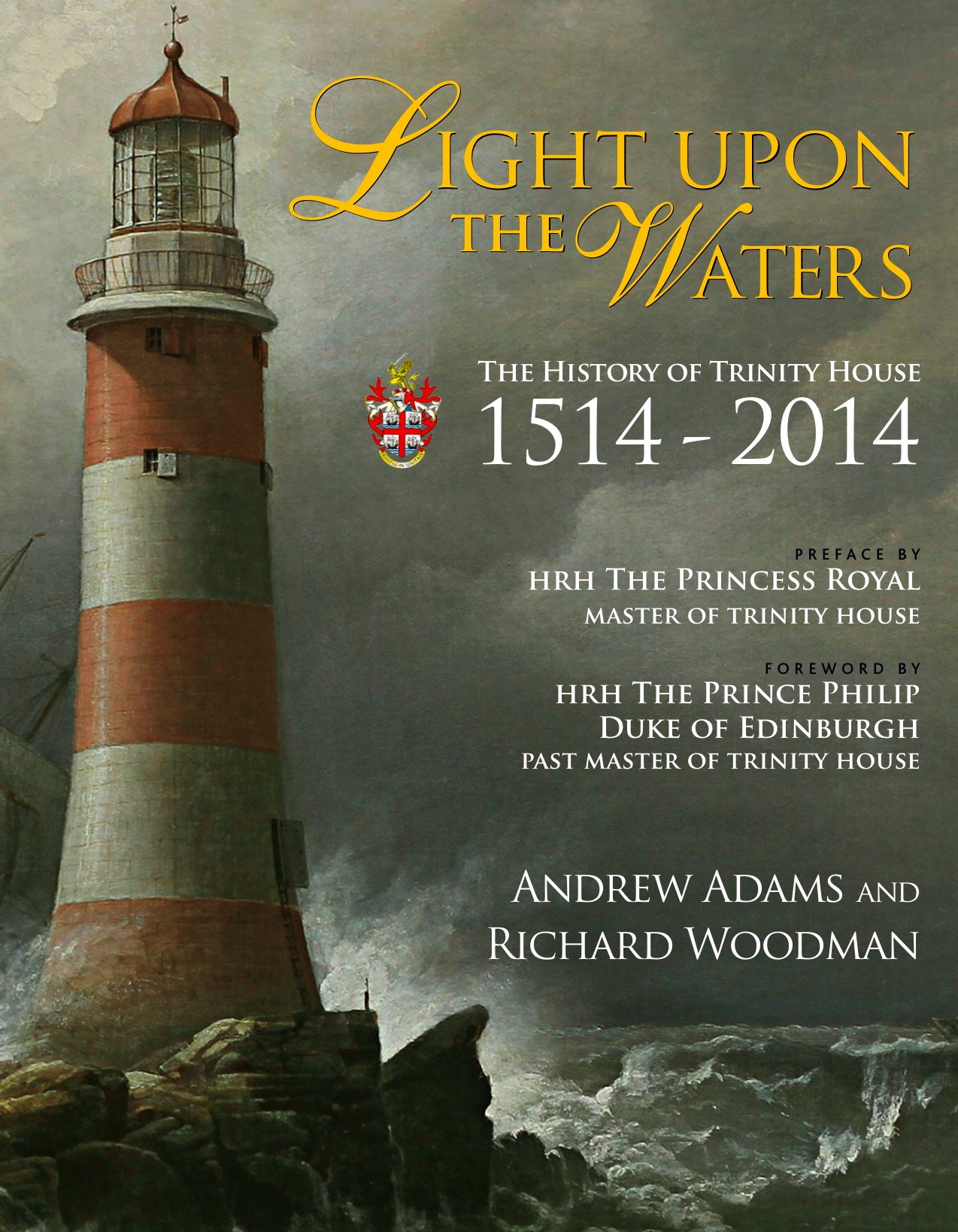 Trinity House is a complex and ancient English organisation, deeply rooted in our maritime life.
Its origins are obscure. In about 1215 the Archbishop of Canterbury is thought to have established a brotherhood consisting of ‘God-fearing men who promise, in the love of Christ the Lord and in the name of the master and members of the guild of The Trinity, to suppress those whom the Devil induces to lead ships in their destruction by false lights…by building and lighting beacons to guide sailors.’
Today, Trinity House is very much an active player on the maritime scene, its main roles are as a Guild or Fraternity of mariners, a maritime charity, a licensor of deep sea pilots and a provider of offshore aids to navigation.
It was granted a Royal Charter by Henry VIII in 1514. A revised charter from James II dates from 1685 and essentially forms the basis of Trinity House as we know it in the modern era.
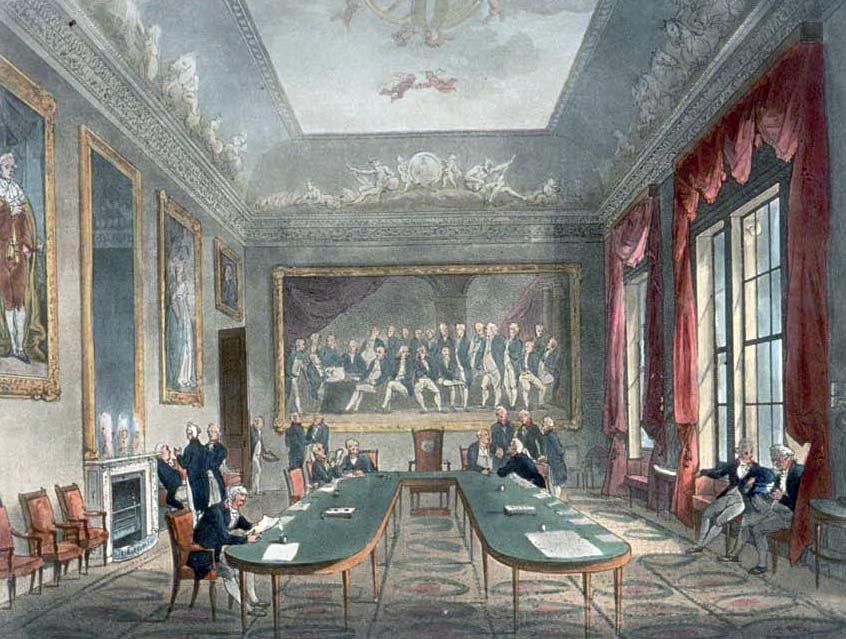
A meeting of the Corporation of Trinity House, 1808
Andrew Adams was a boy seaman when he joined Trinity House in 1963. During his over 40-year career he gained a wide experience afloat, becoming Chief Pilot in the Port of Harwich, and an RNR Captain and Nautical Adviser. He is a Younger Brother (1) of Trinity House.
Richard Woodman went to sea aged 16 and served in cargo-liners and Ocean Weather Ships before spending more than 30 years with Trinity House, several in command afloat and ashore. He was elected an Elder Brother in 2006.
The book is set out in seventeen chapters, basically in date order but also covering specific themes such as the River Thames, marks and signs for the sea, pilotage, and the French Wars.
Given my abiding interest in the Age of Fighting Sail, Chapter Eight, ‘The Great War with France’ was of particular appeal. In my own book Mutiny I wrote about the work of Trinity House during the bloody Nore Mutiny and was pleased to see this aspect covered in some detail.
Lighthouses have long held a special attraction for me and I was intrigued with some of the fascinating details in the chapter on the Great Age of Lighthouse Construction, covering the period 1836 to 1914. It’s of note that in 1914 Trinity House was responsible for 96 lighthouses, two manned fog-signal stations, 51 lightvessels, 509 unlit and 76 lighted oil-gas buoys.
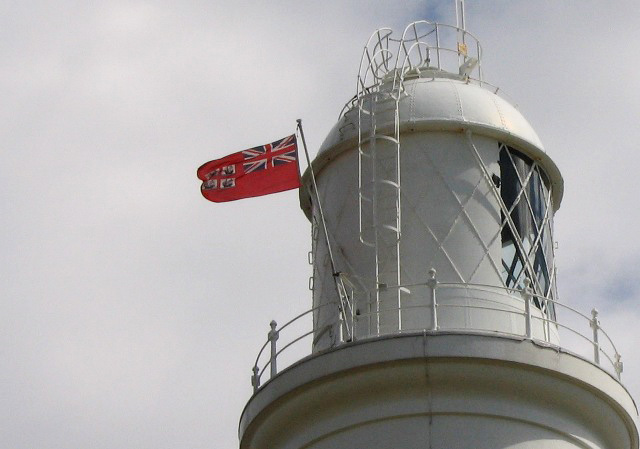
Trinity House flag flying on Portland Bill lighthouse
This book can be enjoyed in several ways – a cover to cover reading immersion or, as I have done, a dipping into chapters of particular interest, to later return to other pages to enjoy further aspects.
The authors are to be commended on this work, the definitive guide to a very British institution. It deserves a special place in the library of any student of British maritime history and culture.
(1) Trinity House is ruled by a court of thirty-one Elder Brethren, presided over by a Master, at present HRH the Princess Royal. These are appointed from 300 Younger Brethren, who act as advisors and perform other duties as needed. The Younger Brethren are appointed from professionally qualified people with maritime experience.
Andrew Adams and Richard Woodman Light Upon the Waters
Published by The Corporation of Trinity House. ISBN 978 0 9575991 0 9
The National Maritime Museum in Greenwich, is currently hosting an exhibition ‘Guiding Lights: 500 years of Trinity House and safety at sea’. The exhibition, which offers free admission, is open until 4 January 2016.
Copyright notices.
Portland Bill image: By Ian Dunster at en.wikipedia (Transferred from en.wikipedia) [GFDL (http://www.gnu.org/copyleft/fdl.html) or CC-BY-SA-3.0 http://creativecommons.org/licenses/by-sa/3.0/)%5D, from Wikimedia Commons. This work is in the public domain in the United States because it was published (or registered with the U.S. Copyright Office) before January 1, 1923. Trinity House: By Thomas Rowlandson (1756–1827) and Augustus Charles Pugin (1762–1832) (after) John Bluck (fl. 1791–1819), Joseph Constantine Stadler (fl. 1780–1812), Thomas Sutherland (1785–1838), J. Hill, and Harraden (aquatint engravers) [Public domain or Public domain], via Wikimedia Commons. This work is in the public domain in the United States because it was published (or registered with the U.S. Copyright Office) before January 1, 1923.
The Book ‘n’ Bag Bumper Draw!
Posted on February 25, 2015 3 Comments
I’m delighted to launch a new contest with three special prizes! Each prize will be one signed copy of The Silk Tree or Stockwin’s Maritime Miscellany or Pasha, along with a special tote and a selection of bookmarks and postcards. The first draw will be on March 4, the second on March 11 and the third on March 18. Entry is via email to julian@julianstockwin.com – just write Book ‘n’ Bag in the subject line and please include your full postal address. You only need enter once: all entries will go into the hat for all draws.
The Silk Tree Book ‘n’ Bag Prize
 Julian Stockwin takes this tale and turns it into a fascinating story, full of colour and incident… [The characters] dovetail in perfectly and are totally believable participants in the story. I enjoyed this book very much
– Historical Novel Society
- The Silk Tree is my first standalone novel, an epic adventure to unravel China’s most guarded secret, set in the time of Emperor Justinian.
This prize is A Signed First Edition of The Silk Tree and a fab Union Jack tote, along with postcards and bookmarks.
Stockwin’s Maritime Miscellany Book ‘n’ Bag Prize
 A dip in and come-again book – something for everyone!
– Cruising Association
- Stockwin’s Maritime Miscellany is a little non-fiction tome full of fascinating facts and sea lore from the Golden Age of Sail. It ranges from the heroic voyages of discovery in the fifteenth century through the iconic Napolenic wars to the glorious era of the greyhounds of the sea, the clipper ships. A colourful world we will never see again!
This prize is a signed copy of Stockwin’s Maritime Miscellany and a fab Union Jack Tote, along with postcards and bookmarks.
Pasha Book ‘n’ Bag Prize
 Combining historical accuracy with thrilling action and exotic locales, Pasha is … Kydd’s most exciting adventure yet
– Foreword Reviews
- Kydd is on detachment in a new and dangerous sphere of interest: the Dardanelles, connecting the Mediterranean Sea to the Black Sea and providing a route to India. The French have long coveted this route, knowing that it could be the key to toppling the British Empire in India.
This prize is A Signed First Edition of Pasha and a fab Union Jack tote, along with postcards and bookmarks.
The Bearded Mariner
Posted on February 17, 2015 9 Comments
A recent newspaper piece about me rather flatteringly began: ‘If ever an author epitomised the lure of the sea and the sagas it can serve up Julian Stockwin is your man. He has a mariner’s beard, charming becalmed persona…
Beards and the mariner have a long association. Ferdinand Magellan sported one when he circumnavigated the globe and proved that the world was round, as did Sir Francis Drake, who helped England become a mighty sea power in the 1500s. The ancient mariner in Samuel Taylor Coleridge’s poem wore a ‘long grey beard’ and Captain Ahab in ‘Moby Dick’ had a dark, almost sinister, beard. And of course there was Blackbeard, the English pirate with his ferocious facial hair.
One of the reasons beards were favoured by seafarers is undoubtedly the fact that fresh water was often in short supply in the days of wooden sailing vessels. A beard also gave protection against the elements, especially for those venturing into frigid waters.
But beards at sea were not always universally popular. Peter the Great, who did much to reform the Russian navy, did not believe that beards were the way to go in his modernisation. He instituted a tax on beards!
In Kydd’s day, perhaps surprisingly, the men of the lower deck rarely sported beards. One of their number acted as a barber using a cut-throat razor and they were shaved regularly. This probably reflected Admiralty concerns for hygiene as unclean beards could harbour unwanted guests…
During the 19th century, merchant marine sailors traditionally stopped shaving from the time they left their last port of call until the time they reached home. By the time a sailor returned from some faraway place, he could have grown a full beard.
In Queen Victoria’s time it was proposed that sailors in the Navy should henceforward be allowed to wear beards. ‘Has Mr Childers ascertained anything on the subject of the beards?’ the Queen wrote to the First Lord of the Admiralty. ‘Her own personal feeling,’ she went on, ‘would be for the beards without the moustaches, as the latter have a rather soldier-like appearance, but then the object in view would not be obtained, viz. to prevent the necessity of shaving. Therefore it had better be as proposed, the entire beard, only it should be kept short and very clean.’
In 1869 the Admiralty officially gave permission to discontinue the use of the razor. Since that time sailors have had to request ‘permission to cease shaving’ before growing a beard and moustache (‘a full set’). If, after a period without shaving, it becomes clear that the individual cannot grow a proper full set, his commanding officer may order him to shave it off.
The future Edward VII, prevented by his mother Victoria from engaging in active service nevertheless famously sported a magnificent full naval beard as did the ‘Sailor King’ George V who did see much naval service, as a young officer in the Far East adding as well a tattoo of a red and blue dragon on his arm.

My own beard, which I wear to this day
I personally did not have a beard in my early days in the Navy but grew one later, and sport it to this day.
But times are a-changing. The bearded mariner is a dying breed, largely due to operational reasons to ensure the safety of sailors using respiratory protection. A beard prevents a proper seal. (Moustaches and sideburns can still be worn in accordance with dress regulations and accommodation is usually made for personnel with religious and medical exemptions.)
The US Navy did away with beards in 1985 to emphasize ‘pride and professionalism,’ and for safety reasons. The Royal Canadian Navy has done likewise. The Royal Australian Navy and the Royal Navy are more flexible and still permit full set beards with the proviso that they must be modified or shaved off if operational reasons require it.
This full set rule is broken in November in the Royal Navy and other navies as part of the ‘Movember’ campaign against prostrate cancer. Sailors are encouraged to compete to grow the best and strangest moustaches to raise cash for this worthy cause.
Do you have a favourite pic. of a bearded sailor?
Copyright notices
Every effort is made to honour copyright but if we have inadvertently published an image with missing or incorrect attribution, on being informed of this, we undertake to delete the image or add a correct credit notice
Building an Age of Fighting Sail Reference Library, Part 2
Posted on February 10, 2015 1 Comment
It’s a question I’m quite often asked – what books do I suggest would be useful to acquire in order to learn more about the period I write about. It was hard to make a selection from the vast range of wonderful titles out there, so I’ve decided it warranted two blog posts – here’s the second clutch I plucked from my shelves that I think readers wanting to delve deeper into the fascinating Age of Fighting Sail might find useful. You can catch up [ here ] with the first
— ♥ —
Broadsides by James Davey and Richard Johns
 A delightful exploration of how contemporary caricaturists saw the Royal Navy in the second half of the eighteenth century, with prints from the superb collection at the National Maritime Museum. Will appeal to both naval buffs and students of Georgian society and culture alike.
Maritime Power and the Struggle for Freedom by Peter Padfield
 Padfield’s illuminating book charts the epic struggle between Great Britain and revolutionary and Napoleonic France, revealing both the hidden forces beneath the surface of events and the strategies and battle tactics which ensured Britain’s final victory.
Jane Austen and the Navy by Brian Southam
 Two of Jane Austen’s brothers served in the Royal Navy, and later became admirals. Her novels, especially Mansfield Park and Persuasion reflect her interest in, and admiration for, the Navy. Based on family papers and naval records, Southam’s book shows the novelist as a historian of Nelson’s Navy – not the Navy of great victories at sea but the Navy at home and of sailors amongst their family and friends.
Naval History of Great Britain by William James
 A comprehensive six-volume set that covers the operation of the Royal Navy during the Revolutionary and Napoleonic Wars.
In the first volume James examines aspects as the naval events at Toulon in 1793 where Sidney Smith burnt half of the French Mediterranean fleet, Howe’s victory at the Glorious First of June and the Royal Navy’s role in colonial expeditions. The volumes can be purchased separately, or as the complete set – and provide an unsurpassed historical record of Kydd’s Navy, both on the national and international scale.
The Marine Art of Geoff Hunt by Geoff Hunt
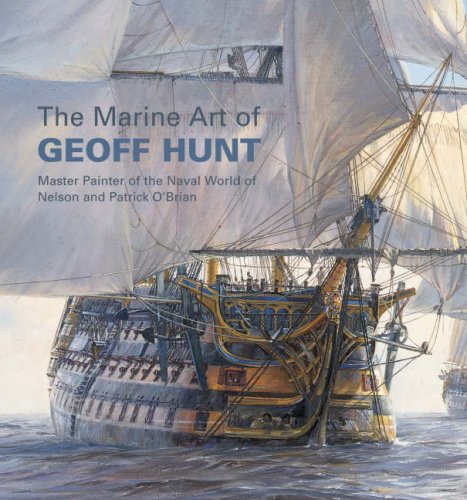 “I have always painted, as far back as I can remember, and always ships…” Geoff Hunt, former President of the Royal Society of Marine Artists is deservedly recognised as possibly the premier nautical painter of his generation. This magnificent book contains over 100 paintings and sketches, and is enriched by Geoff’s personal discussion of techniques and artistic influences. In the chapter “Illustrating the Naval writers” he takes us behind the scenes of three of the covers of the Kydd series.
Young Nelsons by D. A. B. Ronald
 Drawing on letters, poems and first-hand accounts, this book tells the fascinating (and sometimes poignant) stories of Britain’s boy sailors during the Napoleonic Wars. Nelson himself went to sea at twelve and at the Battle of Trafalgar there were hundreds of young Nelsons, among them 13-year-old Norwich Duff, who was aboard Mars and witnessed the death of her brave captain – a man who was also his father. It fell to the lad to have to write to his mother reporting the tragic event. Among other famous young Nelsons was Prince William Henry, who was sent to sea at age 13 and later to be King of England.
 Julian Stockwin