
QUARTERDECK: Aft through the hawse-hole
Posted on March 10, 2014 8 Comments
A regular feature on each of the Kydd titles – with story background, research highlights, writing challenges and more

The US edition of QUARTERDECK
Thank you for all your kind comments on the post about my fourth book, MUTINY.
The fifth book in the series is QUARTERDECK. Tom Kydd was promoted acting lieutenant at the bloody Battle of Camperdown in October 1797. Now, he must sit an examination to confirm his rank – or face an inglorious return before the mast.
With this book, with four other titles under my belt, did I feel the writing had become easier?
Because of the wonderful feedback I had received from readers all over the world my confidence had increased that people really did want to share my passion about the age of fighting sail. However, until a manuscript is actually accepted by your editor, there is always a certain apprehension. Have I told a good story? Will it draw people in? Has it got the right balance? The waiting time until that phone call or email comes from your editor is always a bit nail-biting…This was true for QUARTERDECK – and remains so to this day.
Was this book a watershed in the series?
Yes. Richard Gere famously overcame modern day hurdles to become an officer and a gentleman, but they were nothing compared to the almost impossible odds two hundred years ago! The Royal Navy, however, although steeped in custom and tradition, did provide a rare means for someone low born to achieve high status.
Of the six hundred thousand or so British seamen who fought in the Napoleonic wars, amazingly, 120 became officers, crossing a great social divide. Of these, perhaps twenty or so were promoted to captain of their own ship – and five made Admiral! History has left us little record of these achievers, but we do know of some who started their career this way – men such as Bligh, Cook and in the case of HMS Victory at Trafalgar both the signals officer Pascoe and Quiliam, the first lieutenant.
When I started writing the Thomas Kydd series I felt strongly that I wanted to portray life at sea at the time of Nelson starting from the viewpoint of the common sailor. I have always had the greatest admiration for what they achieved. The typical stereotype of the sailor of that time as a mere cipher couldn’t be further from the truth. In large part it was they who gave Britain conquest of all the seas. Nelson himself publicly recognised this.
Right from the start I knew my hero would eventually become an officer and in many ways QUARTERDECK posed some formidable writing challenges. I had to take Tom Kydd from the environment of the lower deck, where he was popular and, now a master’s mate, at the pinnacle of his calling, to an alien realm where the talk was of foxhunting and the Season, and where, at first, he was neither liked nor respected.
I found my own experience, having myself served both on the fo’c’sle and on the quarterdeck, invaluable. As I wrote I was able to draw on my own feelings during my time in the navy. Remembering my initial apprehensions as a new officer certainly gave me insights for QUARTERDECK.
Where was location research?
Both in the UK and overseas. We spent some time in the pretty little town of Falmouth in Cornwall. In Kydd’s day it was a favoured last provisioning stop before a long Atlantic crossing. It has a superb harbour: together with Carrick Roads, it forms the third capacious natural harbour in the world, and is the deepest in Western Europe.
It was also the home of the ships of the packet service. (The term ‘packet’ derives from the fact that state letters and dispatches were historically known as ‘the packet’.) There were several packet stations in British ports but Falmouth was the hub of the Packet Ship Service, which carried mail to all corners of the British Empire. Mail came down from London by postboy or stagecoach. It was then sealed in leather portmanteaux of varying sizes which were lead-weighted so that they could be thrown overboard at the prospect of imminent capture.
However the packet service was not always held in esteem. Ashore in Falmouth Kydd is told:
‘A nest of villains…They carry the King’s mails, but should they spy a prize, they will not scruple to attack at risk to their cargo – and worse! Even under the strictest post office contract, they weigh down their vessel with private freight to their common advantage. And should this not be enough, it is commonly known that while the post office will recompense them for a loss at sea to an enemy, profit may just as readily be won from the insurances.’

With Bob Squarebriggs and the half model of Artemis
Local research done, Kathy and I then had the great pleasure and duty of visiting Canada. We found Halifax, the previous home of the North American Station, fascinating, with so much maritime history – and even stayed at the Lord Nelson hotel and dined at the Press Gang restaurant! A special delight was meeting Bob Squarebriggs and being presented with a half model of Artemis that he had made from scratch as a gift for me. I was quite taken aback at his generosity, and even more moved when I found out that Bob, as a result of an accident, could not work for any length of time on such a project before tiring.
Did the research for QUARTERDECK pose any particular challenges?
Well, there was one in particular. As a plot requirement I needed to determine which of the woods found in the area Kydd was in did not float. This was not as simple as it sounds. My ex-scientist father-in-law in Tasmania came back with mathematical formulae and details of specific gravity, and after a considerable time researching further I felt I had a fairly intimate acquaintance with every tree in America! But still I had not got the definitive answer; this was finally resolved by a very helpful member of the United States Department of Agriculture Forest Products Laboratory.

Captain Truxtun, USS Constellation
Regarding research for the dawn of the new American Navy, I was most fortunate to make the acquaintance of Tyrone Martin, an erudite scholar and a former captain of Old Ironsides. He provided valuable insights into the US naval service and the heavy frigates. I get a special buzz introducing real-life characters into the books and it was fun writing about Kydd sailing in the new commissioned Constellation under Captain Truxtun.
Copyright notices
Truxton image: By Bass Otis (d. 1861[1]) (Portrait of Thomas Truxtun) [Public domain], via Wikimedia Commons
Every effort is made to honour copyright but if we have inadvertently published an image with missing or incorrect attribution, on being informed of this, we undertake to delete the image or add a correct credit notice
BookPick: A Century of Sea Travel
Posted on March 7, 2014 Leave a Comment
[To leave a comment or reply go to box at the end of the page]
Christopher Deakes and Tom Stanley are well qualified as authors of a book such as this. Deakes worked for many years as a shipping agent and over the years amassed a large collection of shipping postcards. Stanley’s background is as a postcard and ephemera dealer specialising in shipping, and together they have come up with a delightful volume that celebrates a nautical world now disappeared.

Sea travel in the steamship era
Their book is a voyage through the life of the passenger steamship described by the travellers who sailed in them and mirrored by atmospheric and often touching contemporary illustrations and photographs.
In memoirs and letters home, diaries and journals, the writers recorded every aspect of their seagoing experiences: they wrote of their ship, its crew and their fellow passengers, of the food and entertainment on board, of romance, accidents and disasters. They noted incidents on board that amused or angered them, described the ports at which their ship called, and the fear and excitement of storms at sea.
A captivating book for armchair travellers, ship enthusiasts – and all those who still go to sea to seek romance and adventure. Just the thing with a glass of Pimms on a lazy summer day…
‘I always return to the Kydd series’
Posted on March 3, 2014 5 Comments
[To leave a comment or reply go to box at the end of the page]
The March Reader of the Month is 19-year-old Marcus Brandenborg Bjørn from Denmark, keen sailor and Kydd fan! Kathy and I had the pleasure of meeting Marcus during our recent location research trip to Denmark
Where did your love of Age of Sail novels come from?
The first Age of Sail novel I read was Mr. Midshipman Hornblower, which my father recommended, then the rest of the series followed. They were in Danish and I mainly read them for the adventure. The books that truly got me interested were the Kydd series. I went to my librarian and asked if she had something like the Hornblower series, but in English, since my English teacher had recommended that I should read some English literature. I took Kydd out of the library and was instantly hooked! I absolutely loved the small historical details, and I started discovering more for myself. Since then I have read most of the Patrick O’Brian novels, the Bolitho novels, the Kydd novels a couple of times and some Ramage books. I always return to the Kydd series though, since it is the perfect mix of historical accuracy and adventure.
The Kydd series did not just get me interested in the Age of Sail, but also in the English language. I do read Danish literature but only when my Danish teacher makes us do it! I just completed a large examination project about Joseph Conrad’s ‘Heart of Darkness’. I feel the English language is a much richer and vivid one than Danish.
You sail yourself. What type of boat do you have and where do you sail?

Marcus sailing in Roskilde Fjord last summer
I have sailed as long as I can remember. My father always took me sailing in our boat when I was little, and we have been all over the Danish seas. I sailed in competitions from when I was eight until I was fourteen. The sea has always been a part of me. I sail a Drabant 22, which is a 22-ft long sailing boat. It is a small but very charming and fast, just perfect for a guy my age. She’s called Fie. I often joke with my girlfriend by saying Fie is the true love of my life. She is moored in Roskilde, so Roskilde fjord is my playground during the summer.
What are your career plans?
Since I was a kid, I knew I wanted to have something to do with the sea. I played with the idea of a shipping career, since my father used to be in shipping. Then I started getting interested in the navy and especially the officers’ academy; something just fell into place and I knew that is what I wanted to do with my life. The entry requirement is going through changes though, and you have to get a degree to apply for the Naval Academy, so at this time I am trying to figure out what degree I should pursue. I am between law school, history and economics, but currently leaning towards law school.
Do you have a favourite Kydd series novel?
My favourite is definitely TREACHERY. It has a bit of everything. It sees Kydd as a young gentleman with good career prospects; it sees Kydd almost in the gutter, and it ends up with Kydd being a wealthy man. It shows the duality of Kydd very well. A very eventful book that changes both Kydd and Renzi’s lives drastically. I have read the book as a standalone several times.
What are your two favourite characters and why?
After Kydd and Renzi I would say my other favourite characters are Stirk and Bowden. Stirk is a rough, hard but unbelievably loyal man. The fact that he takes pride in Kydd’s rise, instead of harbouring jealousy and contempt, goes to show this hard man’s kindness and loyalty. Even though he is from the lower deck he’s also a quite clever character, and Kydd owes a lot to him. Bowden is a character that a young man can relate to. He’s also a very righteous, fair and competent officer. In many ways, he’s like Kydd.
Would you have liked to have lived in the Georgian Age?
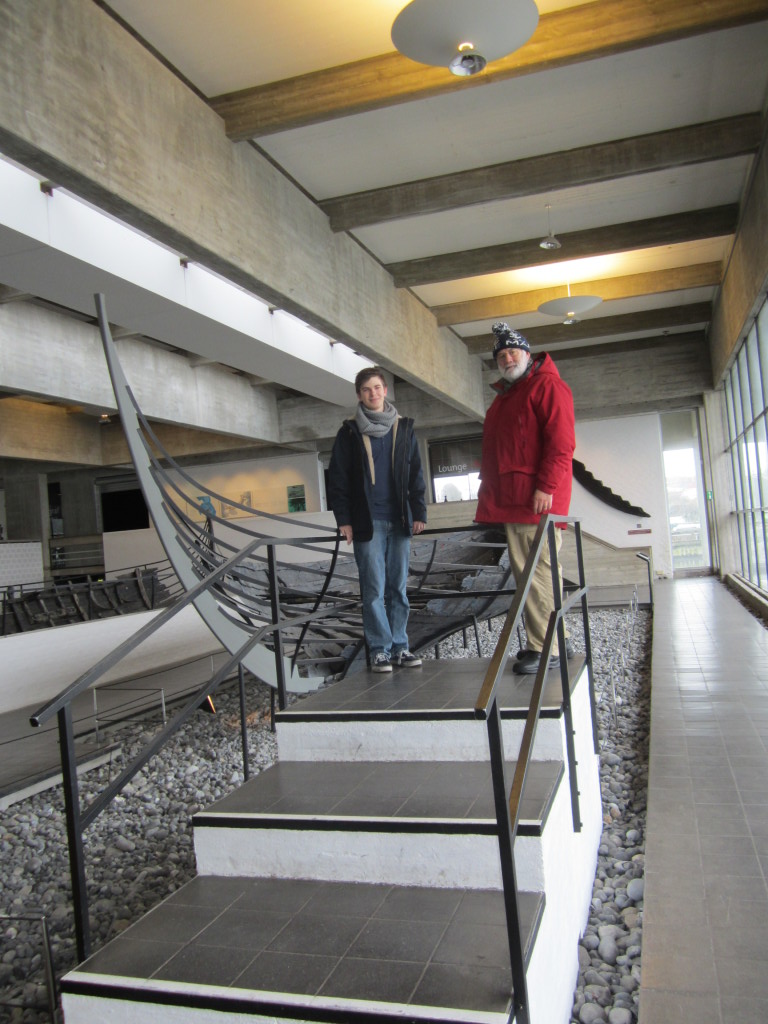
Marcus proudly showing me around the world-class Viking Museum, Roskilde
I think I’m very lucky to live in this age.
When one is used to a social democratic society with extremely low corruption, it would be a hard transition.
That being said, sure it would be very interesting going back in time and living as a sea officer.
Take Lord Cochrane for example, his life sounds like something taken straight out of one of the Kydd tales or Patrick O’Brian’s books.
You live close to Roskilde and the Viking ship museum. What does the Viking heritage mean to you?
The Viking heritage means a lot to all Danes. We are taught about the Vikings from a very young age. Denmark has a long history of losing wars, but during the age of Vikings we were the conquerors for once. Even England was under our rule. I am also proud of the sailors that sailed the dreaded long ships. We were master shipbuilders and navigators at the time.
[ The Viking Ship Museum, Roskilde ]
Would you like to be a candidate for Reader of the Month? Just get in touch with a few sentences about your background and why you enjoy the Kydd series. Each published Reader of the Month will receive a special gift
Mutiny: Divided loyalties
Posted on February 28, 2014 18 Comments
Thank you for all your kind comments on the post about my third book, Seaflower: Turquoise Waters, Deadly Perils. The fourth book in the series is MUTINY, dealing with the tumultuous times of 1797. Kydd is now a truly seasoned sailor and has advanced to the rate of master’s mate.
Before beginning to write MUTINY, I sat down for a long planning session about the plot specifics and the location research that needed to be done.

Top of the Rock!
One of the things that had become apparent to me was that the mutinies at the Nore and Spithead had been virtually untouched by nautical fiction writers. I saw this as an opportunity – and a challenge – to bring to life – through Kydd’s eyes – one of the most extraordinary events in English history. Ten thousand men, one thousand guns and scores of ships held the country to ransom; the government near collapse, the economy on the brink of ruin…
Vitally, I had to decide where Kydd’s loyalties lay. Was it with his fellow seamen or King and country?
But this was only part of the book. The storyline I’d devised meant I would be dealing not just with the Nore fleet mutiny but also with the defence of the fabled Rock of Gibraltar and Venice in the tumultuous last days of La Serenissima Repubblica.
Sheerness was the first stop for location research for MUTINY. I’d spent several years of my boyhood there and found sailors’ clay pipes from the long ago anchored fleets in the mudflats, but that was many years ago – but as the main focus of the book was to take place there, it was essential to return.
I was pleased to be able to meet up with David Hughes, a local historian with a wonderful depth of knowledge of the events of 1797. Many of the locales Kathy and I visit may seem very exotic but Sheerness on a cold grey winter’s day is no picnic! After walking along the sea front into a bitter onshore breeze for over an hour there was no alternative other than to find the nearest hostelry for a warming double tot of rum!
Gibraltar provided a wealth of primary sources and many buildings from Kydd’s time still stand. During our time in Gibraltar we celebrated our 25th wedding anniversary, cracking a bottle of champagne ‘on top of the Rock’! Nice one…

Venice, city like no other. Spot the Lovely Lady!
But of all the research locations I’d been to thus far, Venice was – and is to this day – the one that stands above all the others because of its sheer presence: a city unlike any other on the planet. And in many ways it’s little changed from Kydd’s day…
Admiral Lorenzo Sferra of the Museo Storico Navale provided an insight into the state of the Venetian republic’s navy in 1797. This splendid museum is housed in a 15th century granary, which served the Arsenale, the vast state-owned ship-building complex. One of the highlights of the visit to the museum was seeing the magnificent model of the last Bucintoro, the ceremonial barge of the Doge of Venice.
Back in the UK local research mainly consisted of following the mouth of Devon’s River Erme inland from the sea, digital camera in hand. But the question of dialect posed a challenge. A very helpful expert of historic Devonian speech patterns, John Germon, came to the rescue…
At the end of each day’s research we have a firm rule that I must download the photos I have taken and make sure all are properly labelled and sorted, then transcribe my often extensive notes before we can declare the sun is over the yardarm…

With Commodore Johnstone-Burt at the launch of MUTINY at Britannia Royal Naval College, Dartmouth
For MUTINY I estimate I took over 600 photos. There were also boxes of photocopies of primary sources, reference books, nautical pilots and charts – stacked on top of each other they reached over several feet high.
The Launch Party for MUTINY was on November 4, 2003, at Britannia Royal Naval College in Dartmouth. It was a splendid affair, held on the Quarterdeck, the symbolic heart of the college. Its high vaulted ceiling, Portland stone columns and surrounding Poop Deck provided a stunning venue. A night to remember!
Seaflower: Turquoise Waters, Deadly Perils
Posted on February 21, 2014 14 Comments
Thank you for all your kind comments on the post about my second book, ARTEMIS. The third book in the series is SEAFLOWER. There’s certainly a shock for Kydd and Renzi at the beginning of the story – the two friends are ‘turned over’; instead of being able to return to loved ones in England they find themselves shipped out in haste to Barbados.
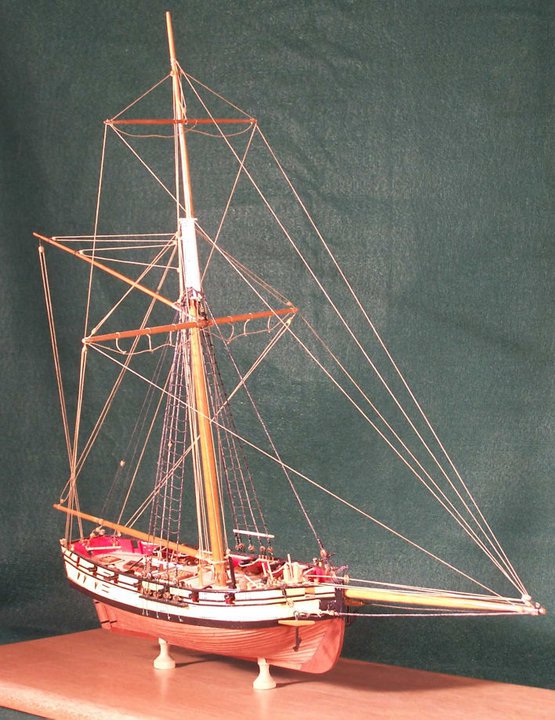
A model by Bob Squarebriggs of the little topsail cutter Seaflower
On a cold, grey January morning in 2001 Kathy and I set off from London for the much warmer climes of the Caribbean and our first major location research trip for the Kydd series.
What were some of the highlights of this trip?
I’d done extensive research before we left but there are always things you can only get when you actually visit a place, the chief of these is a mental map of how it would have looked two hundred years ago. There are also the small but so evocative things – the colours, smells, sounds which you just can’t get from travel books. And then there is the serendipity element: quite often on location research I’ve chanced on some small piece of information from a knowledgeable local that I’d not known about before that develops into a sub-plot or adds substance to something I’d only had a tantalising fragment of detail on.
For example, I’d come across references to the Maroons in my preliminary reading but it was only after more research in the Jamaican library that I saw how they could be an interesting sub-plot in the book.

The Blue Mountains of Jamaica, home to the Maroons
The Maroons had a colourful history. When the British captured Jamaica in 1655 the Spanish colonists fled leaving a large number of African slaves. Rather than be re-enslaved by the British, they escaped into the hilly, mountainous regions of the island, joining those who had previously escaped from the Spanish, to live with the Arawaks. The Maroons intermarried with Arawak natives, establishing independence in the back country. They survived by subsistence farming and by raiding plantations. Over time, they came to control large areas of the Jamaican interior before they were eventually shipped out to Canada!
Any other examples of serendipity?
Well, there was the Camelford incident. Curator Reg Murphy of the Antigua dockyard told me the story of a deadly confrontation on the quayside in Kydd’s day. A rusting old anchor marks the spot where a British peer and acting commander – Thomas Pitt, the 2nd Baron Camelford – shot dead another officer in a pistol duel. I was intrigued and had to find out more… This incident became the basis for my fatal meeting between Farrell and Powell.
Which location did you enjoy most?
We visited four countries – Jamaica, Antigua, Guadeloupe and Barbados – and all were fascinating and worthwhile in their own right – but to me English Harbour was the most evocative of Kydd’s day. As a former shipwright trained in traditional wooden ship construction, the facilities there in the eighteenth century for the Royal Navy were of special interest and I took much pleasure in having Kydd learn something about the chippy’s art when he spent some time in that very dockyard under the strict eye of the Master Shipwright.
Today, Nelson’s Dockyard (as it is now known) is the world’s only Georgian-era dockyard still in use.
In 1784, 26-year-old Horatio Nelson arrived there in HMS Boreas to serve as captain and second-in-command of the Leeward Island Station. Under him was the captain of HMS Pegasus, Prince William Henry, duke of Clarence, who was later crowned King William IV. The prince acted as best man when Nelson married Fannie Nisbet on Nevis in 1787.
When the Royal Navy abandoned the station at English Harbour in 1889, it fell into a state of decay, but was restored and re-opened in 1961.
The Dockyard Museum in the original Naval Officer’s House is worth a visit – it has a collection of ship models, mock-ups of English Harbour, maps, prints – and Nelson’s telescope and tea caddy.
What did you find to be the best resources for your research?
The staff of the Barbados Museum and Historical Society in St Michael were very obliging. The National Library of Jamaica in East Street, Kingston, was also particularly helpful in sourcing documents relating to the period I was interested in. The original papers and letter books of two former governors, Roger Hope Ellestson and Sir George Nugent, were invaluable in building up a picture of plantation society.
Do you have a favourite scene in the book?
I enjoyed writing Seaflower immensely and I guess, if pressed, my favourite passage is in chapter 9 in a scene of fellowship and good feeling that I can relate to from my own days at sea, and which fellow Old Salts have told me resonates with them.
The little topsail cutter has successfully completed working up to battle readiness and returns to Port Royal for rest. The passage reads:
Kydd swarmed up the narrow ladderway to the upper deck, where a sizeable gathering was celebrating Seaflower’s prospects. Doggo was leaning on a swivel gun forward of the mast, waving his tankard, with an audience and in full flow…
A friendly hail, and Renzi stepped on deck. ‘Tip us some words, mate,’ Petit called.
Renzi stood still and thoughtful, then declaimed into the velvet night:
‘Majestically slow before the breeze
The tall ship marches on the azure seas;
In silent pomp she cleaves the watery plain
The pride and wonder of the billowy main.’
[Then Ned Doud is persuaded to give a song.]
‘Come, come, m’jolly lads! The winds abaft
Brisk gales our sails shall crowd;
The ship’s unmoor’d, all hands aboard
The barky’s well mann’d and stor’d!’
The Drury Lane ballad, thought confected by a landman, was a great favourite and all joined in the chorus.
‘Then sling the flowing bowl – fond hopes arise
The can, boys, bring; we’ll drink and sing
While foaming billows roll.’
In the warm darkness something told Kydd that he would be lucky to experience an evening quite so pleasurable again.
My Pinterest board on Kydd in the Caribbean
See also my blog on SEAFLOWER and CARIBBEE
Copyright notices
Every effort is made to honour copyright but if we have inadvertently published an image with missing or incorrect attribution, on being informed of this, we undertake to delete the image or add a correct credit notice
A Jewel of a Museum: Orlogsmuseet
Posted on February 18, 2014 7 Comments
[To leave a comment or reply go to box at the end of the page]
On location research for the Kydd series one of the first stops I always make are the local sea connections. And on my latest trip, I was most agreeably taken with the Orlogsmuseet, the Royal Danish Naval Museum in Copenhagen. It’s a jewel of a museum, located in a former naval hospital on Christianshavn, near to the site of Nelson’s great battle with the Danes, where he used his telescope to good effect!
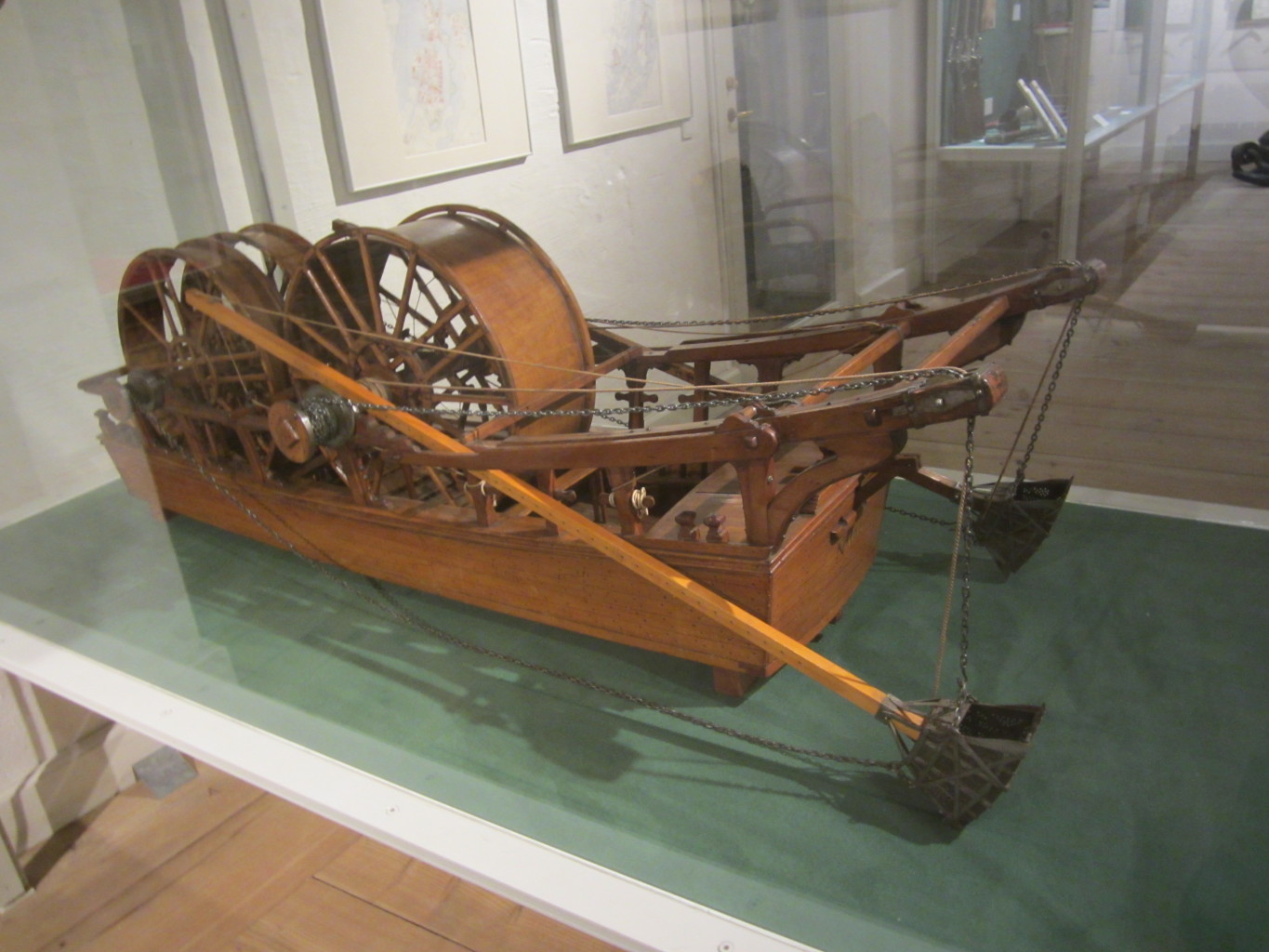
An 18th c dredger operated by human power!
It houses one of the world’s finest assembly of naval models, some dating back to the late 17th century, the oldest ship, a vessel from the 1660s. The collection consists of several hundred large and small models, ranging from fully-rigged ships-of-the-line to entire docks and other dioramas. All the models display very fine craftsmanship and exquisite rigging detail. As was the practice in the Age of Sail in many countries, the models served as blue prints for ship builders.
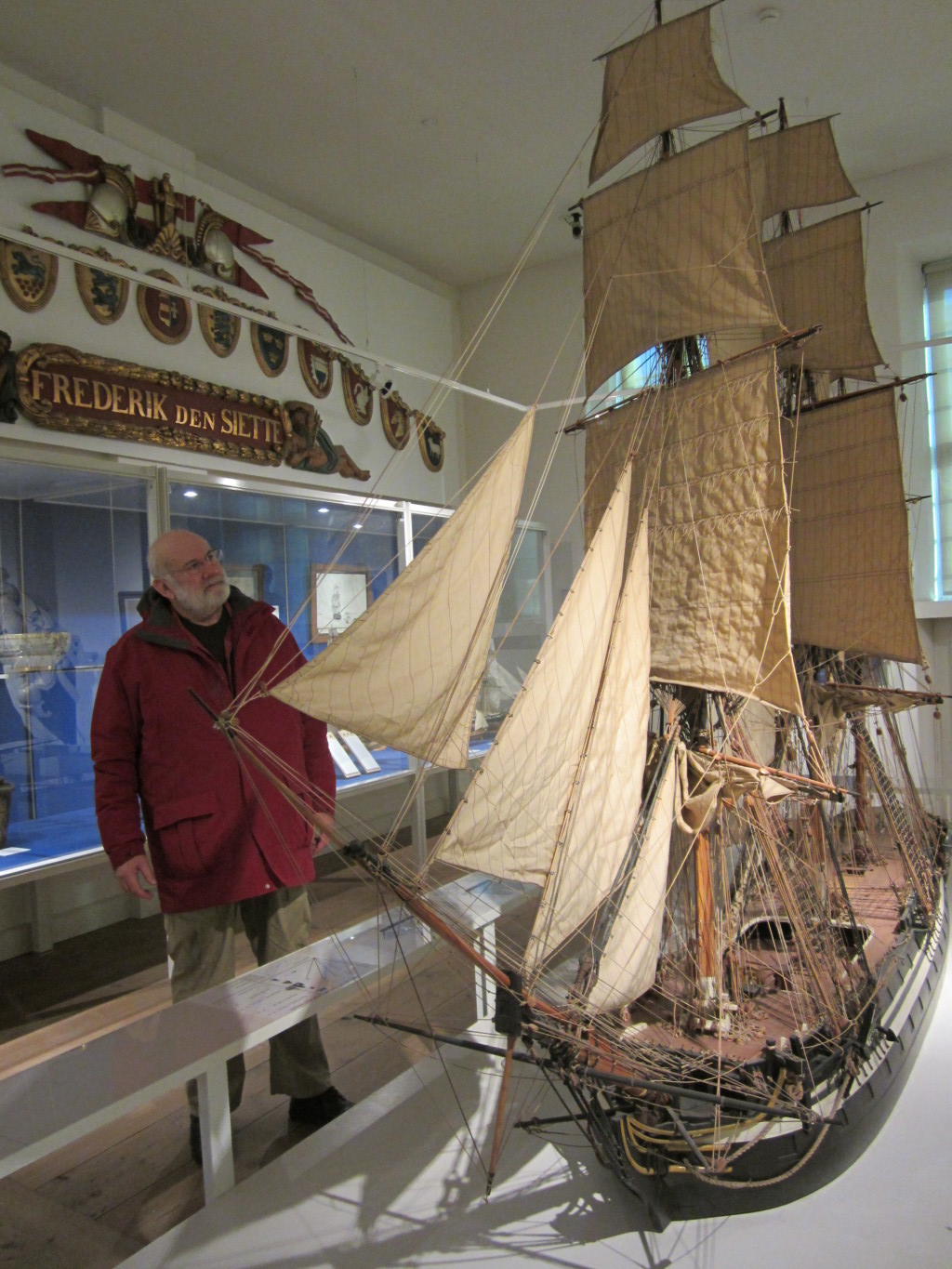
Admiring this stunning model of Phoenix
One of the largest of the models is the ship-of-the-line Phoenix, launched in 1810. An incredible model, both in its size and detail. I wonder just how many thousands of hours it took to build!
There are also displays of ships’ equipment, uniforms and nautical art. Christoffer Wilhelm Eckersberg, a luminary of Danish painting, produced some very dramatic work which is represented in the museum.
A place to linger in and soak up the long and illustrious maritime history of Denmark!

A former NATO colleague’s final command
One exhibit that I had to pay particular attention to was the indoor display by section of the submarine Spaekhuggeren (killer whale). During my Cold War days in the Navy one of my NATO acquaintances was Orlogskaptajn Johan Knudsen. We are friends to this day and Spaekhuggeren was the first boat he sailed in – and his last command.
The children’s section of the museum is great fun and very hands-on! It was full of enthusiastic schoolchildren when we passed by.
Most of the information on the various exhibits is in Danish and English. The very fine website is in Danish but it gives a good idea of the range of the exhibits.
The Orlogsmuseet website
The Last of Her Kind
Posted on February 14, 2014 15 Comments
[To leave a comment or reply go to box at the end of the page]
I once asked Kathy whether she would like to live aboard a boat instead of buying a house but for some reason she did not seem to warm to this idea. The concept has always appealed, though, and when Bruce Macdonald got in touch to say to say he’d enjoyed my post on Jack Tar and closed with the comment:
‘We live aboard a very small full-rigged ship on Canada’s west coast called North Star of Herschel Island’
I just had to find out more – so I invited him to write a Guest Blog about the tall ship he has called home for seventeen years.
Over to Bruce:
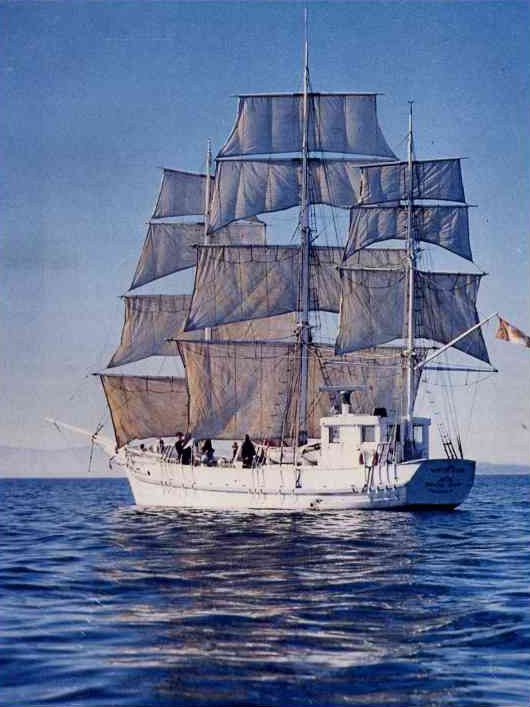
Fully rigged, and before the wind
‘I started before the mast on the 72-foot brigantine T S Playfair on the Great Lakes when I was 14 years old and worked my way up to executive officer aboard a sister ship, Pathfinder, by the time I was seventeen. During university I spent a couple of summers teaching keel boat sailing and the day I graduated I was again given command of Pathfinder which I ran for the next six years.
Having command of a sail-training square-rigger was a very rewarding experience. It was a job that I would have gladly carried on with for many years more but when my wife and I had our first daughter I recognised that I did not want to be an absentee father away at sea for six months a year.
We took over management of a nautical book and chart store and soon moved west to Victoria, British Columbia to open a franchise of that store and our second daughter was born there.
However, I got the urge to be back at sea and we began a search for a sailboat to live aboard. After a search up and down the coast we purchased North Star of Herschel Island and made her our home.
She’s a 1935 former Arctic fur trading ship built for two Canadian Inuit trappers to transport their fur to markets on the mainland and trade for supplies. The ship is 78’ LOA, with a 15 foot beam and draws six and a half feet. There were over one hundred of these vessels built for the western Arctic Inuit but North Star is the last one afloat.
Her previous owner had re-rigged her from being a cutter to the present rig as he was planning a solo or short-handed circumnavigation and wanted the sails small enough that he could handle them himself and the square rig was for his intended trade wind route.
Despite a positive survey we were a bit worried about buying such an old wooden boat but as another sailor-friend pointed out, North Star had been kept in the freezer most of her life. Her original stomping ground was the Beaufort Sea which was only clear of ice for about two months each year. This was when she did her trading and then she was hauled ashore over skids of freshly killed seals by the whole village of Sachs Harbour, Banks Island. Three times they were not fast enough and she was frozen solid into the ice over the winter with no damage to her.
The ship had been purpose built for operating in the ice by the Geo. W. Kneass company of San Francisco of 3 1/2 inch quarter sawn, edge grain Douglas Fir on oak ribs every twelve inches. The fir was then given a coating of Stockholm Tar, then a layer of Irish ship’s felt to keep the caulking in and then another layer of tar. Atop this was a second hull of one-inch ironbark that rose to a few feet above the waterline at the stem and then carried on aft to the mahogany transom. Capped in oak North Star is purposefully overbuilt. When the previous owner brought the ship south he added more tar, ship’s felt and tar and then completely clad her in copper sheathing to stop marine growth and invasive species such as the teredo worm.

North Star in the ice floes
Once we were settled aboard the real work began. We stripped the hull down to bare wood as some moisture had got between the finish and the hull. The ship had been preserved with a thick coat of white paint every year and in some places it was almost an inch thick. The steering hadn’t been used in many years and was seized. I spent days lying on deck with a hacksaw blade slowly working through four bolts trapping the rudder post until I could finally turn the large wooden helm. The steering is via worm gear and so the helm is set behind the helmsman which required a bit of getting used to.
We worked at refurbishing the hull all summer and finally took her out in the fall to a marine music festival up the coast. A neighbor who had lived aboard his old Mission ship for many years gave us some good advice – that no matter what, we had to get off the dock and sail the ship somewhere every season or we would soon forget why we had taken on such a project. We have held to his words every year, sometimes only being able to get away for a few weeks but usually sailing from May through October up and down the coast.
The second year we owned the ship we invited two foster children into our family and so with four kids we had a lot of energy aboard. We would find remote anchorages and swim off the ship and enjoyed exploring the different ports we visited.

Bruce
We chose not to have television or video games aboard and so the children soon became avid readers and monkeys in the rigging.
One of the most interesting things about owning this piece of floating history is that we have met many of the former owner’s seventeen children. They have regaled us with stories of their lives aboard in the Arctic Ocean.
One memorable evening we anchored off of a First Nations’ Indian Reservation. There were no other vessels about and we saw no one ashore. Around midnight my wife Sheila called me up on deck. The sky was chock-a-block with stars and a full moon lit up the cove; the sound of drumming and chanting coming from the reservation permeated the night. Here we were on an old wooden fully-rigged ship listening to the First People’s ceremony ashore. The music sent a chill up my spine with the realisation that we were re-living a scene that the earliest European explorers must have encountered when they first arrived on this rugged coast.’
R Bruce Macdonald’s book, North Star of Herschel Island (purchased via his website), recounts the colourful and fascinating history of this ship including her involvement in the whaling industry and the fur trade, use by the Canadian government to assert Canadian Arctic sovereignty during the Cold War and her role in surveying the controversial B.C./Alaska boundary. All proceeds of the sale of the book go to the ship’s maintenance fund
Opera Buff – and Kydd Fan
Posted on February 1, 2014 2 Comments
[To leave a comment or reply go to box at the end of the page]
My first two Readers of the Month have been a Cuban grandmother living in the States and an eleven-year-old boy from the UK. This month my Reader of the Month is from the Land of the Rising Sun.
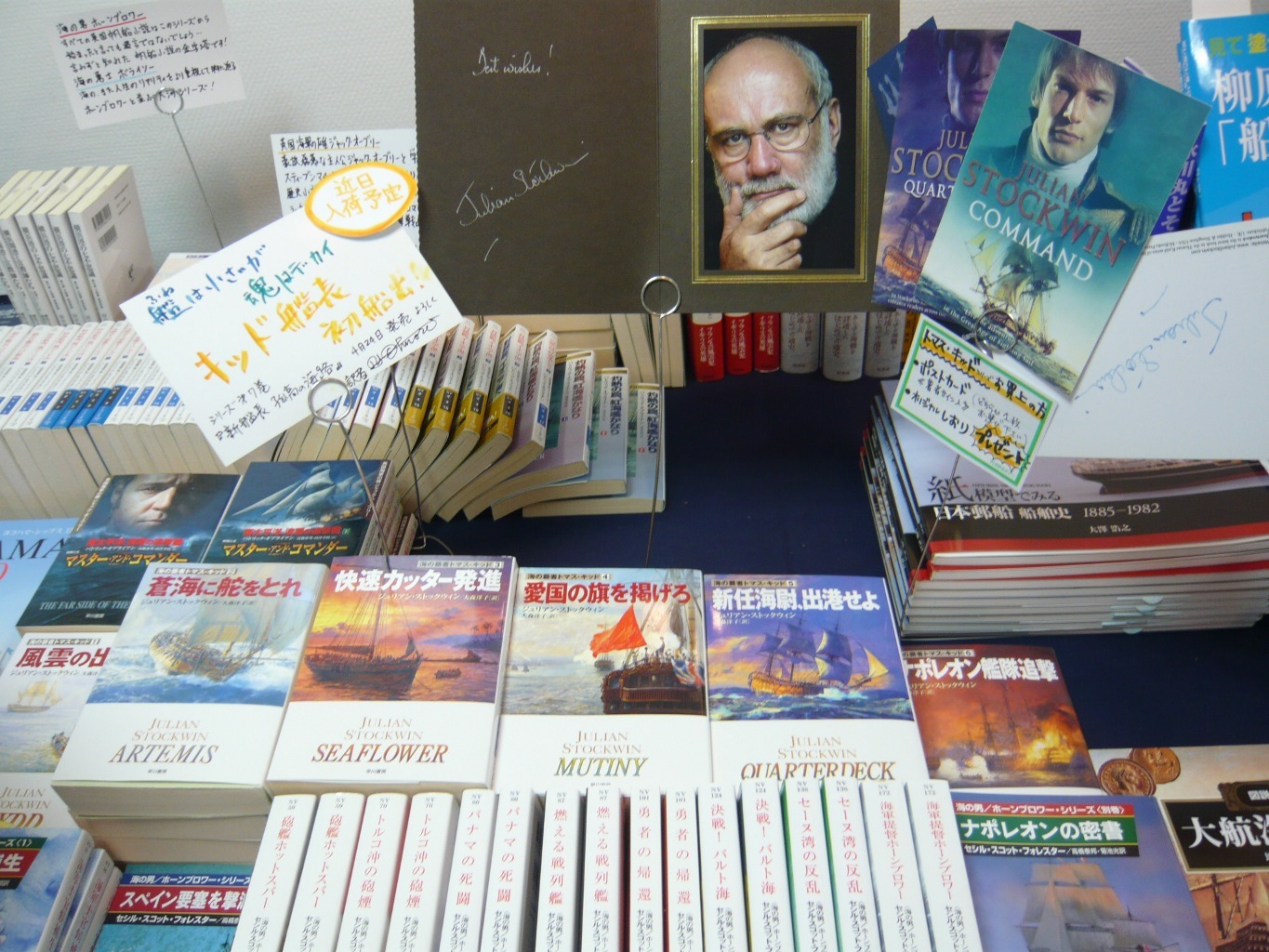
A Kydd display in a Japanese bookstore
The Japanese editions of the Kydd series are brought out by Hayakawa, one of that country’s largest publishers, based in Tokyo. Hayakawa is launching a translation of Treachery in the spring.
The books (translated by Yoko Omori, who I’ve had the great pleasure of meeting) are delightful to hold in the hand, measuring just four by six inches, and of course reading from back to front! I can understand some of the characters as Japanese has similarities to Chinese, which I took on board while living in Hong Kong.
The February Reader of the Month, Akiko Umechi, has followed the series since the first book. She lived by the sea as a child and remembers reading the Arthur Ransome saga at an early age. She then became absorbed in maritime adventure stories and famous sailors’ biographies, including Nelson, who she says became her hero.
At university, Akiko studied European and American history and archaeology. This led to an interest in maritime archaeology, and wrecked ships like Vasa, Mary Rose, and Orient.
Akiko now lives in a small town near Tokyo and works as a public employee, still very much retaining her heartfelt love for the sea and salty tales.
An opera buff, she appears in productions as a vocalist several times a year.

Akiko Umechi visiting the Japanese sail training ship Nippon-Maru
Akiko reads the English versions and the Japanese translations of the series, and enjoys them both. Her favourite title is Seaflower. Her favourite character (after Kydd and Renzi) is Bowden, followed by Cecilia, Kydd’s sister.
Akiko says: ‘The Kydd books are popular in Japan for a number of reasons. The main one is a sense of reality. When I read the books, I can feel that I am on the quarterdeck with Kydd. I am watching a scene, just as Kydd is doing. I can feel the ship’s movement, hear the roaring sea. The reader lives the adventure with the characters!’
Would you like to be a candidate for Reader of the Month? Just get in touch with a few sentences about your background and why you enjoy the Kydd series. Each published Reader of the Month will receive a special thank-you gift
Kathy and I are off on location research for the next couple of weeks and my BigJules blogs will resume mid-February
BookPick: Britain Against Napoleon
Posted on January 30, 2014 1 Comment
[To leave a comment or reply go to box at the end of the page]
I have Roger Knight’s scholarly The Pursuit of Victory: The Life and Achievement of Horatio Nelson on my reference shelves and certainly consulted it, along with others, for my book VICTORY. Now he’s come up with a broader work – on the wars against the French, 1793-1815.

Knight, Britain Against Napoleon
Britain Against Napoleon is a sweeping examination of this fascinating period and has succeeded in providing a unique and authoritative exploration of how the British state successfully organised itself to overcome Napoleon – and how so very close it came to defeat.
The Duke of Wellington famously said that the battle which finally defeated Napoleon was ‘the nearest run thing you ever saw in your life.’ Knight’s book shows how true this was for the Napoleonic war as a whole and how the nation was left completely worn out – but triumphant against a regime many times more powerful than itself.
Looking past the familiar exploits of the military and navy, Knight pays tribute to the machinery of state and shows how the entire British population was involved. He also points to the role of the bankers and international traders of the City of London who played a critical role in financing the effort and supporting the rest of Europe with subsidies in cash and kind.
It’s no small book, running to close to 700 pages, but I commend it to any serious student of the period and I know it’s one I shall refer to again as I continue to pen my Kydd tales.
Useful detailed appendices, a glossary, timeline and extensive bibliography are included.
The Good Ship Vega Needs Your Help!
Posted on January 29, 2014 Leave a Comment
[To leave a comment or reply go to box at the end of the page]
Vega is a 122 year old Hardanger built Norwegian sailing cargo vessel. Every year
the vessel sails 8,000 sea miles delivering
25 tons of donated educational and medical supplies to some of
South East Asia’s most remote island communities.
But now that work is seriously threatened unless money can be raised for a new mizzen mast

The damaged mizzen mast that needs urgent replacement
Our very modest budgets prohibit us from simply commissioning a new mast but fortunately having grown up in a wooden boat yard I have the experience to make this mast if we can locate a proper timber length to make it from.
Right now we need a shipping company willing to transport this wood from either Australia or Vancouver, Canada to Singapore where we will be doing the work.”
One of Shane’s friends has set up an account to collect funds for the replacement mast. Please help if you can!
Donate now
Read more about Vega
 Julian Stockwin