
Blogging away, blogging away…
Posted on August 2, 2013 15 Comments
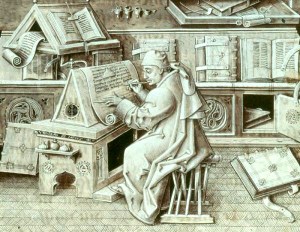
And the subject of this blog is…
I’m pretty new to this blogging lark (my very first BigJules post was just two weeks ago) but it’s great fun – and thank you for all the feedback and comments! Being an author can be a pretty lonely existence so it’s great to hear from readers. And while I thoroughly enjoy writing the Tom Kydd series, sometimes it’s nice to put pen to paper (metaphorically) outside the confines of the structure of a novel.
Being a bit of a research geek I decided to look into the history of blogs. The first one was in 1994 but it wasn’t until three years later that the term ‘weblog’ (shortened to ‘blog’ in 1999) was coined. Blogs took off in the early 2000s – and now there’s probably well over 200 million blogs worldwide! Makes one feel a bit humble.
Anyway, as well as the BigJules blog that I’ve just started, during this year I’ve been doing a monthly guest blog about writing historical fiction.
I’ve also guest blogged at English Historical Authors, on Horatio Nelson.
I welcome suggestions for future blogs, either in the form of a question to ‘Ask BigJules’ or a general topic you’d like to see covered.
Good thing Kathy’s a hard taskmaster about the number of ‘Kydd’ words I write each day, or I might just get a bit carried away with blogs…
Oh, and I’m also on Facebook, Twitter and Pinterest. Now, I really must get back to Thomas Kydd – he’s in a bit of a pickle and only I can save him…
Copyright notices
image: Jean Le Tavernier [Public domain], via Wikimedia Commons)
Every effort is made to honour copyright but if we have inadvertently published an image with missing or incorrect attribution, on being informed of this, we undertake to delete the image or add a correct credit notice
‘Very sad about tot…’
Posted on July 31, 2013 8 Comments
[To leave a comment go right to the end of the page and just enter it in the ‘Leave a Reply’ box]
In a number of respects the Old Navy that I knew and loved is no more. Sailors do not sleep in hammocks these days, the female of the species now serves alongside chaps at sea – and the tot is no longer on regular issue.
It was in Jamaica back in the mid seventeenth century that rum, also colourfully known as rumbustion, rumbullion, kill devil, Barbados waters and red-eye, was first issued on board ships of the Royal Navy – a full half pint of neat rum a day, instead of the beer ration. Disturbed by the ensuing problem of drunkenness Admiral Vernon (nicknamed Old Grogram because of the boat cloak he favoured made out of that material) ordered that the rum issue be diluted 1:4 and issued twice daily; thereafter the drink was called ‘grog’. By 1793 the dilution was usually 1:3.
From Vernon’s time to the end of the Napoleonic Wars, two issues of grog per day remained the custom whenever beer was unavailable. But the use of rum gradually became more widespread, as did the issuing ritual. In Kydd’s day, the ship’s fiddler played ‘Nancy Dawson’, the signal for cooks of messes to repair to the rum tub to draw rations for their messmates. This was always done in the open air due to the combustible nature of rum!
Rum became a currency onboard with its own special vocabulary:
Sippers – a small taste.
Gulpers – the next level up – a substantial swig from a mate’s ration.
Sandy bottoms – you got the entire tot!
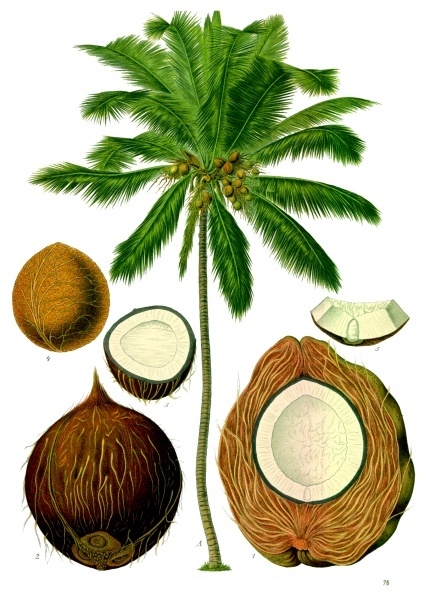
Jamaican Cocoanut
In the Age of Sail ‘sucking the monkey’ was a way for Jack Tar to illicitly get his hands on rum from ashore. Canny hawkers would empty out the ‘water’ from coconuts and fill them with rum. The innocent-looking fruit was then ferried out to ships in bumboats – with many eager matelot customers awaiting!
Although Horatio Nelson’s body was preserved in brandy en route back to England, to this day navy rum is known as Nelson’s blood. This is perhaps due to the widespread myth that his body was preserved in rum, and that sailors aboard HMS Victory made a small hole in the cask in which it had been placed then syphoned off and drank some of the spirit, hoping to imbibe not only the rum but of the essence of their great hero.
July 31, 1970 saw the last issue of rum in the Royal Navy. It became known as Black Tot Day.
The First Sea Lord, Admiral Sir Michael Le Fanu (affectionately known as ‘Dry Ginger’) issued this message:
- Most farewell messages try
To jerk a tear from the eye
But I say to you lot
Very sad about tot
But thank you, good luck and good-bye.
—
Michael Le Fanu was set to take over as Chief of Defence Staff but a sudden serious illness prevented this. He passed away in November of that year.
Copyright notices
Coconut: By Franz Eugen Köhler, Köhler’s Medizinal-Pflanzen (List of Koehler Images) [Public domain], via Wikimedia Commons
Every effort is made to honour copyright but if we have inadvertently published an image with missing or incorrect attribution, on being informed of this, we undertake to delete the image or add a correct credit notice
Soup to Go!
Posted on July 28, 2013 15 Comments
[To leave a comment go right to the end of the page and just enter it in the ‘Leave a Reply’ box]

Lewis and Clark, portable soup fans
In the 1750s the Royal Navy began issuing portable soup to ships embarking on long voyages, following recommendations by the naval surgeon James Lind that it should be supplied for the sick. It was also seen by some of their Lordships as an anti-scorbutic, which we now know was erroneous. But indirectly it helped; it made ‘greens’ more palatable…
Portable soup was the forerunner of the modern stock cube. Meat and offal were boiled until the mixture formed a thick glue-like paste, then it was dried to be cut or broken into pieces.
Portable soup is said to have been invented by a Mrs Dubois, although references to similar products can be found a half century before then. She and a Mr Cookworthy (really!) were given a contract to manufacture it for the Royal Navy in 1756. By 1793, the doughty entrepreneurs were making 897 tons a year, also offering it for sale for ‘gentlemen on journeys at sea’.
The stuff was virtually indestructible: a piece that went around the world with Captain Cook is preserved to this day in the National Maritime Museum. Whether or not that’s still edible isn’t something I’m volunteering to try out – but a similar piece from Cook’s supplies was analysed in 1938 and found to be safe to consume!
But getting back to the eighteenth century – the Navy was keen to establish whether portable soup would indeed prevent scurvy and conducted a number of experiments with various foodstuffs. In 1766 they instructed Captain Wallis in Dolphin to load his ship with 3000 pounds of portable soup to take on his circumnavigation. James Cook, for his voyage to Tahiti two years later, also took aboard a large supply. In his journal, Cook writes of ordering celery and oatmeal to be boiled in portable soup and served to the ship’s company for breakfast. An acquired taste, I suspect…
Portable soup found its way to the New World, too. Lewis and Clark carried 193 pounds of it with them on their two-year expedition into the territory of the newly acquired Louisiana Purchase.
The Georgian cookery writer Hannah Glasse in her best-selling The Art of Cookery Made Plain and Easy gives a recipe which is probably slightly more up-market than the naval version. Hers calls for 100 pounds of beef, 9 gallons of water, 12 anchovies, mace, cloves, pepper, 6 onions and thyme. This is to be boiled for 9 hours, strained, then boiled again until it is like a stiff glue. It’s then dried in the sun until hard. She goes on to say that a piece the size of a walnut ‘will make a pint of water very rich.’
By 1815, however, with the publication of navy physician Blane’s ‘On the Comparative Health of the British Navy from 1779 to 1814’ – which dismissed portable soup as ‘insufficiently hearty, solid or abundant for the purpose of recruiting health’ – Admiralty victualling practice shifted in favour of canned meats, a process invented in France in 1806.
But portable soup remains with us to this day. Bovril, anyone?
Footnote: The eradication of scurvy from the Royal Navy was not to be seen until the 1790s, when lemon juice was issued to all ships.
Copyright notices
Lewis and Clark image: Public Domain/ Wikimedia Commons
Every effort is made to honour copyright but if we have inadvertently published an image with missing or incorrect attribution, on being informed of this, we undertake to delete the image or add a correct credit notice
From a BETRAYAL reader…
Posted on July 25, 2013 3 Comments
[To leave a comment go right to the end of the page and just enter it in the ‘Leave a Reply’ box]

Reader Paulo Meireles
BETRAYAL is the latest book in the Kydd series. I was chuffed to open an email today from Paulo Meireles, a reader in Portugal, with some insightful comments about the background of my tale.
This is what Paulo said:
“I didn’t know that the British made two attempts to conquer Buenos Aires. Seems indeed sad that many lives were lost in, what appears now, a very futile and naïve military attempt. The faith Commodore Popham had in the raising of the locals in support for the invaders (in this case the British), is familiar throughout history…
Would independence have had the same attraction if the colonials didn’t witness the inability of the Spanish Crown to defend its colonies? We were still to see the French occupation of Spain, the liberation war of the Spaniards against Bonaparte and the Cadiz Constitution of 1812.
General Beresford indeed became the military ruler of Portugal, under the Regency that governed the country while the King João VI was in Brazil. After the Napoleonic wars ended, the presence of the British in higher ranks of the military became more and more unpopular, which culminated in the liberal movement of 1820. Beresford, returning from Brazil, where he went to request more powers from the King, was refused entrance to Portugal.
 One of Beresford’s and the Regency’s most criticized and controversial decisions was the death sentence on General Gomes Freire de Andrade, a distinguished military gentleman with service in Russia, Turkey and France, who had fought in Napoleon’s Army (in the Portuguese Legion). He was accused of conspiracy and treason and executed in the São Julião da Barra fortress in Oeiras.
The Cadiz Constitution of 1812 served as a model for other constitutions in South America and also for the Portuguese Constitution of 1820, this one also resulting from the liberal movement that ousted Beresford. Eventually the pressure from the liberals for the return of the king from Brazil and their tentative moves to renew the old bonds between Portugal and its major colony precipitated the declaration of independence from that territory. Brazilian ports had been opened in the meantime to friendly countries in 1808, and in 1810 a new treaty between Portugal and the UK reinforced this opening. In 1815 there was created the United Kingdom of Portugal and Brazil.”
Do email me if you would like to comment on BETRAYAL – or any of my other titles. Of course, you can also post a comment here! Look out for a contest for a signed paperback of BETRAYAL next week, along with a selection of signed cover postcards and other Stockwin memorabilia!
‘My fin’
Posted on July 24, 2013 3 Comments
[To leave a comment go right to the end of the page and just enter it in the ‘Leave a Reply’ box]
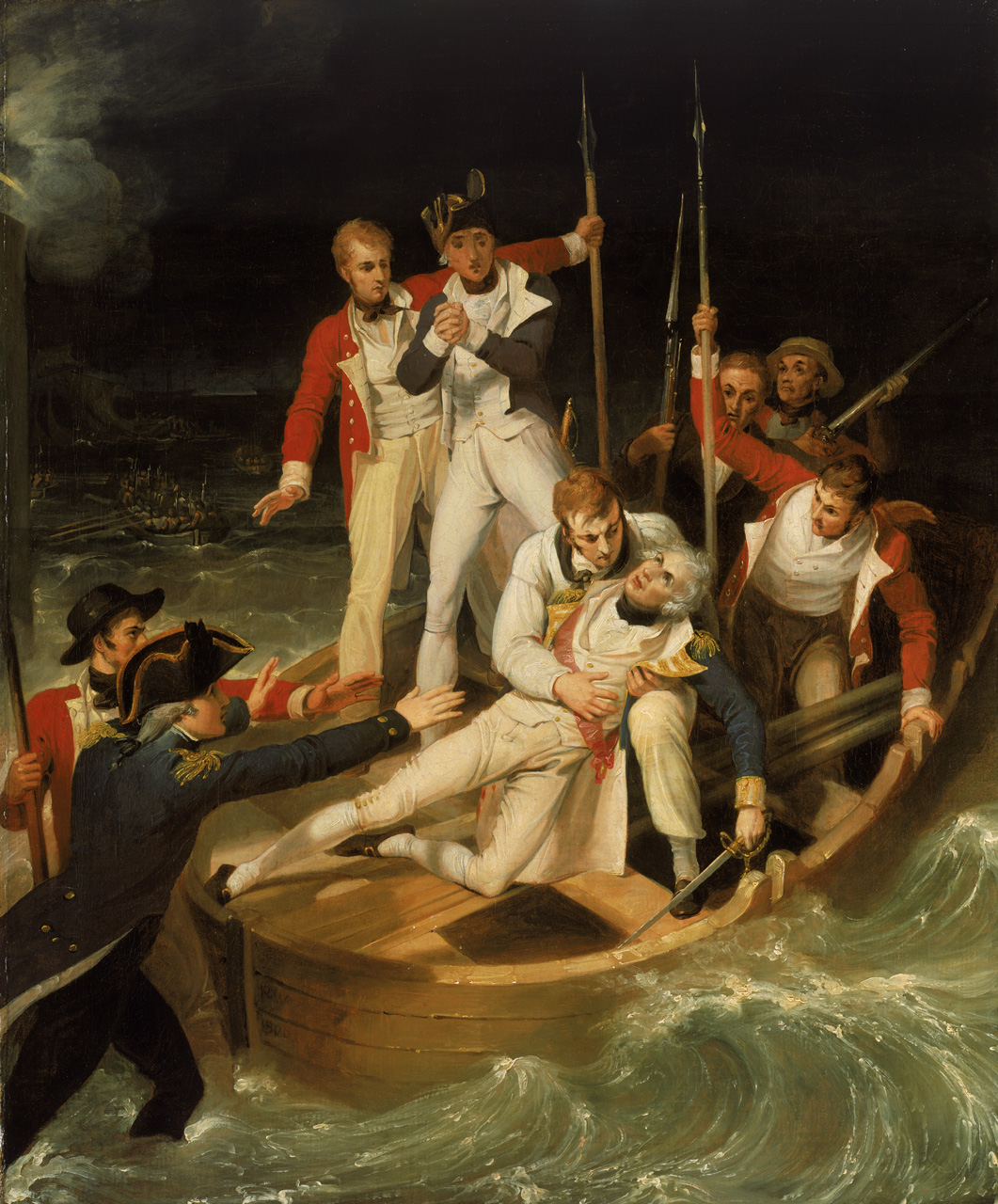
Nelson Wounded at Tenerife, by Richard Westall
I have to confess that I’m a bit squeamish about all things medical. I love to read about a rattlin’ good Age of Sail sea battle and immerse myself in the tactics and sailing conditions – but then there’s the aftermath, the deaths and injuries, the amputations…
In Georgian times many wounded sailors didn’t survive the surgeon’s saw, even though a limb could be amputated in just one and a half minutes! If shock or loss of blood didn’t kill them, infection often did.
This day in 1797 Horatio Nelson lost his arm after a desperate shore assault at night. He was struck by a musket ball; a tourniquet fashioned by his stepson probably saved his life.
Nelson was rowed to HMS Theseus where his right arm was amputated high up near the shoulder. The operation was performed without anaesthesia, and it is unlikely that he was given rum to dull the pain as alcohol was said to interfere with the clotting of the blood.

A reconstruction of a surgeon’s table in the orlop
In typical Nelson style, within a short time of the surgery he was issuing orders to his captains. The wound, however, took many months to heal as one of the ligatures used during the operation, which normally fell out after a few weeks, remained in the wound, causing infection and great pain.
After the amputation he sometimes experienced the sensation of a phantom arm. Nelson nicknamed his stump ‘my fin’ – and it was said that it twitched if he was angry or agitated. His officers would then warn: ‘The admiral is working his fin, do not cross his hawse!’
Horatio Nelson had a wry sense of humour about his infirmity. When the landlady of the ‘Wrestlers Arms’ in Great Yarmouth asked permission to rename her public house ‘The Nelson Arms’ in his honour, Nelson replied: That would be absurd, seeing I have but one.’
Copyright notices
Painting: Richard Westall [Public domain], via Wikimedia Commons
Every effort is made to honour copyright but if we have inadvertently published an image with missing or incorrect attribution, on being informed of this, we undertake to delete the image or add a correct credit notice
In Praise of Pies
Posted on July 22, 2013 7 Comments
Reminiscing about the good old days with a former shipmate recently I recalled returning to our ship in the wee hours and stopping to grab a meat pie from “Harry’s Cafe de Wheels”, not far from the Woolloomooloo dockyard, Sydney. He told me that so popular with the navy did this eatery become that in 1978 Rear Admiral David Martin – over a pie and a glass of champagne – commissioned it “HMAS Harry’s”!
Pies have a long history, going back to 9500 BC! In the days of sail, a sea pie was a dish much favoured. Depending on what ingredients were available, it consisted of meat or fish and vegetables between layers of pastry representing decks of a ship. Thus you’d have a two-decker sea pie, a three-decker and so on.
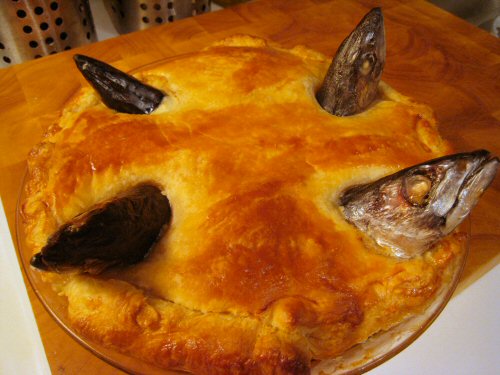
Stargazy pie
To this day I’m rather partial to pies and would loved to have sampled a great battalia pie, which Disraeli described as a masterpiece of the culinary art of the time! Apparently the ingredients were chicken, pigeon, rabbit, spices, cock’s combs and other delights, in a rich claret sauce. Not sure about the cock’s combs, though…
And to my shame I haven’t yet tasted a stargazy pie, the famous Cornish dish with the heads of sardines protruding through the crust.
When William Pitt the Younger died in 1806 his last words were widely reported to have been, “I think I could manage one of Bellamy’s veal pies.”
Copyright notices
Pie: ByStar Krista (baked stargazy pie Uploaded by Diádoco) [CC BY 2.0 (http://creativecommons.org/licenses/by/2.0)%5D, via Wikimedia Commons
Every effort is made to honour copyright but if we have inadvertently published an image with missing or incorrect attribution, on being informed of this, we undertake to delete the image or add a correct credit notice
Stockwin Goodie Bag Draw!
Posted on July 20, 2013 4 Comments
[To leave a comment go right to the end of the page and just enter it in the ‘Leave a Reply’ box]

The KYDD cap
The first BigJules contest is a draw of all those who’ve sign up to ‘follow’ my new blog – with the prize of a special Stockwin Giveaway with books, a Kydd Cap and a few mystery items! Entry is automatic once you’ve signed up.
The draw will be at the end of August and the winner will be contacted by email.
BookPick: Conquest of the Ocean
Posted on July 17, 2013 Leave a Comment
[To leave a comment go right to the end of the page and just enter it in the ‘Leave a Reply’ box]
 Brian Lavery certainly brings impeccable credentials to this work having held posts at Chatham Historic Dockyard and the National Maritime Museum, where he is currently a Curator Emeritus.
He has the ability to both focus in tightly on a subject and also tackle subjects with a very broad canvas. It’s the latter that his latest book The Conquest of the Ocean deals with. It’s no mean feat to take 5000 years of seafaring history and do it justice in some 400 pages but this is just what Lavery has accomplished.
Lavery brings the book to life with excerpts from first person narratives, diaries and logbooks. The illustrations in this book are also first-rate – paintings, early maps, sketches and modern photography.
The Conquest of the Ocean is a fascinating narrative of a subject dear to my heart.
The Kydd ships brought to life
Posted on July 15, 2013 Leave a Comment
[To leave a comment go right to the end of the page and just enter it in the ‘Leave a Reply’ box]
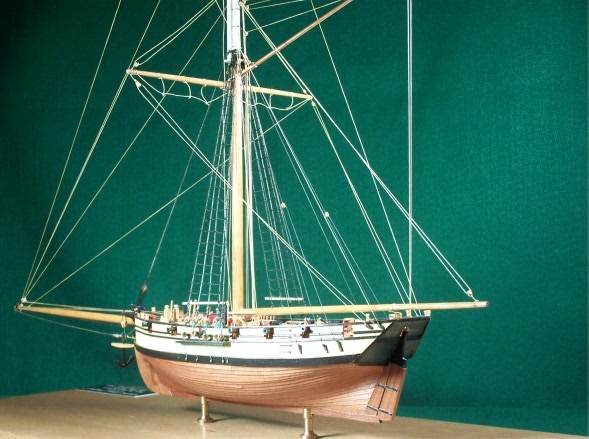
Seaflower – by Robert Squarebriggs
The renowned maritime artist Geoff Hunt RSMA was commissioned to paint original artwork for the covers of the first nine books in the Kydd series. Each featured one of Kydd’s ships, superbly represented. These paintings are available as limited edition prints at http://www.artmarine.co.uk/kydd.aspx
From INVASION onwards, my publisher decided to design the covers using the latest computer generated imaging techniques, bringing what I think is a very contemporary – yet still historical – look to the books.
But how many authors have the great privilege of seeing the ships in their books portrayed across the whole spectrum of model making? There have been representations of the Kydd ships as physical models ranging from 1:1200 to 1:64 in scale, half models, and even a virtual L’Aurore, a computer-generated image!
In future posts I’ll feature individual modellers.
Captivating Cape Town!
Posted on July 15, 2013 Leave a Comment
[To leave a comment go right to the end of the page and just enter it in the ‘Leave a Reply’ box]

Kathy on top of the world
Thanks to Tom Kydd, Kathy and I have travelled all over the world on location research, reconstructing in our minds the world of the Georgians and the eighteenth and early nineteenth century Royal Navy.
For CONQUEST, our destination was South Africa. Cape Town is a city in a truly memorable setting – Table Mountain in the background, the Atlantic Ocean on one side of the peninsula, the Indian on the other. Located on the shore of Table Bay, Cape Town was originally developed by the Dutch East India Company as a victualling station for Dutch ships sailing to Eastern Africa, India, and the Far East. Jan van Riebeeck’s arrival on 6 April 1652 established the first permanent European settlement in South Africa there.
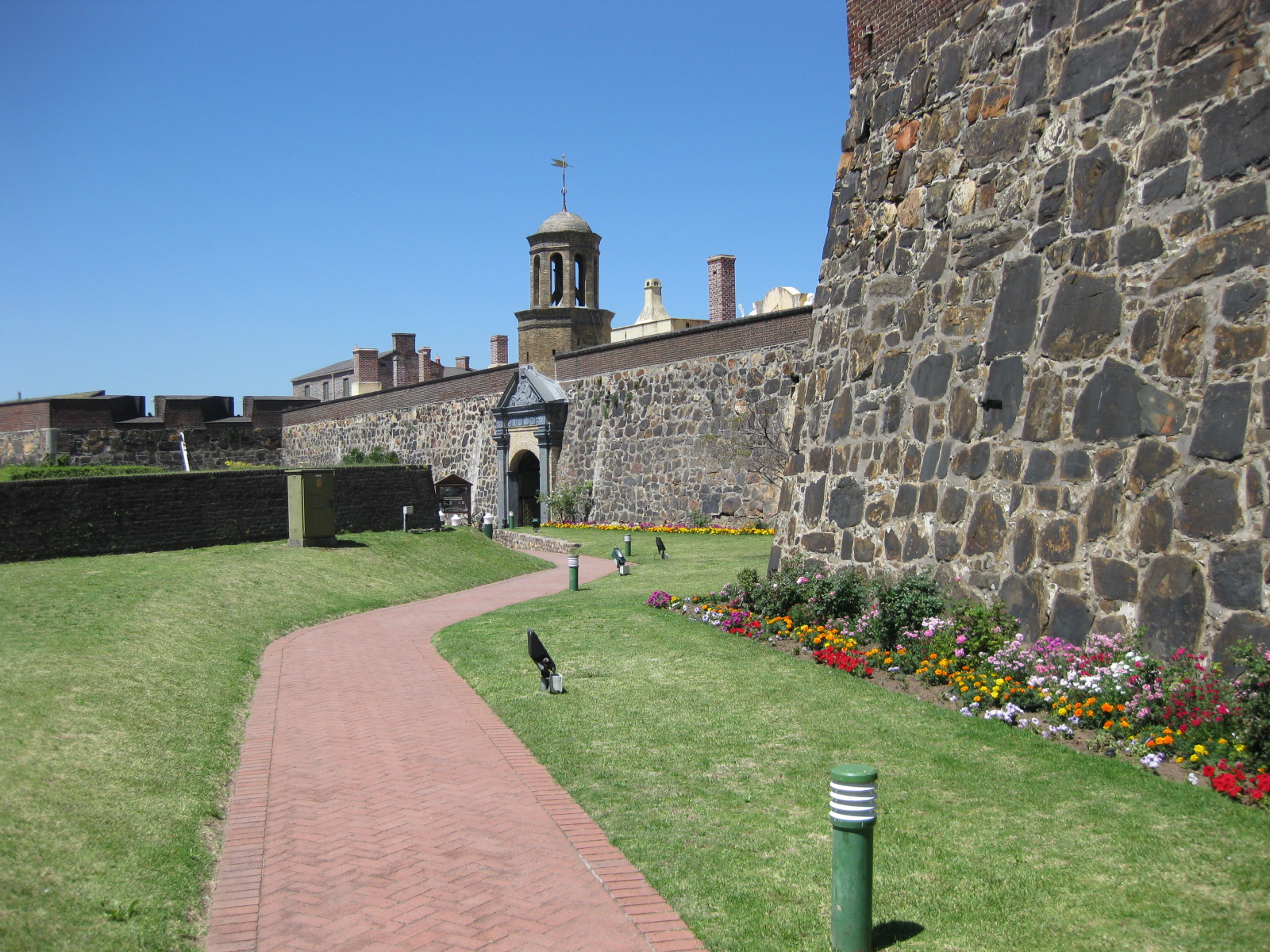
Castle of Good Hope
In the distance is the battlefield of Blaauwberg featured in the book. The view of Table Mountain from there is breathtaking.
Many of the historical buildings of the city were there in Kydd’ s day. Foremost of these is the Castle of Good Hope, built in the seventeenth century by the Dutch East India Company.
Cape Town is located at latitude 33.55° S coincidentally almost the same as Buenos Aires, where the succeeding book BETRAYAL is set.

