
TYGER: “A very rich and satisfying reader experience”
Posted on September 22, 2015 6 Comments
 A number of early review copies of Tyger, the next book in the Kydd series, were made available by my publishers (Hodder & Stoughton in the UK; McBooks Press in the US). I’ve been chuffed with the feedback from these reviewers, many saying it’s the best book yet! And I’m honoured that the September-October issue of Quarterdeck devotes a whole nine pages to my work and features specially commissioned photographs, taken in my study in my home in Devon. Click on the picture to download this free online maritime/historical fiction journal.
Here’s excerpts from just three advance readers’ comments:
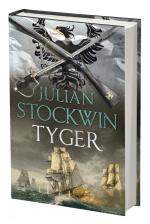 ‘All the elements of action, surprise, disappointment, horror and elation were woven by you into a sea story for the ages. It is one of the best Kydd books to date. The fact that you are a real sailorman, like myself, makes what you say and do in your books really authentic. All in all a big thank you and a bigger Bravo Zulu to Sir Thomas and you.’ – Harry Scholer
‘I don’t know how you do it but Tyger is better than your last book. The character descriptions are strong enough I didn’t have to flip back and forth to the Dramatis Personae. The action scenes are real heart pounders. The political shenanigans read so true and gossipy. It could have been a dull recitation but you made it very lively. Your books have many different layers of stories woven throughout and, you added in Baltic history in easy reader spoonfuls! It’s a difficult challenge to make the past come alive, retelling who did what to whom while keeping a reader in eager anticipation of the outcome. It makes for a very rich and satisfying reading experience.’ – Diana Dunn
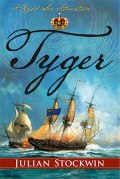
US Edition
If you’d like to whet your appetite click here for an excerpt from chapter one
And please accept my invitation to attend the Official Launch
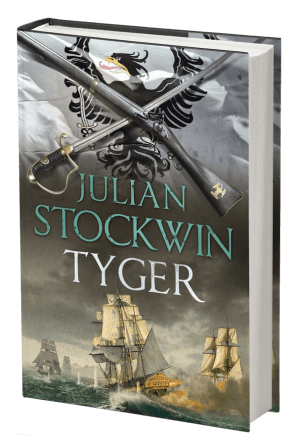
Tyger will be published simultaneously in the UK, Canada, Australia/New Zealand and South Africa on 8 October. An ebook and audio download will also be available. It will be released in the US in November
If you’d like a 10-page excerpt of Quarterdeck featuring the interview with me, Tyger review etc. email admin@julianstockwin.com with “Stockwin Quarterdeck” in the subject line and I’ll be happy to send you a .pdf file to download.
BookPick: Across the Pond, a Double Helping
Posted on September 15, 2015 5 Comments
I’m crossing the Pond for this Double Helping of BookPicks! I became fascinated with espionage during research for the Kydd series, in particular for my book Treachery, so I was exercised to read John A. Nagy’s ‘Spies in the Continental Capital’ on the critical role of intelligence operations across Pennsylvania in the eighteenth century and was not disappointed. And in another field of interest for me, Michael G Laramie’s book ‘By Wind and Iron’ provided me valuable insight into America’s rich maritime history, focusing on a natural invasion route into the heart of North America from the seventeenth century through to the early nineteenth century.
Spies in the Continental Capital
 It did not take long after the Seven Years War, the French and Indian War in North America, for France to return spies to America in order to determine the likelihood of regaining the territory they lost to Britain. One of the key places of French espionage was the colony of Pennsylvania since its frontier had been an important crossroads of French influence in North America. The French recognized that there was a real possibility that the colonies would seek their independence from Britain. Against this backdrop, Nagy begins his investigation of espionage in colonial Pennsylvania.
Philadelphia played a key role in the history of spying during the American Revolution because it was the main location for the Continental Congress, was seized by the British, and then returned to Continental control. Philadelphia became a centre of spies for the British and Americans as well as a number of double agents. George Washington was a firm believer in reliable military intelligence but after evacuating New York City, he neglected to put a spy network in place: when the British took over Philadelphia, he didn’t make the same mistake, and he was able to keep well abreast of British troop strengths and intentions. Likewise, the British used the large Loyalist community around Philadelphia to assess the abilities of their Continental foes, as well as the resolve of Congress. In addition to describing techniques used by spies and specific events, Nagy has accessed rare primary source documents to provide new and compelling information about intelligence operations on both sides, a fascinating study for those like me who sympathise with both sides.
By Wind and Iron
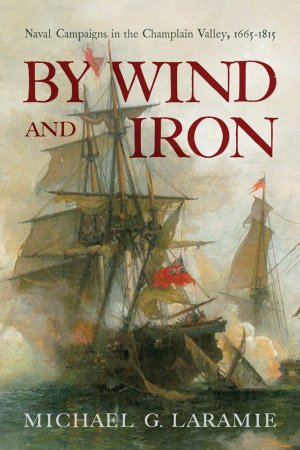 For more than 150 years, the natural invasion route along the waterways of the Champlain and Richelieu valleys into northeastern North America was among the most fiercely contested in the history of the continent.
Whether the French and their Indian allies attacking British forts and settlements during the Seven Years’ War, the American Continentals striking north into Canada during the American Revolution or the British battling French and later American forces in these wars and the War of 1812, it was clear to policy makers in Quebec, London, Paris, Philadelphia, and Washington that whoever controlled this corridor and its lakes and rivers, controlled the heart of the continent.
Laramie details the maritime history of this region from the first French fortifications along the Richelieu River in the late seventeenth century through the American victory over the British at the Battle of Plattsburgh on Lake Champlain in 1814. Using period letters, journals, and other primary source materials, he examines the north-eastern waterways and their tributaries within the framework of the soldiers and sailors who faced the perils of the campaigns, while at the same time clarifying the key role played by this region in the greater struggle for North America and American independence.
John A Nagy Spies in the Continental Capital
Published by Westholme. ISBN 978 1 59416 133 9
Michael G Laramie By Wind and Iron
Published by Westholme. ISBN 978 1 59416 198 8
Both books are also published by Pen & Sword
Tyger Extra: the Audiobook
Posted on September 8, 2015 15 Comments
‘Listen to any good books recently?’ It seems more and more of us are downloading audiobooks, thanks to the ubiquity of smartphones and tablets – and the format’s popularity on long car journeys. The UK audio market rose by nearly 25% in 2014 – and has grown by an astonishing 170% in the past five years, making it the fastest growing market in publishing.

Christian Rodska
I myself was thrilled when I learned that once again Christian Rodska was to narrate the latest audiobook in the Kydd series, Tyger.
This multi-talented actor/ narrator has a truly superb range of voices — and a real feel for stories about the sea. Let’s hear from Ellie Wheeldon of Hodder & Stoughton’s digital team and Elspeth McPherson, Strathmore Publishing, about just what’s involved in getting my manuscript to a listener.
Christian Rodska
Ellie:
- ‘We had to wait patiently for first proofs to come in before we got started on the audiobook, although we schedule things in months in advance with our studio partners. We work with a number of third parties. Tyger was recorded at Strathmore Publishing, a well-established studio in Farringdon. After estimating running time and costs based on word count (and reading the book of course!) we sent the text and a casting brief to the studio team. In this case we have a long-standing (and excellent!) reader, so that sped things along nicely!’
Elspeth McPherson on how it’s done :
- ‘The the actual process of recording the audiobook begins with the publisher contacting the production company (us – Strathmore Publishing) to say that they have a book that they would also like to include as an audio version, and when it will be published. We get told when final text will be due and when final files (edited sound files) will be needed. At this stage we talk about who will be a suitable reader, often reading an early draft of the text. We usually suggest 3–4 possible readers and these suggestions get shared with the author and the book’s editor and a decision is made. Some books are part of a series so the reader of previous books is the obvious choice. We (sometimes the publisher) then contact the reader’s agent and arrange a suitable time to do the recording. We have a recording studio on site with a large and a smaller recording booth so we can have two projects on the go at any one time. We book a producer for the recording and also a sound editor to take the recording away, fix retakes that were done in the studio and make it all flow smoothly.
 Usually the producer and narrator will have some contact beforehand to discuss voices and pronunciations. Often the author might get involved in advising on pronunciations (especially with a sci-fi book where the author might have created the names / words) and sometimes on characterisation. More difficult pronunciations get checked by the production company and we have been known to call the Natural History Museum for dinosaur names, Kew for botanical names, obscure gun clubs in USA and various embassies among others!
Many readers will mark up their scripts extensively. Sometimes in colours for different voices, sometimes like a play scripts with the character names in the margin and the tone of the speech (loud, angrily, whispered etc.). I have seen a script marked up like a musical score with the phrasing and pauses written in too. The more prepared the reader is the more smoothly the recording goes. If the audiobook forms part of a series the production company often keeps reference clips of voices to refer back to when future books are recorded.’
How long does the recording take?
- ‘The recording usually takes double the finished length of the book. So if an audiobook is likely to be 12 hours long it would take 4 x 6 hour days to record.’
Is there is ‘proof-listener’?
- ‘We always use proof listeners who work alongside our editors to check the recording and anything that the editor might have missed.’
Once approved, what happens to the digital audio file of the recording?
- ‘Occasionally the client also wants to check the recording, but usually they are happy to leave it to our check-listeners. Once everyone is happy with it we upload the final recording to Audible and send notifications to both the publisher and Audible that the files are there. We aim to have the files three weeks before publication date (which is almost always a Thursday, so three Thursdays before pub date is the delivery date).’
In the UK and Commonwealth, Tyger will be available as a digital download at Audible and iTunes on October 8, coinciding with the release of the hardback, and a CD set of the audiobook is planned for March 2016 release. The audio download will also be available in the US.
The previous Kydd Series audiobooks (all narrated by Christian) are currently available as digital downloads at Audible in the UK and Audible in the USA.
For those who like to switch between ebook and audiobook format the titles have Whispersync for Voice capability.
All of the previous Kydd titles as CD audiobook sets, as well as The Silk Tree, are currently available From Whole Story Audiobooks where you can also listen to an excerpt of each book.
Christian Rodska fittingly has the last word:
‘It’s always a pleasure when my agent calls to say I have another Kydd adventure by Julian Stockwin to record – Tyger will be the sixteenth. His research is impeccable, his knowledge and understanding of the sea and those who spend their lives upon it unparalleled and I look forward to the next one!’
Sink me the ship, master gunner!
Posted on August 30, 2015 4 Comments
On this day in 1591, The Battle of Flores began, a naval engagement of the Anglo-Spanish War. It was fought off the Island of Flores, one of the Azores, islands set in the Atlantic 850 miles west of Portugal.
Facing each other were an English fleet of 22 ships under Lord Thomas Howard and a Spanish fleet of 53 ships.
One particular incident would go down in history and be inspiration for one of the English language’s greatest poets.
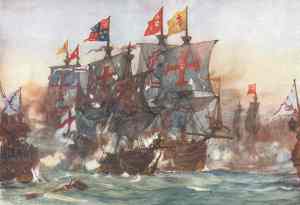
The last fight of the Revenge
Revenge lived up to her name – less than a week after the battle, with a 200-man Spanish prize crew aboard, she was lost with all hands in a vicious storm. The ship’s valiant deeds have ensured that she is one of the most renowned in naval history, and a number of ships have proudly borne her name, including one at the Battle of Trafalgar. The most recent Revenge was a Polaris submarine launched in 1969 and retired several years ago.
Alfred Lord Tennyson celebrated Grenville’s bravery in his poem The Revenge: a Ballad of the Fleet:
- At Flores, in the Azores Sir Richard Grenville lay
And a pinnace, like a flutter’d bird, came flying from far away
“Spanish ships of war at sea! we have sighted fifty-three!”
Then sware Lord Thomas Howard: “’Fore God I am no coward
But I cannot meet them here, for my ships are out of gear
And the half my men are sick. I must fly, but follow quick.
We are six ships of the line; can we fight with fifty-three?”
Then spake Sir Richard Grenville: “I know you are no coward
You fly them for a moment to fight with them again.
But I’ve ninety men and more that are lying sick ashore.
I should count myself the coward if I left them, my Lord Howard,
To these Inquisition dogs and the devildoms of Spain.”
So Lord Howard past away with five ships of war that day
Till he melted like a cloud in the silent summer heaven
But Sir Richard bore in hand all his sick men from the land
Very carefully and slow
Men of Bideford in Devon
And we laid them on the ballast down below
For we brought them all aboard
And they blest him in their pain, that they were not left to Spain,
To the thumb-screw and the stake, for the glory of the Lord.
He had only a hundred seamen to work the ship and to fight
And he sailed away from Flores till the Spaniard came in sigh,
With his huge sea-castles heaving upon the weather bow.
“Shall we fight or shall we fly?
Good Sir Richard, tell us now
For to fight is but to die!
There’ll be little of us left by the time this sun be set.”
And Sir Richard said again: “We be all good Englishmen
Let us bang these dogs of Seville, the children of the devil
For I never turn’d my back upon Don or devil yet.”
Sir Richard spoke and he laugh’d, and we roar’d a hurrah and so
The little Revenge ran on sheer into the heart of the foe
With her hundred fighters on deck, and her ninety sick below
For half of their fleet to the right and half to the left were seen
And the little Revenge ran on thro’ the long sea-lane between.
Thousands of their soldiers look’d down from their decks and laugh’d,
Thousands of their seamen made mock at the mad little craft
Running on and on, till delay’d
By their mountain-like San Philip that, of fifteen hundred tons
And up-shadowing high above us with her yawning tiers of guns
Took the breath from our sails, and we stay’d.
And while now the great San Philip hung above us like a cloud
Whence the thunderbolt will fall
Long and loud
Four galleons drew away
From the Spanish fleet that day.
And two upon the larboard and two upon the starboard lay
And the battle-thunder broke from them all.
But anon the great San Philip, she bethought herself and went
Having that within her womb that had left her ill content
And the rest they came aboard us, and they fought us hand to hand
For a dozen times they came with their pikes and musqueteers
And a dozen times we shook ’em off as a dog that shakes his ears
When he leaps from the water to the land.
And the sun went down, and the stars came out far over the summer sea
But never a moment ceased the fight of the one and the fifty-three.
Ship after ship, the whole night long, their high-built galleons came
Ship after ship, the whole night long, with her battle-thunder and flame
Ship after ship, the whole night long, drew back with her dead and her shame.
For some were sunk and many were shatter’d and so could fight us no more—
God of battles, was ever a battle like this in the world before?
For he said, “Fight on! fight on!”
Tho’ his vessel was all but a wreck
And it chanced that, when half of the short summer night was gone
With a grisly wound to be drest he had left the deck
But a bullet struck him that was dressing it suddenly dead
And himself he was wounded again in the side and the head
And he said, “Fight on! fight on!”
And the night went down, and the sun smiled out far over the
summer sea
And the Spanish fleet with broken sides lay round us all in a ring
But they dared not touch us again, for they fear’d that we still could sting
So they watch’d what the end would be
And we had not fought them in vain
But in perilous plight were we
Seeing forty of our poor hundred were slain
And half of the rest of us maim’d for life
In the crash of the cannonades and the desperate strife
And the sick men down in the hold were most of them stark and cold
And the pikes were all broken or bent, and the powder was all of it spent
And the masts and the rigging were lying over the side
But Sir Richard cried in his English pride:
“We have fought such a fight for a day and a night
As may never be fought again!
We have won great glory, my men!
And a day less or more
At sea or ashore,
We die—does it matter when?
Sink me the ship, Master Gunner—sink her, split her in twain!
Fall into the hands of God, not into the hands of Spain!”
And the gunner said, “Ay, ay,” but the seamen made reply
“We have children, we have wives
And the Lord hath spared our lives.
We will make the Spaniard promise, if we yield, to let us go
We shall live to fight again and to strike another blow.”
And the lion there lay dying, and they yielded to the foe.
And the stately Spanish men to their flagship bore him then,
Where they laid him by the mast, old Sir Richard caught at last
And they praised him to his face with their courtly foreign grace
But he rose upon their decks, and he cried:
“I have fought for Queen and Faith like a valiant man and true
I have only done my duty as a man is bound to do.
With a joyful spirit I Sir Richard Grenville die!”
And he fell upon their decks, and he died.
And they stared at the dead that had been so valiant and true
And had holden the power and glory of Spain so cheap
That he dared her with one little ship and his English few
Was he devil or man? He was devil for aught they knew
But they sank his body with honor down into the deep.
And they mann’d the Revenge with a swarthier alien crew
And away she sail’d with her loss and long’d for her own
When a wind from the lands they had ruin’d awoke from sleep
And the water began to heave and the weather to moan
And or ever that evening ended a great gale blew
And a wave like the wave that is raised by an earthquake grew
Till it smote on their hulls and their sails and their masts and their flags
And the whole sea plunged and fell on the shot-shatter’d navy of Spain
And the little Revenge herself went down by the island crags
To be lost evermore in the main.
This tale (and many other wonders from the Golden Age of Sail) is from Stockwin’s Maritime Miscellany. There’s a copy of the book up for grabs – just email me with the name of the commander of the Spanish fleet at the battle of Flores. First out of the hat on September 4 will be the winner! Please include your full postal address
Copyright notices
Charles Dixon [Public domain], via Wikimedia Commons
Every effort is made to honour copyright but if we have inadvertently published an image with missing or incorrect attribution, on being informed of this, we undertake to delete the image or add a correct credit notice
Shedding Light on the Past
Posted on August 18, 2015 5 Comments
I always enjoy hearing from readers and it’s particularly gratifying to find that my books have enriched their lives in one way or another. This was the case with Adam Quinan, who emailed me about Betrayal and Conquest. As an aside, one of the joys – and challenges – of being an author of historical fiction is to be able to do our best to bring the past alive. Historians can only go so far, as they are constrained by having to find evidence in the form of primary sources and documents of any assertion they make; the novelist can use his imagination and what-if thinking to join up the dots in an exciting way…
Over to Adam:
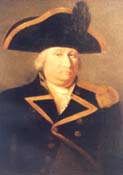
John Thomson, father
‘I’ve been slowly catching up with the Kydd series and have just finished Conquest and Betrayal. My great great great grandfather Lieutenant John Thomson was first lieutenant of HMS Narcissus under Captain Donnelly from 1803 – 1806. He was involved in the Cape Town and Buenos Aires expeditions.
Earlier in his career he had been involved in General Abercrombie’s landing at Aboukir Bay which must have come in useful during the landing in Cape Town.
In Buenos Aires he was appointed as Acting-Commander of the captured Spanish ship Neptuno and appointed Port Captain of Buenos Aires (according to a family memorandum) just as Kydd was.
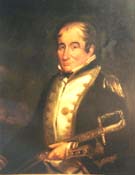
John Thomson, son
Unfortunately, unlike Kydd, he was not able to escape after Beresford’s surrender and was captured and held prisoner until the following year’s expedition when he was released and sent back to the UK.
Reading Betrayal and Conquest brought the fairly dry historical narrative to a vivid life, giving me a much better idea of how he might have lived and what he might have experienced.
The full story of his naval career which also involved his service with his father under Sir Edward Pellew aboard HMS Indefatigable and his later activities as a commander in the War of 1812 on the North American station, together with some supporting documents from the National Archives etc. can be found at a website that my brother and I prepared a number of years ago.’

Adam Quinan
‘John Thomson 2 had two daughters, one of whom, Emma Jane, married my great great grandfather Dr E.J. Quinan of Dublin in 1851. Unfortunately, John Thomson’s Lloyds Patriotic Fund Sword is no longer in the family, My father years ago traced it to an auction sometime in the 1950s but the purchaser’s name was withheld for privacy reasons. Similarly, the Ottoman medal is no longer in the family.’
I’d love to hear of any other readers’ family links to the Great Age of Fighting Sail. Email me or add a comment to this post. I’ll send a copy of Conquest to the first out of the hat on August 24.
BookPick: Chasing Conrad
Posted on August 11, 2015 3 Comments
Chasing Conrad is the second book by Simon J Hall (following Under a Yellow Sky) that I’ve had the pleasure of reading. This book is set in the mid-1970s during the closing years of the golden age of British shipping, when cargo carriage at sea saw radical change and the romance of being at sea in old-style cargo ships came to an end. The author is a Master Mariner, now working in the financial sector. This book is his account of the five years he worked as a sea officer in the Far East and South Pacific.
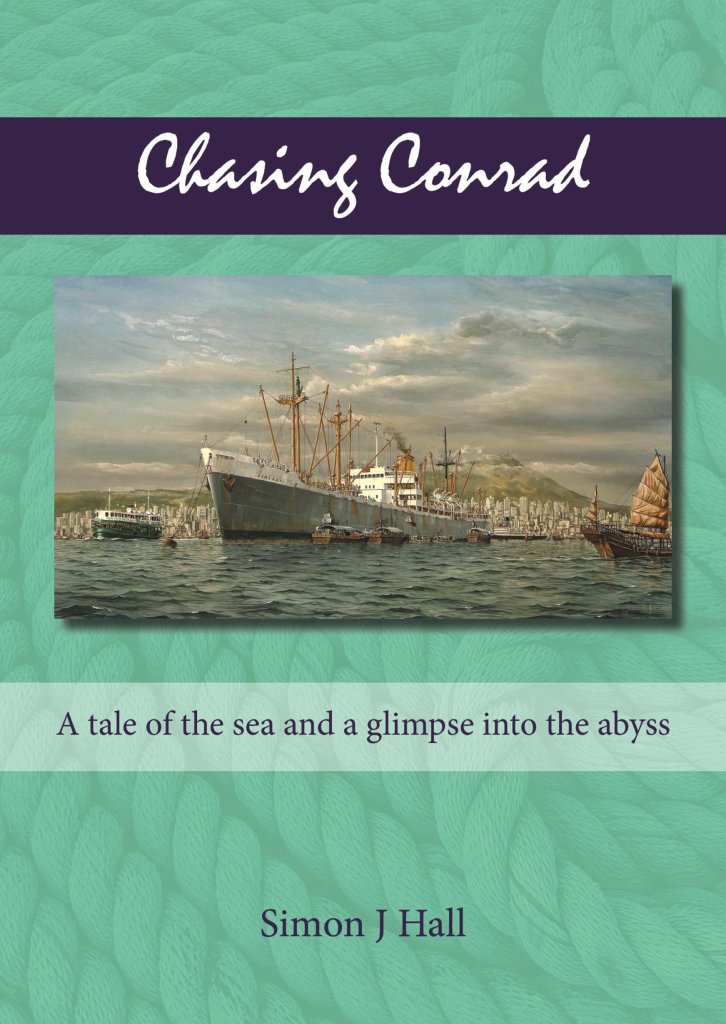 In his Acknowledgements Page Hall gives thanks to, among other things, Doom Bar beer (one of my own favourite real ales!), Admiralty charts 1263 and 748B, his discharge book, all the letters he wrote home (which his mother kept) and his many seafaring friends. He also acknowledges he has been brutal in his descriptions of some of the British ports in the 1970s – and this lack of embroidery of the truth gives the book a gritty reality and memorable narrative.
His prose can also be tactile and atmospheric. He describes a night watch in the Indian Ocean:
- ‘Alone on the bridge wing in the warm tropical night, I heard the wind sing through the stays as an Aeolian harp and I felt anointed by my good fortune.’
On loading rubber and timber in Sarawak he writes:
- ‘The whole pace of life slowed, it felt as torpid as the idle Rajang river itself and we all slowed with it. Everything was so still, so unmoving, as if the whole world had lain down and gone to sleep.’
I enjoyed his descriptions of jaunts to various parts of the world, some of which overlap with my own sea travels in the Navy. His passages on stepping ashore in Hong Kong certainly brought back memories…
- ‘We slid in through the West Lamma Channel and anchored in Victoria Harbour, before being taken to our mooring buoy. There was a buzz in Hong Kong like nowhere else. The harbour was alive with all manner of vessels: a mass of deep sea ships, small coasters, Chinese junks, small inshore boats, bumboats running supplies to all the ships. The green and white Star Ferries ran constantly between Hong Kong Island and the mainland…
We stayed in Hong Kong for one week…I ordered some clothing from Goh Kwok, the company recommended tailor. He measured me up for six shirts. The cost was about the same as a price of one shirt from Marks & Spencer in England. The shirts were ready the next day; a runner brought them out to the ship on a morning bumboat, handing me a package neatly wrapped in brown paper tied with string…
One afternoon I explored the Walled City of Kowloon, the notorious crime district controlled by the 14K Triads. Humanity was packed close in the Walled City, the building was unregulated and blocks leant dangerously close together, sometimes it was hard to see the sky. I never felt menaced although I made sure I was out before the sun went down.’
Hall’s recounting of his struggle against alcohol abuse is a particularly poignant aspect of the book:
- ‘I ordered another cold beer and lit another cigarette, then sat with the ghost of my past dreams while the afternoon died around us and we surveyed the wreckage of all my hopes.’
This, along with his first volume, is an important work that captures the spirit of an era of our maritime heritage now vanished but bridged for us by works such as this.
Under A Yellow Sky review
Simon J Hall Chasing Conrad
Published by Whittles Publishing. ISBN 978 1 84995 155 5
On this day: The Battle of the Nile
Posted on August 1, 2015 1 Comment
On this day in 1798 began the Battle of the Nile, a major naval engagement between the Royal Navy and the Navy of the French Republic. The battle was the climax of a naval campaign that had ranged across the Mediterranean during the previous three months, as a large French convoy sailed from Toulon to Alexandria carrying an expeditionary force under the then General Napoleon Bonaparte. In the engagement the British fleet, led by Rear-Admiral Sir Horatio Nelson, decisively defeated the French in a near-apocalyptic battle of annihilation.
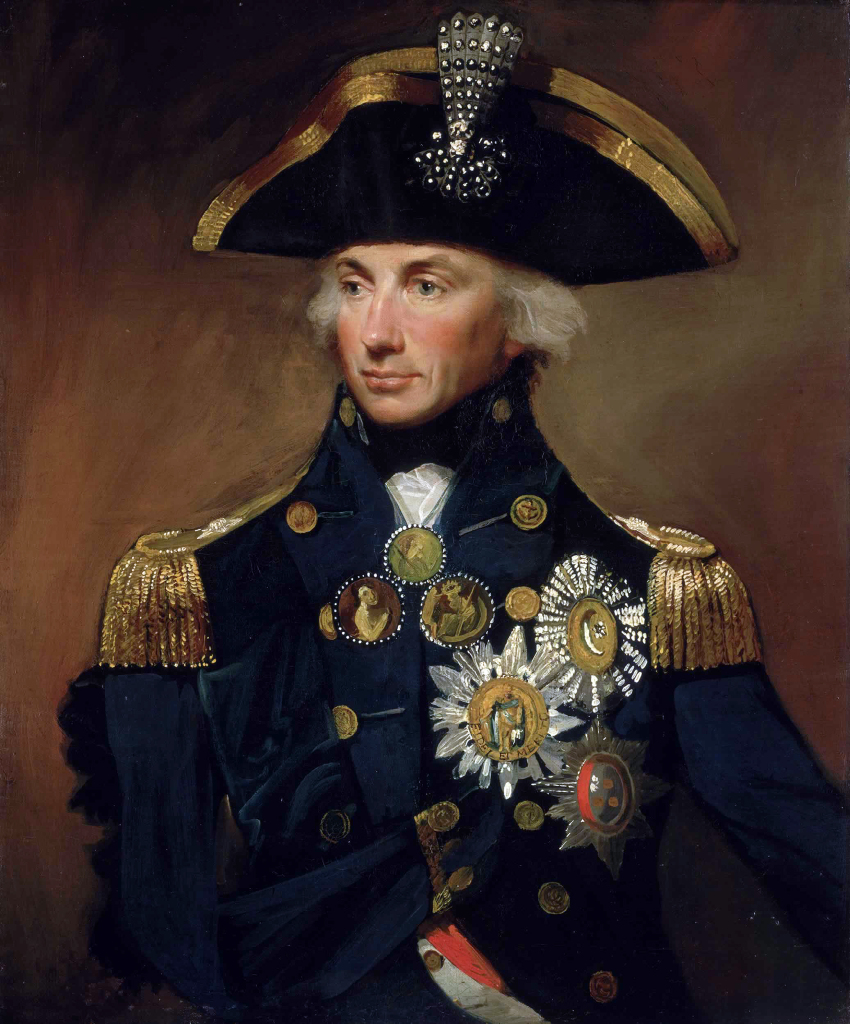
Nelson. On his cocked hat is the aigrette presented by the Ottoman sultan after Nelson’s victory
Nelson’s achievement at the Battle of the Nile is all the more amazing as only the year before much of the British fleet was in a state of mutiny. Yet Nelson took on an enemy of superior numbers and utterly exterminated them, with loss of life on the French side eight times that of the British!
In the course of the extensive research I did for Tenacious I was intrigued to find a number of Devon connections, the English county in which I now live:
More officers and men who defended their country in the Battle of the Nile came from Devon than any other county.

Tenacious
The only captain killed at the Battle of the Nile was Devon man George Westcott, commander of the 74‑gun ship-of-the-line Majestic. When Nelson located the French fleet at anchor at Aboukir Bay, he quickly ordered the British into the attack. Majestic was towards the rear of the British line, and did not come into action until late in the battle. In the darkness and smoke she collided with Heureux and became entangled in her rigging. Trapped for several minutes, Majestic suffered heavy casualties. Westcott was hit by a musket ball in the throat and killed. He was buried at sea. Despite humble origins, like Tom Kydd he had risen to become one of Nelson’s celebrated ‘band of brothers’ and a monument to his memory was erected in St Paul’s, and also in his home town. In January 1801, Nelson, passing through Honiton, on his way to take up a new command at Plymouth, presented Mrs. Westcott with his own Nile medal, saying, ‘You will not value it less because Nelson has worn it.’
After his victory at the Nile, Nelson was given the Freedom of the City of Exeter and a sword was presented to him at the Guildhall. It passed through various hands after his death and was eventually returned to the city in 1934. The scabbard bears the City Arms with the inscription ‘Horatio Nelson (Vice Admiral of the Blue) enrolled as a Freeman of the City of Exeter, 21st January 1801. Thomas Floud Mayor.’
The loss of the French flagship L’Orient during the Battle of the Nile has gone down as ‘the mother of all ship explosions’ in the Great Age of Fighting Sail. When the conflagration aboard the ship reached the magazine L’Orient exploded in an incredible spectacle, with blazing parts of the ship hurled hundreds of yards into the air. After the explosion both sides fell into a stunned silence for about ten minutes and an eerie light pervaded the scene. Mangled, wounded and scorched bodies were strewn all over Aboukir Bay.
The poem Casabianca by Felilcia Hemans was written in commemoration of the death of the son of the captain of the L’Orient:
- The boy stood on the burning deck
Whence all but he had fled
The flame that lit the battle’s wreck
Shone round him o’er the dead
One of the most unusual battle trophies must be the coffin made from the wreckage of L’Orient. After the battle Swiftsure recovered a section of L’Orient’s mainmast. The ship’s carpenter made it into a coffin which Captain Hallowell presented to Nelson. While his officers were appalled, Nelson was amused and for a time kept the coffin standing in his cabin.
L’Orient had reportedly been carrying the treasure of the Knights of St John, looted by Napoleon at his capture of Malta. An underwater archaeological study of L’Orient‘s wreck-site has recovered some artefacts including small-arms, coins and personal possessions of crew-members – but whether Napoleon’s hoard was landed before the battle or lies buried somewhere within Neptune’s Realm may remain a mystery forever…
I have two paperbacks of Tenacious up for grabs! Just email julian@julianstockwin.com with the name of the French commander at the Battle of the Nile. Please include your full postal address. Deadline: August 10
Copyright notices
Lemuel Francis Abbott [Public domain] via Wikimedia Common
Every effort is made to honour copyright but if we have inadvertently published an image with missing or incorrect attribution, on being informed of this, we undertake to delete the image or add a correct credit notice
BookPick: The Vega Adventures
Posted on July 28, 2015 8 Comments
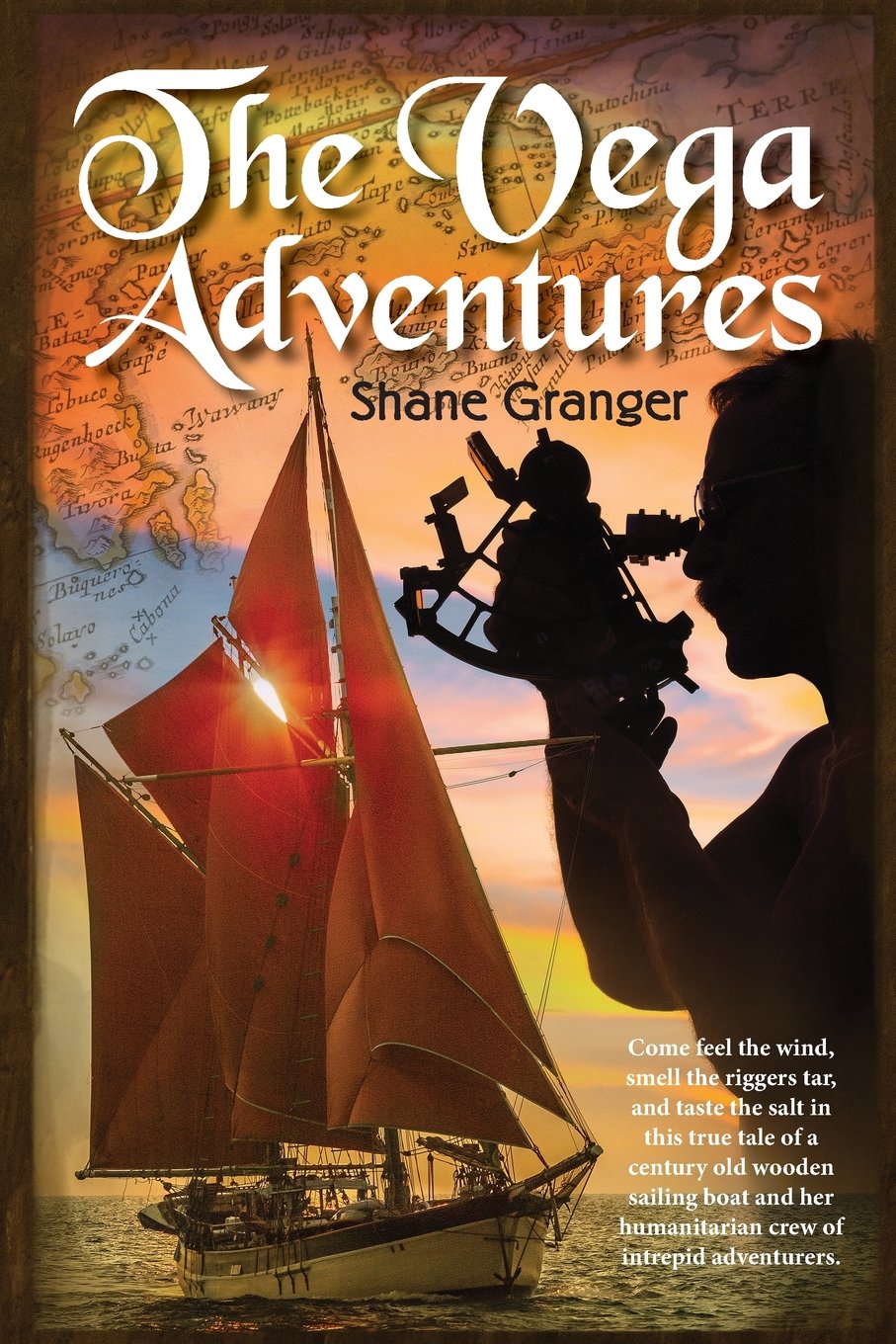
 I have known of the work of Shane Granger and Meggi Macoun for several years now and have developed a huge admiration for their achievements and dedication. As a life’s work, each year they deliver over 25 tons of educational and medical supplies to some of the world’s most remote communities, showing how a modest input can make a major difference.
The way they succeed is to initially ask the health workers, teachers and village leaders exactly what tools, medical supplies, educational materials etc. they need to improve their communities. They then take these lists back to sponsors and try to secure the things that are really needed. Thus there is no waste, no useless items.
All the crew are volunteers. Entirely achieved under sail, impressively, 95% of all donations received go directly to the recipients.
It was my special pleasure to read The Vega Adventures.

Meggi with Robert Nyo, one of the donors of supplies that will be delivered to remote schools
Shane Granger has been in love with the sea since he was seven years old. He’s worked as a radio DJ, advertising photographer, boat builder, director of museum ship restoration, and bush pilot, but has always been drawn back to the sea. Shane has sailed thousands of miles solo, most of that on a square-rigged brigantine he salvaged from a beach in West Africa – a vessel he once single-handedly sailed across the Atlantic without a functioning rudder. He’s also walked across the Sahara Desert, been kidnapped by bandits in Afghanistan – and now has published his first book.
I should also pay tribute to Shane’s partner Meggi. She’s a talented artist and photographer – and holds her own with Shane in all aspects of Vega’s life. The handsome cover of the book is down to Meggi’s talents, as are many of the delightful little line drawings inside.

Shane tackling some of the never-ending maintenance of Vega
In 2002, Shane and Meggi, who both come from advertising/marketing backgrounds, found Vega abandoned in the Canary Islands, in a very sorry state. They sailed her to Cape Town and began a long and extensive refit of the century old vessel. The great tsunami of 2004 changed their lives forever. With thousands of people desperately in need, they quickly loaded their boat with donated food and medical supplies then set sail for Sumatra.
The Historical Vessel Vega is a former Baltic trader built in Norway in the late nineteenth century. Just as in the days of the legendary Spice Island trade, Vega‘s movements are dictated by the winds of the monsoons. Sailing along routes unchanged for thousands of years, Vega makes her annual circuit of some 7500 miles loading her cargo during one monsoon then delivering it when the monsoon changes.
Being an Old Salt I particularly related to this passage in the book:
- “Looking up along the great curving belly of our main square sail I checked its set, then gave the port tack a slight heave, taking up slack from the night’s run. I always find it amazing how much brute power that square sail generates, yet how easy it is to manage.
Glancing aft to where the sun would soon raise, I noted we were still right on course. Not that I expected anything else. A good sailing ship with properly trimmed sails all but steers herself. She may drift a few degrees to one side or the other of her course, but at the end of the day makes good a relatively straight route.
That seems to be something forgotten by most modern sailors…Boats will talk to you if you let them, telling you exactly what they need to get on with their job of sailing the seas safely. All you have to do is pay attention, feel and sense that marvellous interplay between wind, sails, water and hull.
”But Shane is no unrealistic romantic when he describes conditions in bad weather at sea.
- “What is it like to be on watch when a real screaming stinker is blowing? Ah yes, welcome to the joy of a life at sea. Try to imagine sitting out in the open with the wind howling a wholie and the rain blowing horizontally like some demented creature emerging from a fire hose. Then add seas crashing against the hull tossing great buckets of sea water into your face every few seconds…”
And being a cat lover I also enjoyed reading about Vega’s ship’s cat Scourge who sounds a real character!
- “When I took my place at the helm, Scourge was luxuriating in the early morning sun, adapting the gentle rolling motion to her esoteric feline requirements. As the boat rolled to port, she would roll with it waving all four paws happily in the air until with a flop she would land on her side, squirming away to rub her back on the deck. Then as the boat rolled back to starboard she repeated the exercise.”
 Writing in a style that is both informative and engaging, and sometimes with a playful sense of humour, Shane takes the reader, whether he be armchair sailor or deep-sea mariner, on a wonderful journey – tracing the boat’s beginning in the 1890s, recreating modern-day dramas of sailing through dramatic storms, sharing the beauty of exotic tropical islands. But most of all the book is about people – Shane and Meggi, their crew, their donors and the colourful and resourceful inhabitants of the island communities in Eastern Indonesia and East Timor.
Shane Granger The Vega Adventures
Published by Equinox ISBN 978 602 8397 46 9
You can find more information on Vega and Shane’s doughty crew at the website (which also has a link should you wish to make a donation to support their humanitarian work) and via Facebook
And you can buy the book here
Copyright notices
Photos: Historical Vessel Vega
Every effort is made to honour copyright but if we have inadvertently published an image with missing or incorrect attribution, on being informed of this, we undertake to delete the image or add a correct credit notice
An Emperor Aboard!
Posted on July 24, 2015 3 Comments
 On this day in 1815 HMS Bellerophon carrying a very special passenger, Napoleon Bonaparte, dropped anchor at Torbay; then shortly after sailed on to Plymouth Sound.

A fascinating exhibition at the Plymouth City Museum and Art Gallery explores the mystique that grew up around the man – monster to some, folk-hero to others. Centred around a painting by Jules Giradet, which shows thousands of people in small boats in Plymouth Sound flocking to catch a glimpse of him, the exhibition runs until September 26.
Just how did the most famous man in the world at that time happen to be making this journey?
After the Battle of Waterloo Napoleon Bonaparte surrendered – not to the Duke of Wellington but to the captain of the ship that had dogged his steps for more than 20 years, HMS Bellerophon – ‘Billy Ruffian’ to her crew. The ship sailed for England and anchored at Torbay on 24 July 1815. Every effort was made to keep the famous man’s presence a secret, and no-one was allowed to come on board. However, a sailor dropped a black glass bottle into the water which was retrieved by some young boys in a small boat nearby. Inside the bottle was a rolled piece of paper with the electrifying message, ‘We have Bonaparte on board!’

Emperor Napoleon’s coronation
Needless to say people thronged there; at the height of the madness it was said that around 10,000 people boarded 1,000 boats in an attempt to get a view of the most famous man in the world.
The crew of Bellerophon hung notices over the ship’s side as to their famous guest’s movements: ‘In cabin with Captain Maitland’, ‘Writing with his officers’…
Among the crowds were large numbers of pretty young women, naval officers, fashionably dressed ladies, red-coated army officers and smartly attired gentlemen. The men took off their hats respectfully when Napoleon showed himself, as he did every evening around 6 p.m. He commented on the beauty of the young ladies and appeared astonished by the size of the crowds.
On 7 August Napoleon was transferred to HMS Northumberland for exile in St Helena, where he died in 1821.
This account (and many other wonders from the Golden Age of Sail) is from Stockwin’s Maritime Miscellany. There’s a copy of the book up for grabs – just email me with the year Napoleon crowned himself Emperor Napoleon I. First out of the hat on July 31 will be the winner! Please include your full postal address.
Deadline: July 31
Copyright notices
Coronation: Jacques-Louis David [Public domain], via Wikimedia Commons
Every effort is made to honour copyright but if we have inadvertently published an image with missing or incorrect attribution, on being informed of this, we undertake to delete the image or add a correct credit notice
Bonjour, Barfleur!
Posted on July 14, 2015 2 Comments
During a recent location research visit to Normandy Kathy and I visited the lovely little coastal village of Barfleur in northwestern France. It’s not far from Cherbourg and well worth a side trip! And as well as one thousand years and more of history there are some wonderful eateries featuring its famous mussels, Blonde de Barfleur, which connoisseurs rate very highly.

The port of Barfleur today
In the ninth century the Viking invaders from Scandinavia made Barfleur one of the bases. In time it became the largest port in Normandy and bore witness to a number of important historical events.

Cannon from the 1692 battle of Barfleur
Barfleur became the port of embarkation for royal crossings, the royal ship Esneca Regis usually making the crossing to Southampton in a night.
In 1120 Henry I, the Duke of Normandy, was returning to England with his two sons. The crossing had been delayed by a strong north wind and to pass the time much wine was imbibed ashore. The ship Blanche Nef founded on the rock Quillebeuf and all bar Berold, a butcher from Rouen perished. (This incident is described by Renzi in Invasion.)
It is said that Henry I was never seen to smile gain.

Barfleur has a huge tide range; the harbour at low water
Henry II married Eleanor of Aquitaine and passed through Barfleur many times, among them on his way to petition the Pope to lift the excommunication after the murder of Thomas Becket.
In 1190 Richard the Lionheart, oldest surving son of Henri II embarked at Barfleur on his way to his coronation as King of England.
Edward II sacked Barfleur in 1346. The population was reduced to some 800 and was under English rule until 1450.

Kathy enjoying Barfleur’s famous moules
Barfleur was occupied by the Germans during World War II and liberated 15 days after D-Day. The port was used by the Allies – as it had been by William the Conqueror and Richard the Lionheart – to ship war supplies.
Copyright notices
photo credit harbour photo: by Matthieu Tétard at fr.wikipedia [CC BY-SA 2.5 (http://creativecommons.org/licenses/by-sa/2.5)%5D, from Wikimedia Commons
Every effort is made to honour copyright but if we have inadvertently published an image with missing or incorrect attribution, on being informed of this, we undertake to delete the image or add a correct credit notice
 Julian Stockwin